Passage Study
Holy Cleansing: The Serious Gift of the Sin Offering
Leviticus 6:24–6:30
Leviticus 6:24–30 instructs the priests to slaughter the sin offering in the place of burnt offering, eat certain offerings in a holy place, wash blood-stained garments, and treat what touches the offering with care. The rite shows that atonement is not casual or magical; God’s cleansing provision is holy. Jesus fulfills its saving purpose by offering Himself once for sin and bringing His people into true cleansing before God.
- In this study
- 7 verses · 5 movements
Leviticus 6
6:24The LORD spoke to Moses, saying,
6:25“Speak to Aaron and to his sons, saying, ‘This is the law of the sin offering: in the place where the burnt offering is killed, the sin offering shall be killed before the LORD. It is most holy.
6:26The priest who offers it for sin shall eat it. It shall be eaten in a holy place, in the court of the Tent of Meeting.
6:27Whatever shall touch its flesh shall be holy. When there is any of its blood sprinkled on a garment, you shall wash that on which it was sprinkled in a holy place.
6:28But the earthen vessel in which it is boiled shall be broken; and if it is boiled in a bronze vessel, it shall be scoured, and rinsed in water.
6:29Every male among the priests shall eat of it. It is most holy.
6:30No sin offering, of which any of the blood is brought into the Tent of Meeting to make atonement in the Holy Place, shall be eaten. It shall be burned with fire.
CONTEXTUAL OVERVIEW
The sin offering has already addressed guilt among priest, congregation, ruler, and ordinary Israelite. These verses focus on the priestly handling of that sacrifice. The passage’s repeated language of holiness is arresting: the offering is “most holy,” its meat is eaten in a holy place, and even garments and vessels are governed by its contact.
The care required is not superstition. Israel is being taught that God’s appointed way of dealing with sin cannot be treated as ordinary. A sacrifice that bears the burden of cleansing belongs to the sphere of God’s holy presence, and the priest must serve accordingly.
HISTORICAL AND LITERARY CONTEXT
The place of slaughter is the same north-side altar area used for the burnt offering. For certain sin offerings, the priest who offers it receives its meat; for the offerings whose blood is brought into the tent, no one eats it and the whole animal is burned. Leviticus 4 has already illustrated that distinction for the priest and the congregation.
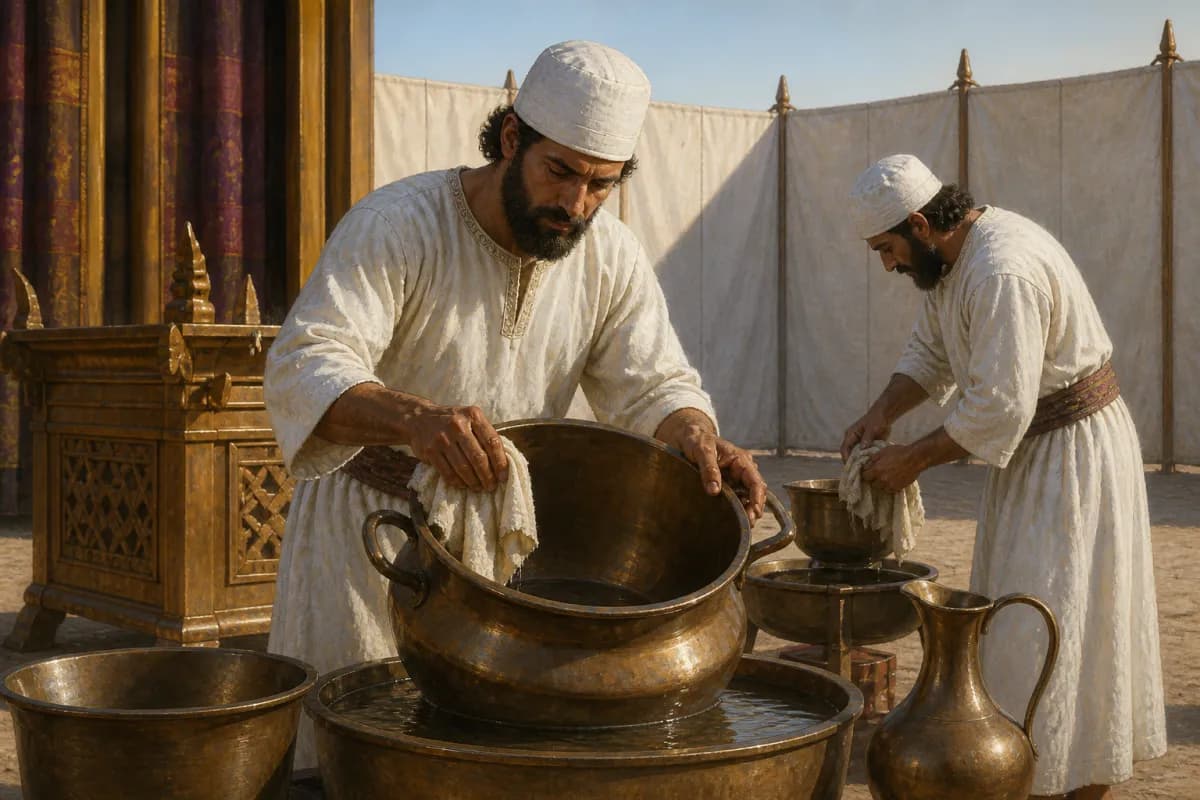
The instructions about splashed blood and cooking vessels protect the boundary between the holy rite and ordinary use. An earthenware pot, being porous, is broken after use; a bronze vessel is scoured and rinsed. The text gives ritual directions, not a transferable household sanitation code, but its concern is plain: holy atonement must be handled under God’s command.
SECTION-BY-SECTION ANALYSIS
- Most holy · Leviticus 6:25The sacrifice dealing with sin belongs distinctly to God and may not be approached as a routine object.
- Priestly meal · Leviticus 6:26Where God permits it, the officiating priest eats the offering as part of appointed sacrificial service.
- Blood brought inside · Leviticus 6:30When blood is taken into the tent for atonement, the animal is not eaten but wholly burned, underscoring the heightened rite.
CHRIST IN THIS PASSAGE
The ritual’s contact rules are not instructions for Christians to reproduce, and the passage should not be made into a hidden map of every detail of the cross. Its strong canonical witness is that sin requires God’s holy provision and that cleansing comes on His terms. Jesus offers Himself as the final sacrifice that the repeated rites could not complete.
Hebrews speaks directly to the pattern of bodies burned outside the camp and Jesus suffering outside the gate to sanctify the people through His own blood. His saving mission does not make sin trivial; it opens real access to God by bearing its cost. Those who come to Him receive cleansing that reaches the conscience and a call to live as people set apart for God.
REFLECTION
Modern readers can either recoil from these detailed instructions or reduce them to religious mechanics. Leviticus resists both reactions. The costliness and care of the rite announce that guilt is serious and that forgiveness is God’s gracious gift, not human self-repair.
Jesus invites us to bring sin into the light without pretending that it has no weight. His cross is sufficient; no repeated sacrifice is needed. That assurance also calls us away from casual patterns that normalize what Christ died to cleanse, toward reverent gratitude and concrete obedience.
Original Hebrew Word Study
Leviticus 6:27
קָדַשׁ
qadash · H6942
Usually translated: to make holy or set apart
Qadash means to set apart as holy. Contact with the sin offering carries sacred seriousness because God has appointed it for cleansing before Him.
Follow the Scripture trail
Holy Cleansing: The Serious Gift of the Sin Offering in the larger story
The connection: The careful handling of the sin offering teaches Israel that God’s cleansing is holy and comes by His appointed mercy. Jesus fulfills that saving purpose through His once-for-all self-offering, cleansing guilty consciences and gathering a people who belong to God.
Respond to the passage
Bring a particular sin to Jesus without minimizing it or trying to punish yourself into peace. Trust His sufficient sacrifice, receive His cleansing, and identify one practice that will help you honor the holiness of the life He has given you.
- Why does the passage give so much attention to what touches the sin offering?
- What does the exception for blood brought into the tent reveal about the seriousness of atonement?
- How does Christ’s final sacrifice let you face sin honestly without living in despair?
Prayer
Holy Father, thank You for providing cleansing rather than leaving me under guilt. Forgive my casual treatment of sin and my attempts to manage it without You. Through Jesus, cleanse my conscience and set my life apart for grateful obedience. Amen.