Passage Study
The Fire Must Keep Burning: Daily Priesthood Before God
Leviticus 6:8–6:13
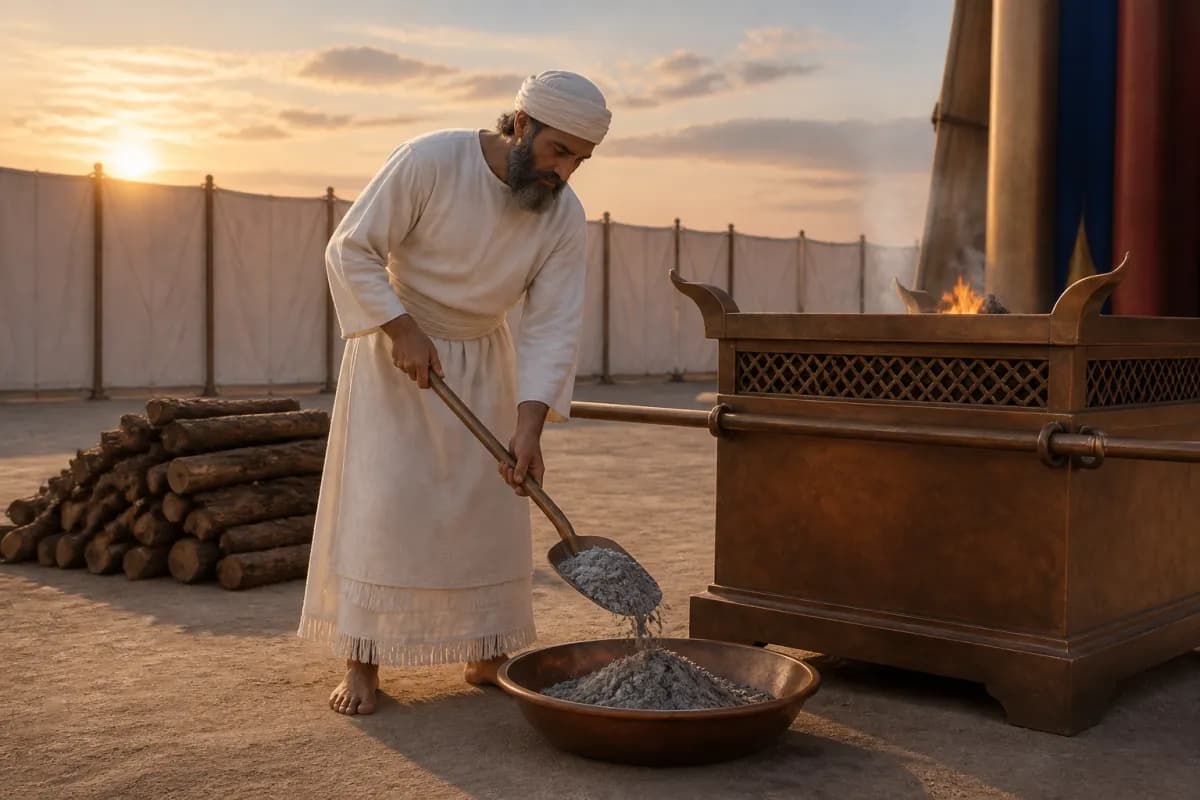
Leviticus 6:8–13 gives priests detailed instructions for the burnt offering: remove the ashes in sacred garments, change clothes before carrying them outside the camp, arrange fresh wood each morning, and never let the altar fire go out. The daily rhythm teaches Israel that approach to God rests on His continuing provision and requires reverent service. Jesus, whose sacrifice is final, brings believers near and makes their whole lives a grateful offering to God.
- In this study
- 6 verses · 5 movements
Leviticus 6
6:8The LORD spoke to Moses, saying,
6:9“Command Aaron and his sons, saying, ‘This is the law of the burnt offering: the burnt offering shall be on the hearth on the altar all night until the morning; and the fire of the altar shall be kept burning on it.
6:10The priest shall put on his linen garment, and he shall put on his linen trousers upon his body; and he shall remove the ashes from where the fire has consumed the burnt offering on the altar, and he shall put them beside the altar.
6:11He shall take off his garments, and put on other garments, and carry the ashes outside the camp to a clean place.
6:12The fire on the altar shall be kept burning on it, it shall not go out; and the priest shall burn wood on it every morning. He shall lay the burnt offering in order upon it, and shall burn on it the fat of the peace offerings.
6:13Fire shall be kept burning on the altar continually; it shall not go out.
CONTEXTUAL OVERVIEW
Leviticus 1 described what an Israelite brings; Leviticus 6 turns to what priests must do after the worshiper leaves. The offering stays on the hearth through the night, and the priest begins the next day by attending to ashes, garments, wood, and the altar. The quiet details show that worship is not sustained by occasional intensity but by appointed, reverent faithfulness.
The repeated command that the fire must not go out gives the passage its center. Israel’s access to God cannot be treated as an emergency measure brought out only when a crisis arrives. God has established a continuing ministry in the place where He chooses to meet His people.
HISTORICAL AND LITERARY CONTEXT
These instructions belong to the priestly manual that follows the earlier descriptions of offerings. Sacred linen garments are worn while ashes are removed near the altar; other garments are worn when the ashes are carried outside the camp. The change marks the ordered distinction between the holy work at the altar and movement beyond the sanctuary area.
The priest adds wood every morning, arranges the burnt offering, and burns the fat of the well-being offering. The daily sequence does not imply that God needs to be fed. It maintains the divinely given place of sacrificial approach and teaches the priests to guard what God has made holy with steady attention rather than improvisation.
SECTION-BY-SECTION ANALYSIS
- Ashes handled reverently · Leviticus 6:10What is left from an offering remains connected to holy service and is not treated as ordinary waste at the altar.
- Garments changed · Leviticus 6:11The change of clothing marks ordered movement between sacred duties near the altar and the carrying of ashes outside the camp.
- Fire renewed each morning · Leviticus 6:9The command creates a daily discipline of readiness, declaring that God’s provision for approach is not neglected or assumed.
CHRIST IN THIS PASSAGE
The continual altar fire should not be turned into a promise that Christians must sustain spiritual intensity by their own effort. Its direct meaning concerns Israel’s sacrificial worship. In the larger canon, it prepares readers to value the continual access to God that Jesus secures through His final sacrifice and living priesthood, not through repeated offerings that must be renewed morning after morning.
Christ’s saving mission brings an end to the need for further sin offerings because His self-offering is sufficient. Yet He also calls His people into enduring worship: not a fresh sacrifice for guilt, but lives presented to God in gratitude. The daily faithfulness of Leviticus finds its gospel horizon in believers who draw near through Jesus and serve with reverence because His mercy remains sure.
REFLECTION
Many acts of faithfulness resemble ash removal more than dramatic fire: the unseen work of prayer, repair, preparation, and care that keeps a household or congregation ready to worship. Leviticus dignifies that work. God notices the ordered attention of servants who treat His presence as weighty even when no crowd is watching.
Jesus frees His people from trying to keep God’s favor alive through anxious effort. His sacrifice has accomplished access. That security does not make daily devotion empty; it makes it grateful. Christians can cultivate steady habits of Scripture, prayer, service, and gathered worship as responses to the Savior who has already brought them near.
Original Hebrew Word Study
Leviticus 6:13
תָּמִיד
tamid · H8548
Usually translated: continually or regularly
Tamid means continually. The altar fire is kept burning as a daily witness that Israel’s approach to God rests on His ongoing provision, not sporadic devotion.
Follow the Scripture trail
The Fire Must Keep Burning: Daily Priesthood Before God in the larger story
The connection: The continually tended altar teaches Israel that God provides an ongoing way to meet with Him through holy service. Jesus fulfills that saving purpose through His final sacrifice and living priesthood, bringing His people near and shaping their daily lives into grateful worship.
Respond to the passage
Receive Jesus’ finished sacrifice as the ground of your access to God. Then choose one quiet practice that helps keep your life ready for grateful worship—prayer, Scripture, service, reconciliation, or faithful gathering with the church—and offer it without trying to earn what Christ has already secured.
- Why does the passage give attention to ashes, garments, and fresh wood rather than only to the dramatic moment of sacrifice?
- What does the command to keep the altar fire burning teach about steady reverence in Israel’s worship?
- How does Jesus’ final sacrifice free you to practice daily devotion as gratitude rather than anxiety?
Prayer
Holy God, thank You that Jesus has opened the way for me to draw near. Deliver me from anxious efforts to earn Your welcome and from careless habits that forget Your holiness. Form in me a steady, grateful life of worship through Christ, my faithful Priest. Amen.