Passage Study
Thanksgiving at God’s Table: Fellowship Ordered by Grace
Leviticus 7:11–7:21
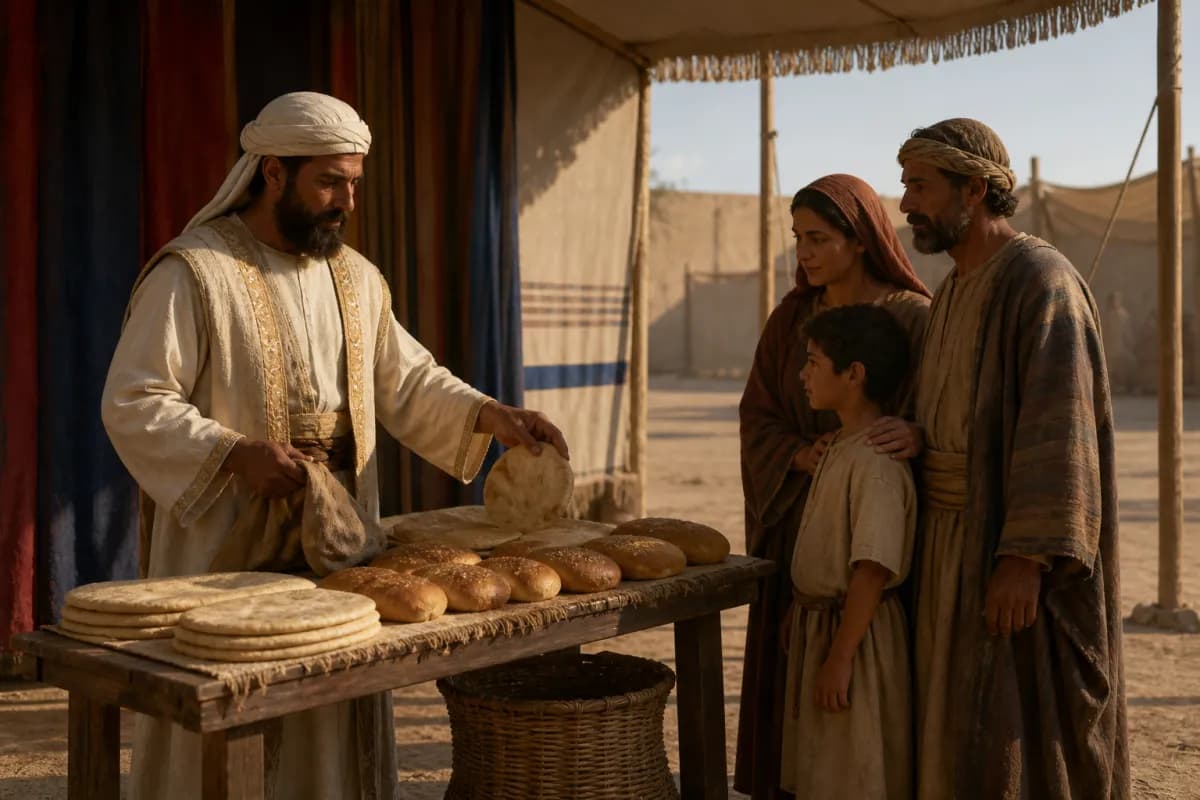
Leviticus 7:11–21 gives detailed instructions for well-being offerings brought in thanksgiving, for a vow, or as a freewill gift. Bread accompanies the thanksgiving offering, the meat is shared within a set time, and anyone unclean must not eat it. God welcomes joyful fellowship, yet His table is not casual: communion rests on His holiness. Jesus makes peace through His blood and gathers a thankful people to share life with God and one another.
- In this study
- 11 verses · 5 movements
Leviticus 7
7:11“‘This is the law of the sacrifice of peace offerings, which one shall offer to the LORD:
7:12If he offers it for a thanksgiving, then he shall offer with the sacrifice of thanksgiving unleavened cakes mixed with oil, and unleavened wafers anointed with oil, and cakes mixed with oil.
7:13He shall offer his offering with the sacrifice of his peace offerings for thanksgiving with cakes of leavened bread.
7:14Of it he shall offer one out of each offering for a heave offering to the LORD. It shall be the priest’s who sprinkles the blood of the peace offerings.
7:15The flesh of the sacrifice of his peace offerings for thanksgiving shall be eaten on the day of his offering. He shall not leave any of it until the morning.
7:16“‘But if the sacrifice of his offering is a vow, or a free will offering, it shall be eaten on the day that he offers his sacrifice. On the next day what remains of it shall be eaten,
7:17but what remains of the meat of the sacrifice on the third day shall be burned with fire.
7:18If any of the meat of the sacrifice of his peace offerings is eaten on the third day, it will not be accepted, and it shall not be credited to him who offers it. It will be an abomination, and the soul who eats any of it will bear his iniquity.
7:19“‘The meat that touches any unclean thing shall not be eaten. It shall be burned with fire. As for the meat, everyone who is clean may eat it;
7:20but the soul who eats of the meat of the sacrifice of peace offerings that belongs to the LORD, having his uncleanness on him, that soul shall be cut off from his people.
7:21When anyone touches any unclean thing, the uncleanness of man, or an unclean animal, or any unclean abomination, and eats some of the meat of the sacrifice of peace offerings which belong to the LORD, that soul shall be cut off from his people.’”
CONTEXTUAL OVERVIEW
The well-being offering is not limited to a crisis of guilt. Here it can be brought in thanksgiving, to fulfill a vow, or as a freewill gift. Its horizon is fellowship: God receives the sacrificial portions, priests receive their appointed share, and the worshiper’s household shares a meal under God’s covenant mercy.
That joy is deliberately ordered. Thanksgiving meat is eaten on the day of offering; vow and freewill meat may continue into the next day but not the third; flesh touched by uncleanness is burned; an unclean person may not eat the sacrifice. The table is a gift, but it remains the table of the holy Lord.
HISTORICAL AND LITERARY CONTEXT
The offering’s Hebrew name is connected with wholeness and well-being. Leviticus 3 established its basic sacrificial pattern; Leviticus 7 expands its social and temporal practice. The different breads brought with a thanksgiving offering include leavened loaves alongside unleavened cakes and wafers. Their inclusion shows that leaven is not universally forbidden, even though it was excluded from the altar’s memorial portion.
The time limits protect the meal’s holiness and likely prevent sacred food from being retained past its appointed use. The text does not invite modern readers to label every food-safety practice sacred law. It forms Israel to receive covenant joy as a gift bounded by God’s word, not as a possession to manage without Him.
SECTION-BY-SECTION ANALYSIS
- Thanksgiving bread · Leviticus 7:13The varied loaves make the meal a concrete celebration of God’s provision, with a priestly portion included.
- Appointed time · Leviticus 7:14The limits on eating keep the offering within the rhythm God gives rather than allowing worship to become self-directed.
- Clean fellowship · Leviticus 7:19The warning against eating while unclean teaches that shared joy before God cannot ignore His holiness.
CHRIST IN THIS PASSAGE
This meal should not be flattened into a direct prediction of the Lord’s Supper. Its stronger relation to Christ is the peace and fellowship it displays: God provides a way for His people to rejoice before Him, and that way is marked by sacrifice, gratitude, and holiness. The New Testament announces that Jesus makes peace through His cross and brings former outsiders near.
Jesus’ saving mission gathers a people around Himself in grateful communion. At His table, believers do not claim moral cleanliness of their own; they come because His blood has reconciled them. His grace also calls them to examine their lives, pursue peace with one another, and share the gifts of God without contempt or exclusion.
REFLECTION
Thanksgiving often becomes private sentiment or rushed words before a meal. Leviticus gives it a fuller shape: remember God’s goodness, share it with others, honor the boundaries of His presence, and let gratitude become embodied generosity. The offering tells Israel that joy in God is communal.
Jesus brings weary and guilty people into peace with the Father, then teaches them to make that peace visible. Consider whether a meal, a prayer of thanks, hospitality, or reconciliation could become a faithful response to His mercy. Christian fellowship becomes credible when gratitude and holiness belong together.
Original Hebrew Word Study
Leviticus 7:12
תּוֹדָה
todah · H8426
Usually translated: thanksgiving
Todah is thanksgiving. The fellowship offering can be brought in gratitude, giving Israel a sacrificial language for celebrating God’s goodness together.
Follow the Scripture trail
Thanksgiving at God’s Table: Fellowship Ordered by Grace in the larger story
The connection: The well-being offering gives Israel a holy meal of thanksgiving and fellowship before the Lord. Jesus fulfills that saving hope by making peace through His blood and gathering a reconciled people who receive God’s gifts with gratitude, holiness, and shared joy.
Respond to the passage
Thank Jesus aloud for one specific mercy, then share that gratitude with someone else through prayer, hospitality, or practical generosity. If a relationship needs peace, ask Him for the humility to take the next faithful step toward reconciliation.
- What changes when thanksgiving is understood as a shared covenant meal rather than a private feeling?
- Why does Leviticus place time limits and cleanness boundaries around a joyful offering?
- How does peace through Jesus shape the way Christians practice gratitude and fellowship?
Prayer
Father, thank You for bringing me near through the peace Jesus made by His blood. Keep my gratitude from becoming shallow or self-centered. Form in me a holy, generous joy that welcomes others and reflects Your reconciling love. Amen.