Passage Study
The Lord’s Portion and the Priest’s Share: Worship with What Is Best
Leviticus 7:22–7:38
Leviticus 7:22–38 reserves the fat and blood of sacrificial animals for the Lord, assigns the breast and right thigh of well-being offerings to the priests, and closes the laws of sacrifice by locating them at Sinai. The passage teaches Israel to honor God with the life and richest portions He claims while receiving priestly provision as His gift. Jesus gives Himself completely for sinners and makes His people a holy priesthood marked by grateful, ordered worship.
- In this study
- 17 verses · 5 movements
Leviticus 7
7:22The LORD spoke to Moses, saying,
7:23“Speak to the children of Israel, saying, ‘You shall eat no fat, of bull, or sheep, or goat.
7:24The fat of that which dies of itself, and the fat of that which is torn of animals, may be used for any other service, but you shall in no way eat of it.
7:25For whoever eats the fat of the animal which men offer as an offering made by fire to the LORD, even the soul who eats it shall be cut off from his people.
7:26You shall not eat any blood, whether it is of bird or of animal, in any of your dwellings.
7:27Whoever it is who eats any blood, that soul shall be cut off from his people.’”
7:28The LORD spoke to Moses, saying,
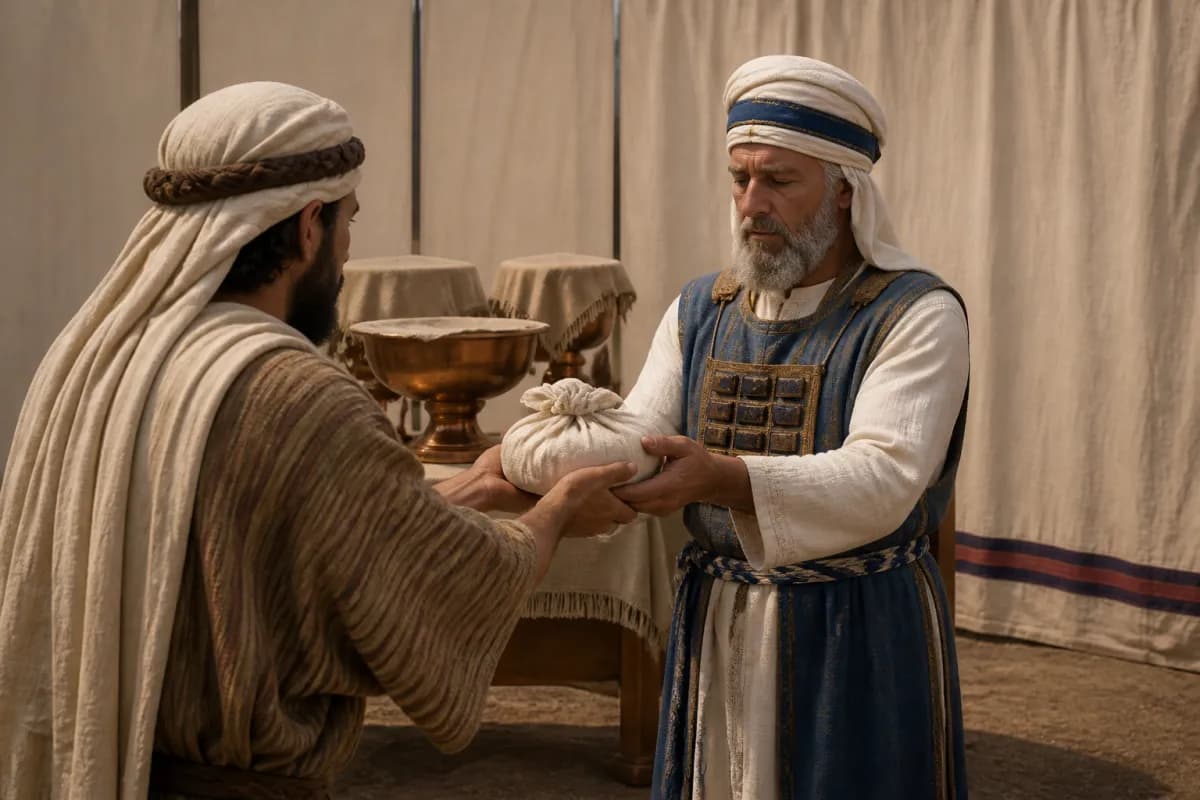
7:29“Speak to the children of Israel, saying, ‘He who offers the sacrifice of his peace offerings to the LORD shall bring his offering to the LORD out of the sacrifice of his peace offerings.
7:30With his own hands he shall bring the offerings of the LORD made by fire. He shall bring the fat with the breast, that the breast may be waved for a wave offering before the LORD.
7:31The priest shall burn the fat on the altar, but the breast shall be Aaron’s and his sons’.
7:32The right thigh you shall give to the priest for a heave offering out of the sacrifices of your peace offerings.
7:33He among the sons of Aaron who offers the blood of the peace offerings, and the fat, shall have the right thigh for a portion.
7:34For the waved breast and the heaved thigh I have taken from the children of Israel out of the sacrifices of their peace offerings, and have given them to Aaron the priest and to his sons as their portion forever from the children of Israel.’”
7:35This is the consecrated portion of Aaron, and the consecrated portion of his sons, out of the offerings of the LORD made by fire, in the day when he presented them to minister to the LORD in the priest’s office;
7:36which the LORD commanded to be given them of the children of Israel, in the day that he anointed them. It is their portion forever throughout their generations.
7:37This is the law of the burnt offering, the meal offering, the sin offering, the trespass offering, the consecration, and the sacrifice of peace offerings
7:38which the LORD commanded Moses in Mount Sinai in the day that he commanded the children of Israel to offer their offerings to the LORD, in the wilderness of Sinai.
CONTEXTUAL OVERVIEW
Leviticus 7 brings the offering manual to its close by returning to the well-being offering’s portions. The worshiper brings the sacrifice with his own hands: the fat is placed on the altar for the Lord, the breast is elevated before Him, and the right thigh becomes the officiating priest’s share. Worship is both personal and ordered; the worshiper participates, but God determines what belongs where.
The prohibition of fat and blood protects two central claims. The fat represents the choice portions placed on the altar, and blood represents life given by God for atonement. Israel’s table is therefore trained by the altar: even ordinary eating remembers that life and blessing are received under the Lord’s authority.
HISTORICAL AND LITERARY CONTEXT
Earlier chapters repeatedly specify that the fat of offerings belongs to the Lord. Here the rule is extended as a lasting food prohibition for Israel, while distinguishing animals that die naturally or are torn by beasts: their fat may be used for another purpose but may not be eaten. The focus is covenant worship and embodied remembrance, not an abstract nutritional theory.
The breast is described as a contribution elevated before the Lord, and the right thigh is the contribution assigned to the priest who presents the blood and fat. These portions feed the priesthood within the public rite. The final verses identify the setting as the day the Lord commanded Israel at Sinai to bring offerings, anchoring the whole system in God’s covenant instruction rather than human invention.
SECTION-BY-SECTION ANALYSIS
- Fat for the Lord · Leviticus 7:25The choice inner portions placed on the altar teach Israel to honor God rather than give Him what is negligible.
- Blood as life · Leviticus 7:26The prohibition preserves the later explanation that blood represents life and is given by God for atonement.
- Shared priestly portions · Leviticus 7:34The breast and thigh sustain the priests while keeping their provision connected to public worship and God’s command.
CHRIST IN THIS PASSAGE
The prohibition of blood is not a coded prediction of Jesus, but it establishes the biblical seriousness of life given before God. Leviticus later explains that blood is given on the altar to make atonement. The New Testament declares that Jesus gives His life freely and that His blood secures forgiveness and access to God.
Christ’s saving mission fulfills the direction of sacrifice without requiring believers to recreate Israel’s food laws. He offers Himself wholly, not a leftover portion, and makes all who trust Him a people set apart for God. Their worship answers His mercy with the best of their lives, resources, and obedience, not as payment for salvation but as grateful participation in His kingdom.
REFLECTION
Leviticus asks a searching question: do we give God what is first and weighty, or what costs us least? The answer is not religious display. It appears in the honest ordering of time, money, speech, energy, and care for others under the God who has given us life.
Jesus does not ask His people to purchase His love with the best part of their lives; He has already loved them to the uttermost. His sacrifice frees generous worship from anxiety. In gratitude, Christians can honor Him with what is choice and trust Him to provide what they need for faithful service.
Original Hebrew Word Study
Leviticus 7:23
חֵלֶב
chelev · H2459
Usually translated: fat; the richest portion
Chelev is fat, the richest portion of the animal. It belongs to the Lord, teaching Israel to honor Him with what is choice rather than treating worship as leftovers.
Follow the Scripture trail
The Lord’s Portion and the Priest’s Share: Worship with What Is Best in the larger story
The connection: The conclusion of Leviticus’s offering laws trains Israel to honor the Lord with life and what is choice while receiving priestly provision under His word. Jesus fulfills this saving direction by giving Himself completely for sinners and forming a holy people whose grateful worship flows from His mercy.
Respond to the passage
Offer Jesus one deliberate first portion of your week: time for prayer, a generous gift, a repaired commitment, or service to someone in need. Let it be gratitude for His life given for you, never an attempt to earn His welcome.
- How do the prohibitions of fat and blood train Israel’s daily life around worship?
- Why does the passage require the worshiper to bring the well-being offering portions personally?
- What would it mean to honor Jesus with what is choice in your life while resting in grace rather than earning it?
Prayer
Lord Jesus, You gave Yourself completely to bring me to God. Free me from offering You leftovers and from anxious attempts to earn Your love. Receive my life as grateful worship, and teach me to honor You with all You have entrusted to me. Amen.