Passage Study
Consecrated for God: Aaron and His Sons Set Apart
Leviticus 8:1–8:36
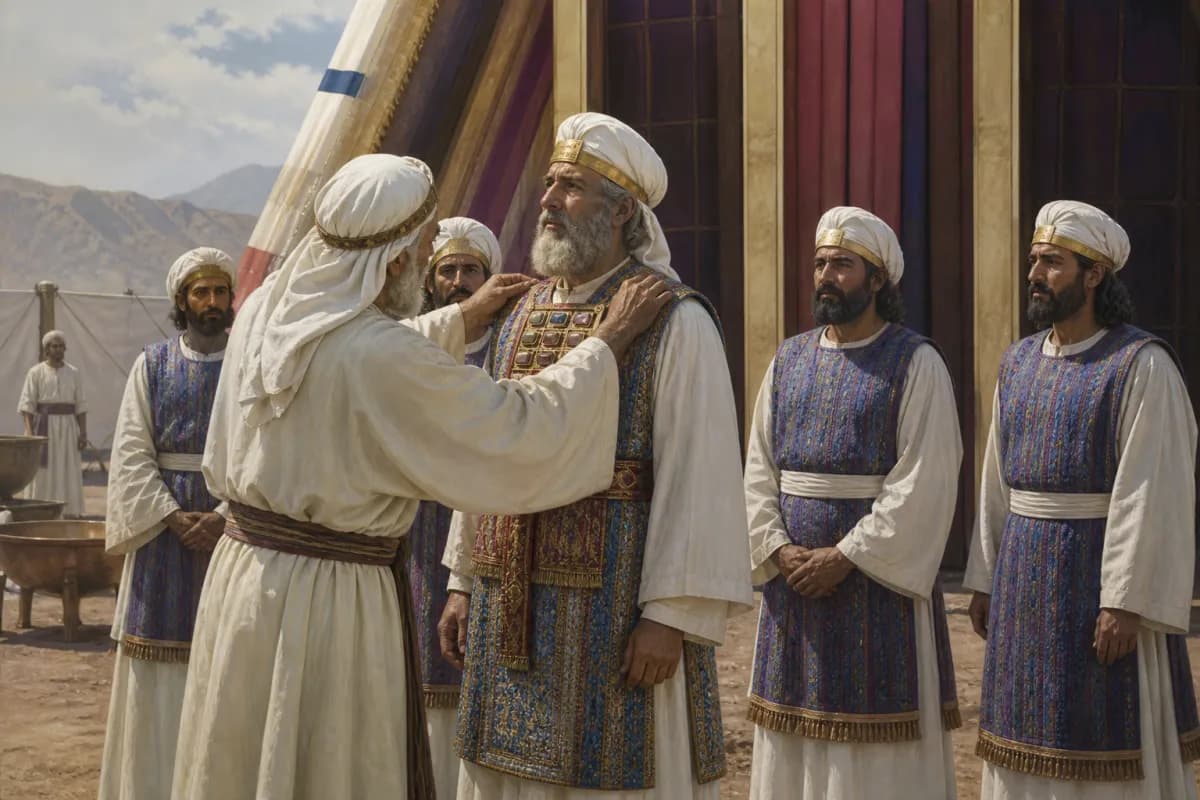
Leviticus 8:1–36 records Moses washing, clothing, anointing, and sacrificing for Aaron and his sons before the gathered people. No priest begins by taking authority for himself: God appoints, cleanses, and sets apart those who draw near on behalf of Israel. Jesus, the truly holy High Priest, brings His people to God and consecrates them for His saving mission.
- In this study
- 36 verses · 5 movements
Leviticus 8
8:1The LORD spoke to Moses, saying,
8:2“Take Aaron and his sons with him, and the garments, and the anointing oil, and the bull of the sin offering, and the two rams, and the basket of unleavened bread;
8:3and assemble all the congregation at the door of the Tent of Meeting.”
8:4Moses did as the LORD commanded him; and the congregation was assembled at the door of the Tent of Meeting.
8:5Moses said to the congregation, “This is the thing which the LORD has commanded to be done.”
8:6Moses brought Aaron and his sons, and washed them with water.
8:7He put the tunic on him, tied the sash on him, clothed him with the robe, put the ephod on him, and he tied the skillfully woven band of the ephod on him and fastened it to him with it.
8:8He placed the breastplate on him. He put the Urim and Thummim in the breastplate.
8:9He set the turban on his head. He set the golden plate, the holy crown, on the front of the turban, as the LORD commanded Moses.
8:10Moses took the anointing oil, and anointed the tabernacle and all that was in it, and sanctified them.
8:11He sprinkled it on the altar seven times, and anointed the altar and all its vessels, and the basin and its base, to sanctify them.
8:12He poured some of the anointing oil on Aaron’s head, and anointed him, to sanctify him.
8:13Moses brought Aaron’s sons, and clothed them with tunics, and tied sashes on them, and put headbands on them, as the LORD commanded Moses.
8:14He brought the bull of the sin offering, and Aaron and his sons laid their hands on the head of the bull of the sin offering.
8:15He killed it; and Moses took the blood, and put it around on the horns of the altar with his finger, and purified the altar, and poured out the blood at the base of the altar, and sanctified it, to make atonement for it.
8:16He took all the fat that was on the innards, and the cover of the liver, and the two kidneys, and their fat; and Moses burned it on the altar.
8:17But the bull, and its skin, and its meat, and its dung, he burned with fire outside the camp, as the LORD commanded Moses.
8:18He presented the ram of the burnt offering. Aaron and his sons laid their hands on the head of the ram.
8:19He killed it; and Moses sprinkled the blood around on the altar.
8:20He cut the ram into its pieces; and Moses burned the head, and the pieces, and the fat.
8:21He washed the innards and the legs with water; and Moses burned the whole ram on the altar. It was a burnt offering for a pleasant aroma. It was an offering made by fire to the LORD, as the LORD commanded Moses.
8:22He presented the other ram, the ram of consecration. Aaron and his sons laid their hands on the head of the ram.
8:23He killed it; and Moses took some of its blood, and put it on the tip of Aaron’s right ear, and on the thumb of his right hand, and on the great toe of his right foot.
8:24He brought Aaron’s sons; and Moses put some of the blood on the tip of their right ear, and on the thumb of their right hand, and on the great toe of their right foot; and Moses sprinkled the blood around on the altar.
8:25He took the fat, the fat tail, all the fat that was on the innards, the cover of the liver, the two kidneys and their fat, and the right thigh;
8:26and out of the basket of unleavened bread that was before the LORD, he took one unleavened cake, one cake of oiled bread, and one wafer, and placed them on the fat and on the right thigh.
8:27He put all these in Aaron’s hands and in his sons’ hands, and waved them for a wave offering before the LORD.
8:28Moses took them from their hands, and burned them on the altar on the burnt offering. They were a consecration offering for a pleasant aroma. It was an offering made by fire to the LORD.
8:29Moses took the breast, and waved it for a wave offering before the LORD. It was Moses’ portion of the ram of consecration, as the LORD commanded Moses.
8:30Moses took some of the anointing oil, and some of the blood which was on the altar, and sprinkled it on Aaron, on his garments, and on his sons, and on his sons’ garments with him, and sanctified Aaron, his garments, and his sons, and his sons’ garments with him.
8:31Moses said to Aaron and to his sons, “Boil the meat at the door of the Tent of Meeting, and there eat it and the bread that is in the basket of consecration, as I commanded, saying, ‘Aaron and his sons shall eat it.’
8:32What remains of the meat and of the bread you shall burn with fire.
8:33You shall not go out from the door of the Tent of Meeting for seven days, until the days of your consecration are fulfilled: for he shall consecrate you seven days.
8:34What has been done today, so the LORD has commanded to do, to make atonement for you.
8:35You shall stay at the door of the Tent of Meeting day and night seven days, and keep the LORD’s command, that you don’t die: for so I am commanded.”
8:36Aaron and his sons did all the things which the LORD commanded by Moses.
CONTEXTUAL OVERVIEW
The tabernacle and its offerings have been described; Leviticus 8 now installs the people who will serve within that holy space. Moses does not conduct a private ceremony. He assembles the whole congregation at the entrance of the tent of meeting, so Israel sees that priesthood belongs to God’s covenant life rather than to Aaron’s family ambition.
The chapter repeatedly says that Moses acts “as the Lord commanded.” Washing, garments, oil, blood, and seven days of waiting all teach the same lesson: access to God is received through His provision. Aaron and his sons are not made fit by ancestry alone, zeal, or personal achievement.
HISTORICAL AND LITERARY CONTEXT
Exodus 28–29 gave the design of the priestly garments and instructions for ordination; Leviticus 8 narrates their execution. Aaron wears the tunic, sash, robe, ephod, breastpiece, and turban with its holy diadem. These public garments identify him as Israel’s representative before the Lord, not as an independent spiritual mediator.
Three sacrifices shape the consecration: a bull for the sin offering, a ram for the burnt offering, and a second ram for ordination. Blood from the ordination ram is placed on the right ear, thumb, and big toe of Aaron and his sons. Their hearing, work, and walk are claimed for holy service, and the seven-day period marks a complete, God-governed installation.
SECTION-BY-SECTION ANALYSIS
- Washing · Leviticus 8:2Before receiving garments of office, Aaron and his sons are washed, confessing that a priest needs cleansing rather than innate qualification.
- Anointing oil · Leviticus 8:10The oil sets the tabernacle, its furnishings, and Aaron apart for God’s service; holiness embraces both people and the place of worship.
- Ear, hand, and foot · Leviticus 8:23Blood on ear, thumb, and toe dedicates the priest’s listening, labor, and path to the Lord who has called him.
CHRIST IN THIS PASSAGE
Leviticus 8 does not identify Aaron with Jesus in every ritual detail, yet it establishes why Israel needs a priest who can truly stand before God. Aaron must first offer sacrifice for his own sin. Jesus is different: He is the holy High Priest who has no sin needing cleansing and who gives Himself once for the sins of others.
Jesus also fulfills the chapter’s purpose of consecrated access. By His saving death He brings believers near to the Father and makes them a holy people for service. The church does not recreate Aaron’s ordination, but Christ sends men and women whose hearing, work, and daily walk belong to Him and bear witness to His reconciling mission.
REFLECTION
This chapter challenges the assumption that serving God begins with finding enough confidence or talent. Aaron’s family begins with washing and receives every sign of office. Christian service likewise starts with grace: Jesus cleanses sinners, gives gifts, and assigns faithful work. That keeps service from becoming self-display.
Ask where your ears, hands, or feet are resisting Christ’s claim. He does not consecrate people to withdraw from the world in fear. He makes them His own so that ordinary listening, work, and movement can point others toward the Savior who brings the unclean near.
Original Hebrew Word Study
Leviticus 8:12
מָשַׁח
mashach · H4886
Usually translated: to anoint
Mashach means to anoint for sacred service. Aaron’s anointing sets him apart to represent the people before God according to God’s own provision.
Follow the Scripture trail
Consecrated for God: Aaron and His Sons Set Apart in the larger story
The connection: Aaron’s consecration teaches Israel that God provides the mediator and holiness required for life near Him. Jesus fulfills that saving purpose as the sinless High Priest who brings His people to the Father and sets them apart to proclaim His mercy.
Respond to the passage
Offer Jesus one concrete part of your hearing, work, or routine that you have kept for yourself. Ask Him to cleanse it, direct it, and use it in service to someone He loves.
- Why does Moses gather the whole congregation for Aaron’s consecration?
- What do the washing, garments, oil, and blood communicate together about priestly service?
- How does Jesus’ sinless priesthood change the way you understand your own service to God?
Prayer
Lord Jesus, holy High Priest, thank You for bringing me near to the Father by Your sacrifice. Consecrate my listening, my work, and my way of life for Your purposes. Make me a faithful witness to Your saving mercy. Amen.