Passage Study
Receiving the Kingdom on the Road to Jerusalem
Matthew 19:1–20:34
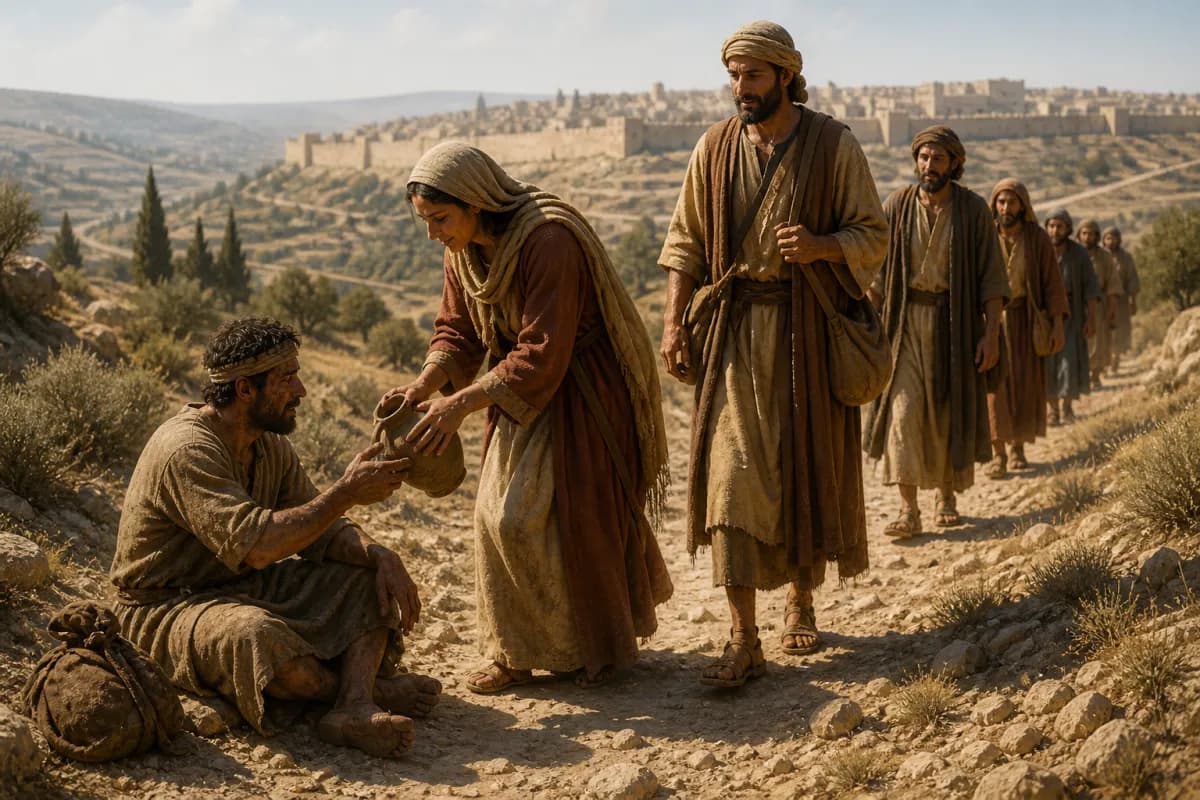
Matthew 19–20 follows Jesus toward Jerusalem as He teaches about covenant faithfulness, children, possessions, reward, service, and mercy. He refuses to let marriage be treated as disposable, receives children whom others dismiss, exposes the rich young man’s divided heart, reorders laborers’ expectations through the landowner’s generosity, predicts His death, and gives sight to two blind men. The King’s road leads to self-giving service, and entrance into God’s kingdom is God’s gift rather than human achievement.
- In this study
- 64 verses · 5 movements
Matthew 19
19:1When Jesus had finished these words, he departed from Galilee and came into the borders of Judea beyond the Jordan.
19:2Great multitudes followed him, and he healed them there.
19:3Pharisees came to him, testing him and saying, “Is it lawful for a man to divorce his wife for any reason?”
19:4He answered, “Haven’t you read that he who made them from the beginning made them male and female,
19:5and said, ‘For this cause a man shall leave his father and mother, and shall be joined to his wife; and the two shall become one flesh’?
19:6So that they are no more two, but one flesh. What therefore God has joined together, don’t let man tear apart.”
19:7They asked him, “Why then did Moses command us to give her a certificate of divorce and divorce her?”
19:8He said to them, “Moses, because of the hardness of your hearts, allowed you to divorce your wives, but from the beginning it has not been so.
19:9I tell you that whoever divorces his wife, except for sexual immorality, and marries another, commits adultery; and he who marries her when she is divorced commits adultery.”
19:10His disciples said to him, “If this is the case of the man with his wife, it is not expedient to marry.”
19:11But he said to them, “Not all men can receive this saying, but those to whom it is given.
19:12For there are eunuchs who were born that way from their mother’s womb, and there are eunuchs who were made eunuchs by men; and there are eunuchs who made themselves eunuchs for the Kingdom of Heaven’s sake. He who is able to receive it, let him receive it.”
19:13Then little children were brought to him that he should lay his hands on them and pray; and the disciples rebuked them.
19:14But Jesus said, “Allow the little children, and don’t forbid them to come to me; for the Kingdom of Heaven belongs to ones like these.”
19:15He laid his hands on them, and departed from there.
19:16Behold, one came to him and said, “Good teacher, what good thing shall I do, that I may have eternal life?”
19:17He said to him, “Why do you call me good? No one is good but one, that is, God. But if you want to enter into life, keep the commandments.”
19:18He said to him, “Which ones?” Jesus said, “‘You shall not murder.’ ‘You shall not commit adultery.’ ‘You shall not steal.’ ‘You shall not offer false testimony.’
19:19‘Honor your father and your mother.’ And, ‘You shall love your neighbor as yourself.’”
19:20The young man said to him, “All these things I have observed from my youth. What do I still lack?”
19:21Jesus said to him, “If you want to be perfect, go, sell what you have, and give to the poor, and you will have treasure in heaven; and come, follow me.”
19:22But when the young man heard this, he went away sad, for he was one who had great possessions.
19:23Jesus said to his disciples, “Most certainly I say to you, a rich man will enter into the Kingdom of Heaven with difficulty.
19:24Again I tell you, it is easier for a camel to go through a needle’s eye than for a rich man to enter into God’s Kingdom.”
19:25When the disciples heard it, they were exceedingly astonished, saying, “Who then can be saved?”
19:26Looking at them, Jesus said, “With men this is impossible, but with God all things are possible.”
19:27Then Peter answered, “Behold, we have left everything and followed you. What then will we have?”
19:28Jesus said to them, “Most certainly I tell you that you who have followed me, in the regeneration when the Son of Man will sit on the throne of his glory, you also will sit on twelve thrones, judging the twelve tribes of Israel.
19:29Everyone who has left houses, or brothers, or sisters, or father, or mother, or wife, or children, or lands, for my name’s sake, will receive one hundred times, and will inherit eternal life.
19:30But many will be last who are first, and first who are last.
Matthew 20
20:1“For the Kingdom of Heaven is like a man who was the master of a household, who went out early in the morning to hire laborers for his vineyard.
20:2When he had agreed with the laborers for a denarius a day, he sent them into his vineyard.
20:3He went out about the third hour, and saw others standing idle in the marketplace.
20:4He said to them, ‘You also go into the vineyard, and whatever is right I will give you.’ So they went their way.
20:5Again he went out about the sixth and the ninth hour, and did likewise.
20:6About the eleventh hour he went out and found others standing idle. He said to them, ‘Why do you stand here all day idle?’
20:7“They said to him, ‘Because no one has hired us.’ “He said to them, ‘You also go into the vineyard, and you will receive whatever is right.’
20:8“When evening had come, the lord of the vineyard said to his manager, ‘Call the laborers and pay them their wages, beginning from the last to the first.’
20:9“When those who were hired at about the eleventh hour came, they each received a denarius.
20:10When the first came, they supposed that they would receive more; and they likewise each received a denarius.
20:11When they received it, they murmured against the master of the household,
20:12saying, ‘These last have spent one hour, and you have made them equal to us who have borne the burden of the day and the scorching heat!’
20:13“But he answered one of them, ‘Friend, I am doing you no wrong. Didn’t you agree with me for a denarius?
20:14Take that which is yours, and go your way. It is my desire to give to this last just as much as to you.
20:15Isn’t it lawful for me to do what I want to with what I own? Or is your eye evil, because I am good?’
20:16So the last will be first, and the first last. For many are called, but few are chosen.”
20:17As Jesus was going up to Jerusalem, he took the twelve disciples aside, and on the way he said to them,
20:18“Behold, we are going up to Jerusalem, and the Son of Man will be delivered to the chief priests and scribes, and they will condemn him to death,
20:19and will hand him over to the Gentiles to mock, to scourge, and to crucify; and the third day he will be raised up.”
20:20Then the mother of the sons of Zebedee came to him with her sons, kneeling and asking a certain thing of him.
20:21He said to her, “What do you want?” She said to him, “Command that these, my two sons, may sit, one on your right hand and one on your left hand, in your Kingdom.”
20:22But Jesus answered, “You don’t know what you are asking. Are you able to drink the cup that I am about to drink, and be baptized with the baptism that I am baptized with?” They said to him, “We are able.”
20:23He said to them, “You will indeed drink my cup, and be baptized with the baptism that I am baptized with; but to sit on my right hand and on my left hand is not mine to give, but it is for whom it has been prepared by my Father.”
20:24When the ten heard it, they were indignant with the two brothers.
20:25But Jesus summoned them, and said, “You know that the rulers of the nations lord it over them, and their great ones exercise authority over them.
20:26It shall not be so among you; but whoever desires to become great among you shall be your servant.
20:27Whoever desires to be first among you shall be your bondservant,
20:28even as the Son of Man came not to be served, but to serve, and to give his life as a ransom for many.”
20:29As they went out from Jericho, a great multitude followed him.
20:30Behold, two blind men sitting by the road, when they heard that Jesus was passing by, cried out, “Lord, have mercy on us, you son of David!”
20:31The multitude rebuked them, telling them that they should be quiet, but they cried out even more, “Lord, have mercy on us, you son of David!”
20:32Jesus stood still and called them, and asked, “What do you want me to do for you?”
20:33They told him, “Lord, that our eyes may be opened.”
20:34Jesus, being moved with compassion, touched their eyes; and immediately their eyes received their sight, and they followed him.
CONTEXTUAL OVERVIEW
As Jesus leaves Galilee and moves through Judea toward Jerusalem, Matthew gathers conversations that expose common ways people try to control kingdom life. Pharisees test Him with a question about divorce; disciples treat children as interruptions; a wealthy man asks what good deed will secure eternal life; laborers measure generosity by comparison; James and John’s family seeks prominent seats. Jesus answers each issue by returning authority to God’s design, grace, and His own coming service.
The final healing scene interprets the road. Two blind men call Jesus “Lord” and “Son of David” while the crowd tells them to be silent. Unlike the rich man, they have no resource to offer; unlike the disciples seeking rank, they ask for mercy. Jesus stops, asks what they want, touches their eyes, and they follow Him. Matthew places their sight immediately before the king’s entry into Jerusalem, where many will shout Davidic praise without understanding the cross.
HISTORICAL AND LITERARY CONTEXT
The divorce debate concerns Deuteronomy 24 and disputed grounds for a certificate of divorce. Jesus does not treat the question as a technical escape route; He appeals to creation’s male-and-female union and names hardness of heart as the reason Moses regulated divorce. His words dignify covenant faithfulness and protect those harmed by casual repudiation. They should not be turned into a weapon against people who have suffered abandonment or abuse, matters the passage itself does not fully address.
Basileia, “kingdom” or royal reign, appears in Jesus’ warning about wealth. The problem is not that material possessions are automatically evil; it is that the rich man goes away grieving because his possessions possess him. The disciples’ question, “Who then can be saved?” receives Jesus’ decisive answer: what is impossible for mortals is possible for God. The surrounding parable of laborers guards this grace from being recast as a wage earned by those who arrive early or sacrifice most visibly.
SECTION-BY-SECTION ANALYSIS
- Matthew 19:1–30 · Matthew 19:14Jesus roots marriage in creation, receives children, and shows that wealth can prevent a person from following Him into the kingdom.
- Matthew 20:1–28 · Matthew 19:1The landowner’s generosity overturns comparison, and Jesus defines greatness by His coming service and ransom-giving death.
- Matthew 20:29–34 · Matthew 20:30Two blind men call Jesus the Son of David, receive mercy, and follow Him toward Jerusalem.
CHRIST IN THIS PASSAGE
Jesus’ own words supply the central Christology: the Son of Man will be crucified and raised, and He came to give His life as a ransom for many. “Ransom” names a costly release, and the phrase “for many” strongly echoes the servant whose suffering bears the sin of many. Jesus is not merely offering an example of humble leadership; He is announcing the saving act that makes kingdom service and forgiveness possible.
The blind men’s “Son of David” cry connects His healing mercy to the royal promise, while His deliberate march toward Jerusalem defines what that kingship will look like. He has authority to call people from possessions and status because He will not use His own status to be served. The road therefore brings readers to Jesus’ mission: He gives Himself for those unable to save themselves and opens their eyes to follow Him.
REFLECTION
The rich young man is not distant from modern readers simply because many have less wealth. His question lets us ask where we want a manageable religious achievement instead of Jesus Himself. Name the possession, status, security, or comparison that makes following Christ feel too costly. Salvation is impossible by self-rescue, but Jesus calls real people to trust Him enough to release what rules them.
Take the blind men’s prayer seriously: “Lord, have mercy on us.” It is a fitting response when you cannot see your way forward. Let the Son of Man’s service reshape one relationship in which you are competing for recognition. Seek the lower place, serve without bargaining for return, and rest in the generosity of the King who gave Himself for you.
Original Greek Word Study
Matthew 19:23
βασιλεία
basileia · G932
Usually translated: kingdom, reign, or royal rule
Basileia means kingdom or royal reign. Jesus exposes how wealth can compete for the heart, then frames entrance into God’s kingdom as the gracious work of God rather than human achievement.
Follow the Scripture trail
Receiving the Kingdom on the Road to Jerusalem in the larger story
The connection: On the road to Jerusalem, Jesus identifies Himself as the Son of Man who ransoms many and the Son of David who hears the helpless. His death and resurrection make clear that kingdom entry is God’s gift and that the greatness He creates is shaped by His self-giving service.
Respond to the passage
Bring to Jesus the thing you cannot release without sorrow—wealth, approval, control, or a claim to be treated first. Ask the Son of David for mercy and choose one concrete act of service that does not seek a return.
- Why does Jesus answer the divorce test by going back to Genesis?
- What does the rich young man’s sorrow disclose about his heart?
- How do the vineyard parable and Jesus’ ransom saying challenge the disciples’ desire for status?
Prayer
Merciful Son of David, open my eyes to the allegiance that competes with You. Thank You for giving Your life as my ransom; teach me to follow Your road of humble service. Amen.