Passage Study
The King Enters His Temple and Exposes Unbelief
Matthew 21:1–23:39
Matthew 21–23 brings Jesus into Jerusalem as the humble Davidic King who cleanses the temple, judges fruitless profession, answers challenges to His authority, and pronounces woes on leaders who burden others while refusing God’s visitation. The city welcomes Him with Scripture-shaped words yet resists His rule. Through parables and public debate, Jesus reveals that repentance, faith, and fruit—not religious position—mark those who receive God’s kingdom.
- In this study
- 131 verses · 5 movements
Matthew 21
21:1When they came near to Jerusalem and came to Bethsphage, to the Mount of Olives, then Jesus sent two disciples,
21:2saying to them, “Go into the village that is opposite you, and immediately you will find a donkey tied, and a colt with her. Untie them and bring them to me.
21:3If anyone says anything to you, you shall say, ‘The Lord needs them,’ and immediately he will send them.”
21:4All this was done that it might be fulfilled which was spoken through the prophet, saying,
21:5“Tell the daughter of Zion, behold, your King comes to you, humble, and riding on a donkey, on a colt, the foal of a donkey.”
21:6The disciples went and did just as Jesus commanded them,
21:7and brought the donkey and the colt and laid their clothes on them; and he sat on them.
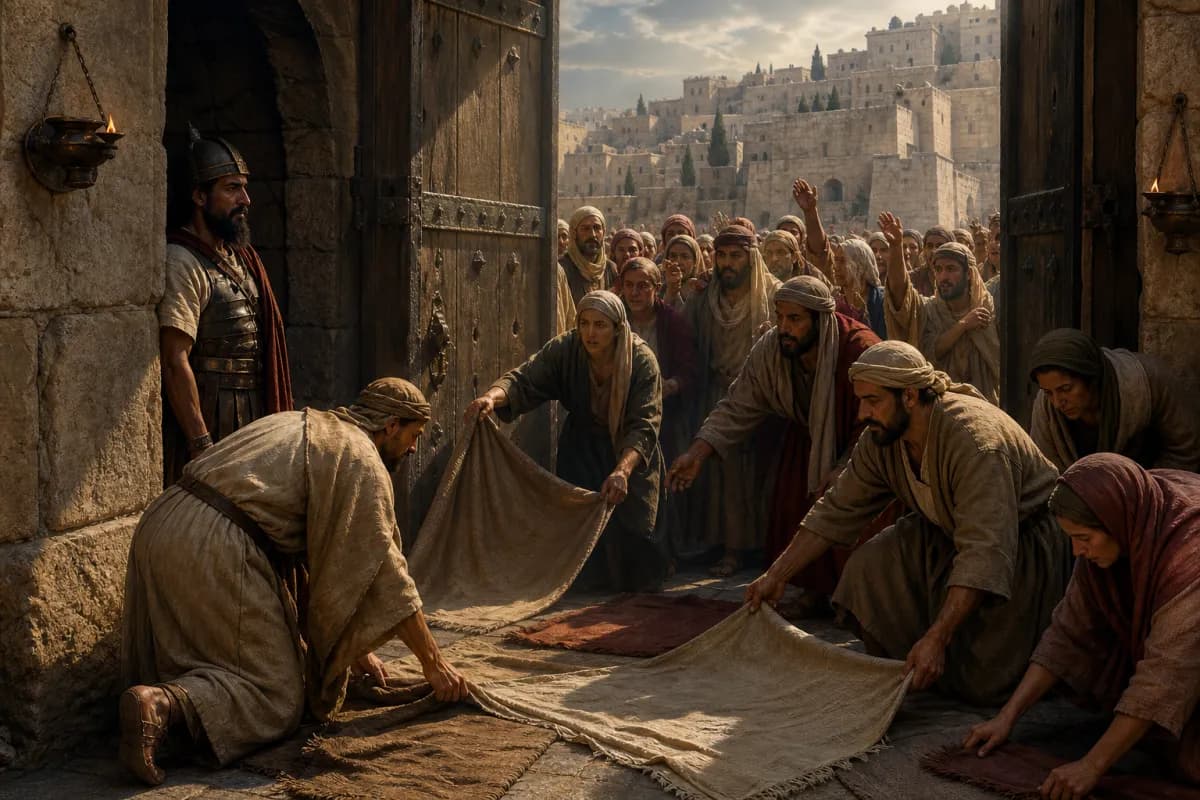
21:8A very great multitude spread their clothes on the road. Others cut branches from the trees and spread them on the road.
21:9The multitudes who went in front of him, and those who followed, kept shouting, “Hosanna to the son of David! Blessed is he who comes in the name of the Lord! Hosanna in the highest!”
21:10When he had come into Jerusalem, all the city was stirred up, saying, “Who is this?”
21:11The multitudes said, “This is the prophet, Jesus, from Nazareth of Galilee.”
21:12Jesus entered into the temple of God and drove out all of those who sold and bought in the temple, and overthrew the money changers’ tables and the seats of those who sold the doves.
21:13He said to them, “It is written, ‘My house shall be called a house of prayer,’ but you have made it a den of robbers!”
21:14The lame and the blind came to him in the temple, and he healed them.
21:15But when the chief priests and the scribes saw the wonderful things that he did, and the children who were crying in the temple and saying, “Hosanna to the son of David!” they were indignant,
21:16and said to him, “Do you hear what these are saying?” Jesus said to them, “Yes. Did you never read, ‘Out of the mouth of children and nursing babies, you have perfected praise’?”
21:17He left them and went out of the city to Bethany, and camped there.
21:18Now in the morning, as he returned to the city, he was hungry.
21:19Seeing a fig tree by the road, he came to it and found nothing on it but leaves. He said to it, “Let there be no fruit from you forever!” Immediately the fig tree withered away.
21:20When the disciples saw it, they marveled, saying, “How did the fig tree immediately wither away?”
21:21Jesus answered them, “Most certainly I tell you, if you have faith and don’t doubt, you will not only do what was done to the fig tree, but even if you told this mountain, ‘Be taken up and cast into the sea,’ it would be done.
21:22All things, whatever you ask in prayer, believing, you will receive.”
21:23When he had come into the temple, the chief priests and the elders of the people came to him as he was teaching, and said, “By what authority do you do these things? Who gave you this authority?”
21:24Jesus answered them, “I also will ask you one question, which if you tell me, I likewise will tell you by what authority I do these things.
21:25The baptism of John, where was it from? From heaven or from men?” They reasoned with themselves, saying, “If we say, ‘From heaven,’ he will ask us, ‘Why then did you not believe him?’
21:26But if we say, ‘From men,’ we fear the multitude, for all hold John as a prophet.”
21:27They answered Jesus, and said, “We don’t know.” He also said to them, “Neither will I tell you by what authority I do these things.
21:28But what do you think? A man had two sons, and he came to the first, and said, ‘Son, go work today in my vineyard.’
21:29He answered, ‘I will not,’ but afterward he changed his mind, and went.
21:30He came to the second, and said the same thing. He answered, ‘I’m going, sir,’ but he didn’t go.
21:31Which of the two did the will of his father?” They said to him, “The first.” Jesus said to them, “Most certainly I tell you that the tax collectors and the prostitutes are entering into God’s Kingdom before you.
21:32For John came to you in the way of righteousness, and you didn’t believe him; but the tax collectors and the prostitutes believed him. When you saw it, you didn’t even repent afterward, that you might believe him.
21:33“Hear another parable. There was a man who was a master of a household who planted a vineyard, set a hedge about it, dug a wine press in it, built a tower, leased it out to farmers, and went into another country.
21:34When the season for the fruit came near, he sent his servants to the farmers to receive his fruit.
21:35The farmers took his servants, beat one, killed another, and stoned another.
21:36Again, he sent other servants more than the first; and they treated them the same way.
21:37But afterward he sent to them his son, saying, ‘They will respect my son.’
21:38But the farmers, when they saw the son, said among themselves, ‘This is the heir. Come, let’s kill him and seize his inheritance.’
21:39So they took him and threw him out of the vineyard, then killed him.
21:40When therefore the lord of the vineyard comes, what will he do to those farmers?”
21:41They told him, “He will miserably destroy those miserable men, and will lease out the vineyard to other farmers who will give him the fruit in its season.”
21:42Jesus said to them, “Did you never read in the Scriptures, ‘The stone which the builders rejected was made the head of the corner. This was from the Lord. It is marvelous in our eyes’?
21:43“Therefore I tell you, God’s Kingdom will be taken away from you and will be given to a nation producing its fruit.
21:44He who falls on this stone will be broken to pieces, but on whomever it will fall, it will scatter him as dust.”
21:45When the chief priests and the Pharisees heard his parables, they perceived that he spoke about them.
21:46When they sought to seize him, they feared the multitudes, because they considered him to be a prophet.
Matthew 22
22:1Jesus answered and spoke to them again in parables, saying,
22:2“The Kingdom of Heaven is like a certain king, who made a wedding feast for his son,
22:3and sent out his servants to call those who were invited to the wedding feast, but they would not come.
22:4Again he sent out other servants, saying, ‘Tell those who are invited, “Behold, I have prepared my dinner. My cattle and my fatlings are killed, and all things are ready. Come to the wedding feast!”’
22:5But they made light of it, and went their ways, one to his own farm, another to his merchandise;
22:6and the rest grabbed his servants, treated them shamefully, and killed them.
22:7When the king heard that, he was angry, and sent his armies, destroyed those murderers, and burned their city.
22:8“Then he said to his servants, ‘The wedding is ready, but those who were invited weren’t worthy.
22:9Go therefore to the intersections of the highways, and as many as you may find, invite to the wedding feast.’
22:10Those servants went out into the highways and gathered together as many as they found, both bad and good. The wedding was filled with guests.
22:11“But when the king came in to see the guests, he saw there a man who didn’t have on wedding clothing,
22:12and he said to him, ‘Friend, how did you come in here not wearing wedding clothing?’ He was speechless.
22:13Then the king said to the servants, ‘Bind him hand and foot, take him away, and throw him into the outer darkness. That is where the weeping and grinding of teeth will be.’
22:14For many are called, but few chosen.”
22:15Then the Pharisees went and took counsel how they might entrap him in his talk.
22:16They sent their disciples to him, along with the Herodians, saying, “Teacher, we know that you are honest, and teach the way of God in truth, no matter whom you teach; for you aren’t partial to anyone.
22:17Tell us therefore, what do you think? Is it lawful to pay taxes to Caesar, or not?”
22:18But Jesus perceived their wickedness, and said, “Why do you test me, you hypocrites?
22:19Show me the tax money.” They brought to him a denarius.
22:20He asked them, “Whose is this image and inscription?”
22:21They said to him, “Caesar’s.” Then he said to them, “Give therefore to Caesar the things that are Caesar’s, and to God the things that are God’s.”
22:22When they heard it, they marveled, and left him and went away.
22:23On that day Sadducees (those who say that there is no resurrection) came to him. They asked him,
22:24saying, “Teacher, Moses said, ‘If a man dies, having no children, his brother shall marry his wife and raise up offspring for his brother.’
22:25Now there were with us seven brothers. The first married and died, and having no offspring left his wife to his brother.
22:26In the same way, the second also, and the third, to the seventh.
22:27After them all, the woman died.
22:28In the resurrection therefore, whose wife will she be of the seven? For they all had her.”
22:29But Jesus answered them, “You are mistaken, not knowing the Scriptures, nor the power of God.
22:30For in the resurrection they neither marry nor are given in marriage, but are like God’s angels in heaven.
22:31But concerning the resurrection of the dead, haven’t you read that which was spoken to you by God, saying,
22:32‘I am the God of Abraham, and the God of Isaac, and the God of Jacob’? God is not the God of the dead, but of the living.”
22:33When the multitudes heard it, they were astonished at his teaching.
22:34But the Pharisees, when they heard that he had silenced the Sadducees, gathered themselves together.
22:35One of them, a lawyer, asked him a question, testing him.
22:36“Teacher, which is the greatest commandment in the law?”
22:37Jesus said to him, “‘You shall love the Lord your God with all your heart, with all your soul, and with all your mind.’
22:38This is the first and great commandment.
22:39A second likewise is this, ‘You shall love your neighbor as yourself.’
22:40The whole law and the prophets depend on these two commandments.”
22:41Now while the Pharisees were gathered together, Jesus asked them a question,
22:42saying, “What do you think of the Christ? Whose son is he?” They said to him, “Of David.”
22:43He said to them, “How then does David in the Spirit call him Lord, saying,
22:44‘The Lord said to my Lord, sit on my right hand, until I make your enemies a footstool for your feet’?
22:45“If then David calls him Lord, how is he his son?”
22:46No one was able to answer him a word, neither did any man dare ask him any more questions from that day forward.
Matthew 23
23:1Then Jesus spoke to the multitudes and to his disciples,
23:2saying, “The scribes and the Pharisees sit on Moses’ seat.
23:3All things therefore whatever they tell you to observe, observe and do, but don’t do their works; for they say, and don’t do.
23:4For they bind heavy burdens that are grievous to be borne, and lay them on men’s shoulders; but they themselves will not lift a finger to help them.
23:5But they do all their works to be seen by men. They make their phylacteries broad and enlarge the fringes of their garments,
23:6and love the place of honor at feasts, the best seats in the synagogues,
23:7the salutations in the marketplaces, and to be called ‘Rabbi, Rabbi’ by men.
23:8But you are not to be called ‘Rabbi’, for one is your teacher, the Christ, and all of you are brothers.
23:9Call no man on the earth your father, for one is your Father, he who is in heaven.
23:10Neither be called masters, for one is your master, the Christ.
23:11But he who is greatest among you will be your servant.
23:12Whoever exalts himself will be humbled, and whoever humbles himself will be exalted.
23:13“Woe to you, scribes and Pharisees, hypocrites! For you devour widows’ houses, and as a pretense you make long prayers. Therefore you will receive greater condemnation.
23:14“But woe to you, scribes and Pharisees, hypocrites! Because you shut up the Kingdom of Heaven against men; for you don’t enter in yourselves, neither do you allow those who are entering in to enter.
23:15Woe to you, scribes and Pharisees, hypocrites! For you travel around by sea and land to make one proselyte; and when he becomes one, you make him twice as much a son of Gehenna as yourselves.
23:16“Woe to you, you blind guides, who say, ‘Whoever swears by the temple, it is nothing; but whoever swears by the gold of the temple, he is obligated.’
23:17You blind fools! For which is greater, the gold or the temple that sanctifies the gold?
23:18And, ‘Whoever swears by the altar, it is nothing; but whoever swears by the gift that is on it, he is obligated.’
23:19You blind fools! For which is greater, the gift, or the altar that sanctifies the gift?
23:20He therefore who swears by the altar, swears by it and by everything on it.
23:21He who swears by the temple, swears by it and by him who has been living in it.
23:22He who swears by heaven, swears by the throne of God and by him who sits on it.
23:23“Woe to you, scribes and Pharisees, hypocrites! For you tithe mint, dill, and cumin, and have left undone the weightier matters of the law: justice, mercy, and faith. But you ought to have done these, and not to have left the other undone.
23:24You blind guides, who strain out a gnat, and swallow a camel!
23:25“Woe to you, scribes and Pharisees, hypocrites! For you clean the outside of the cup and of the platter, but within they are full of extortion and unrighteousness.
23:26You blind Pharisee, first clean the inside of the cup and of the platter, that its outside may become clean also.
23:27“Woe to you, scribes and Pharisees, hypocrites! For you are like whitened tombs, which outwardly appear beautiful, but inwardly are full of dead men’s bones and of all uncleanness.
23:28Even so you also outwardly appear righteous to men, but inwardly you are full of hypocrisy and iniquity.
23:29“Woe to you, scribes and Pharisees, hypocrites! For you build the tombs of the prophets and decorate the tombs of the righteous,
23:30and say, ‘If we had lived in the days of our fathers, we wouldn’t have been partakers with them in the blood of the prophets.’
23:31Therefore you testify to yourselves that you are children of those who killed the prophets.
23:32Fill up, then, the measure of your fathers.
23:33You serpents, you offspring of vipers, how will you escape the judgment of Gehenna?
23:34Therefore, behold, I send to you prophets, wise men, and scribes. Some of them you will kill and crucify; and some of them you will scourge in your synagogues and persecute from city to city,
23:35that on you may come all the righteous blood shed on the earth, from the blood of righteous Abel to the blood of Zachariah son of Barachiah, whom you killed between the sanctuary and the altar.
23:36Most certainly I tell you, all these things will come upon this generation.
23:37“Jerusalem, Jerusalem, who kills the prophets and stones those who are sent to her! How often I would have gathered your children together, even as a hen gathers her chicks under her wings, and you would not!
23:38Behold, your house is left to you desolate.
23:39For I tell you, you will not see me from now on, until you say, ‘Blessed is he who comes in the name of the Lord!’”
CONTEXTUAL OVERVIEW
Jesus enters Jerusalem at the climax of a journey in which He has repeatedly predicted His death. The crowd’s cry, “Hosanna to the Son of David,” recognizes Him with royal language drawn from Israel’s worship, but Matthew quickly tests whether that welcome is more than enthusiasm. Jesus goes to the temple, overturns the tables of those who sell there, heals blind and lame people, and receives children’s praise. The King’s arrival brings both mercy and judgment to the center of Israel’s public worship.
The leaders’ recurring question concerns authority. Exousia means authority, right, or power to act, and their question in 21:23 is not neutral curiosity. They have watched Jesus teach, cleanse the temple, heal, and receive praise, yet they seek to place Him under their control. Jesus answers by asking about John’s baptism, exposing their refusal to follow the evidence God has already given. The chapters then show unbelief protecting status rather than honestly pursuing truth.
HISTORICAL AND LITERARY CONTEXT
Jerusalem’s temple was the symbolic center of Israel’s worship and pilgrimage. Jesus’ action against sellers and money changers should not be reduced to irritation with commerce; He cites Isaiah’s vision of a house of prayer for all nations and Jeremiah’s rebuke of a temple used as a cover for injustice. The action is prophetic: it confronts a worshiping system whose leaders resist God’s purpose while the needy and the children recognize mercy in Jesus’ presence.
Matthew places the fig tree around this temple confrontation. The tree’s leaves without fruit become an enacted warning against visible profession without the fruit God seeks, especially as the following parables address leaders who claim covenant privilege yet reject the Son. This is not a verdict on every Jewish person or an excuse for contempt toward Jewish people. Jesus speaks within Israel’s Scriptures and laments Jerusalem’s refusal even as He holds leaders accountable for their particular response to God’s messengers.
SECTION-BY-SECTION ANALYSIS
- Matthew 21:1–46 · Matthew 21:12The humble King enters, purifies the temple, warns against fruitlessness, and confronts leaders who reject John, the Son, and God’s claim on His vineyard.
- Matthew 22:1–46 · Matthew 22:37Jesus answers public traps with wisdom, centers the law on love, and shows that the Messiah is greater than David’s merely human descendant.
- Matthew 23:1–39 · Matthew 21:31Jesus exposes performative religion that burdens others, neglects justice and mercy, and refuses the prophets God sends.
CHRIST IN THIS PASSAGE
Jesus comes as the humble King foretold by Zechariah, yet He acts with the authority of the Lord whose house the temple is. His cleansing, healing, and teaching identify the kind of reign He brings: not a seizure of privilege, but a holy restoration in which the needy receive mercy and worship is returned to God. His question about David’s Lord enlarges the crowd’s “Son of David” confession; the Messiah is David’s son and David’s superior.
The vineyard parable gives a sober view of His saving mission. Jesus knows He is the beloved son whom the tenants will kill outside the vineyard, but He also declares that the rejected stone will become the cornerstone. The cross is therefore not an accident caused by leaders’ unbelief; it is the rejection through which God establishes His saving purpose. Still, Matthew leaves no room for smugness: everyone who hears the King must repent and bear the fruit of faith.
REFLECTION
These chapters make public religious language searching. A person may say “Lord,” know the right debates, support visible worship, and still resist Jesus when His authority threatens control, profit, reputation, or a cherished grievance. Ask where you resemble the second son: willing words without the obedience the Father seeks. Bring that resistance into the light rather than defending it with religious activity.
Jesus’ lament over Jerusalem keeps His warnings from becoming cold. He speaks grief as well as judgment because He desires to gather those who refuse Him. Receive His authority as good news: turn from hollow profession, practice the justice and mercy He names, and come to the rejected cornerstone who makes a secure place for repentant sinners.
Original Greek Word Study
Matthew 21:23
ἐξουσία
exousia · G1849
Usually translated: authority, right, or power to act
Exousia means authority. Jerusalem’s leaders question Jesus’ authority while refusing the evidence of John’s ministry and Jesus’ works, revealing that unbelief often protects its own control.
Follow the Scripture trail
The King Enters His Temple and Exposes Unbelief in the larger story
The connection: Jesus enters Jerusalem as the promised Davidic King and the Lord of the temple. Rejected as the Son in the vineyard, He will become the cornerstone through His death and resurrection, gathering a people marked not by position but by repentant faith and kingdom fruit.
Respond to the passage
Ask Jesus to show where religious words or visible service have protected you from His authority. Repent specifically, then practice one act of justice, mercy, or faithful obedience that bears the fruit He seeks.
- Why does Jesus’ temple action belong with His healings and children’s praise?
- How do the fig tree and the two sons expose fruitless profession?
- What does the vineyard parable reveal about both Jesus’ death and human responsibility?
Prayer
King Jesus, forgive my empty profession and my resistance to Your authority. Make my worship honest, my life fruitful in justice and mercy, and my hope secure in You, the rejected cornerstone. Amen.