Passage Study
The King Forms a Righteous People
Matthew 5:1–7:29
In Matthew 5–7, Jesus teaches His disciples what life under the reign of heaven looks like. He blesses the poor in spirit and the persecuted, fulfills rather than abolishes the Law and Prophets, exposes heart-level sin, teaches prayer and enemy-love, warns against anxious and hypocritical religion, and calls hearers to build their lives by doing His words. The sermon reveals both God’s holy standard and the grace needed to live as Jesus’ people.
- In this study
- 111 verses · 5 movements
Matthew 5
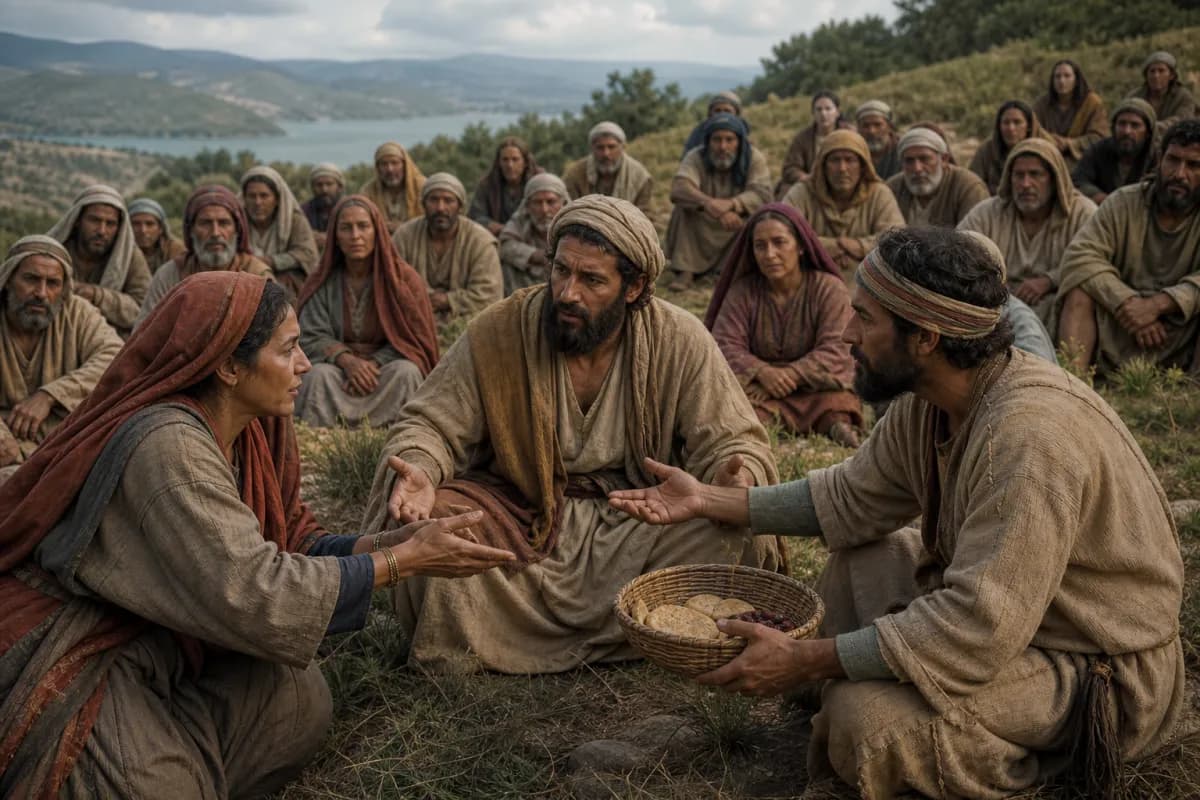
5:1Seeing the multitudes, he went up onto the mountain. When he had sat down, his disciples came to him.
5:2He opened his mouth and taught them, saying,
5:3“Blessed are the poor in spirit, for theirs is the Kingdom of Heaven.
5:4Blessed are those who mourn, for they shall be comforted.
5:5Blessed are the gentle, for they shall inherit the earth.
5:6Blessed are those who hunger and thirst for righteousness, for they shall be filled.
5:7Blessed are the merciful, for they shall obtain mercy.
5:8Blessed are the pure in heart, for they shall see God.
5:9Blessed are the peacemakers, for they shall be called children of God.
5:10Blessed are those who have been persecuted for righteousness’ sake, for theirs is the Kingdom of Heaven.
5:11“Blessed are you when people reproach you, persecute you, and say all kinds of evil against you falsely, for my sake.
5:12Rejoice, and be exceedingly glad, for great is your reward in heaven. For that is how they persecuted the prophets who were before you.
5:13“You are the salt of the earth, but if the salt has lost its flavor, with what will it be salted? It is then good for nothing, but to be cast out and trodden under the feet of men.
5:14“You are the light of the world. A city located on a hill can’t be hidden.
5:15Neither do you light a lamp and put it under a measuring basket, but on a stand; and it shines to all who are in the house.
5:16Even so, let your light shine before men, that they may see your good works and glorify your Father who is in heaven.
5:17“Don’t think that I came to destroy the law or the prophets. I didn’t come to destroy, but to fulfill.
5:18For most certainly, I tell you, until heaven and earth pass away, not even one smallest letter or one tiny pen stroke shall in any way pass away from the law, until all things are accomplished.
5:19Therefore, whoever shall break one of these least commandments and teach others to do so, shall be called least in the Kingdom of Heaven; but whoever shall do and teach them shall be called great in the Kingdom of Heaven.
5:20For I tell you that unless your righteousness exceeds that of the scribes and Pharisees, there is no way you will enter into the Kingdom of Heaven.
5:21“You have heard that it was said to the ancient ones, ‘You shall not murder;’ and ‘Whoever murders will be in danger of the judgment.’
5:22But I tell you that everyone who is angry with his brother without a cause will be in danger of the judgment. Whoever says to his brother, ‘Raca!’ will be in danger of the council. Whoever says, ‘You fool!’ will be in danger of the fire of Gehenna.
5:23“If therefore you are offering your gift at the altar, and there remember that your brother has anything against you,
5:24leave your gift there before the altar, and go your way. First be reconciled to your brother, and then come and offer your gift.
5:25Agree with your adversary quickly while you are with him on the way; lest perhaps the prosecutor deliver you to the judge, and the judge deliver you to the officer, and you be cast into prison.
5:26Most certainly I tell you, you shall by no means get out of there until you have paid the last penny.
5:27“You have heard that it was said, ‘You shall not commit adultery;’
5:28but I tell you that everyone who gazes at a woman to lust after her has committed adultery with her already in his heart.
5:29If your right eye causes you to stumble, pluck it out and throw it away from you. For it is more profitable for you that one of your members should perish than for your whole body to be cast into Gehenna.
5:30If your right hand causes you to stumble, cut it off, and throw it away from you. For it is more profitable for you that one of your members should perish, than for your whole body to be cast into Gehenna.
5:31“It was also said, ‘Whoever shall put away his wife, let him give her a writing of divorce,’
5:32but I tell you that whoever puts away his wife, except for the cause of sexual immorality, makes her an adulteress; and whoever marries her when she is put away commits adultery.
5:33“Again you have heard that it was said to the ancient ones, ‘You shall not make false vows, but shall perform to the Lord your vows,’
5:34but I tell you, don’t swear at all: neither by heaven, for it is the throne of God;
5:35nor by the earth, for it is the footstool of his feet; nor by Jerusalem, for it is the city of the great King.
5:36Neither shall you swear by your head, for you can’t make one hair white or black.
5:37But let your ‘Yes’ be ‘Yes’ and your ‘No’ be ‘No.’ Whatever is more than these is of the evil one.
5:38“You have heard that it was said, ‘An eye for an eye, and a tooth for a tooth.’
5:39But I tell you, don’t resist him who is evil; but whoever strikes you on your right cheek, turn to him the other also.
5:40If anyone sues you to take away your coat, let him have your cloak also.
5:41Whoever compels you to go one mile, go with him two.
5:42Give to him who asks you, and don’t turn away him who desires to borrow from you.
5:43“You have heard that it was said, ‘You shall love your neighbor and hate your enemy.’
5:44But I tell you, love your enemies, bless those who curse you, do good to those who hate you, and pray for those who mistreat you and persecute you,
5:45that you may be children of your Father who is in heaven. For he makes his sun to rise on the evil and the good, and sends rain on the just and the unjust.
5:46For if you love those who love you, what reward do you have? Don’t even the tax collectors do the same?
5:47If you only greet your friends, what more do you do than others? Don’t even the tax collectors do the same?
5:48Therefore you shall be perfect, just as your Father in heaven is perfect.
Matthew 6
6:1“Be careful that you don’t do your charitable giving before men, to be seen by them, or else you have no reward from your Father who is in heaven.
6:2Therefore, when you do merciful deeds, don’t sound a trumpet before yourself, as the hypocrites do in the synagogues and in the streets, that they may get glory from men. Most certainly I tell you, they have received their reward.
6:3But when you do merciful deeds, don’t let your left hand know what your right hand does,
6:4so that your merciful deeds may be in secret, then your Father who sees in secret will reward you openly.
6:5“When you pray, you shall not be as the hypocrites, for they love to stand and pray in the synagogues and in the corners of the streets, that they may be seen by men. Most certainly, I tell you, they have received their reward.
6:6But you, when you pray, enter into your inner room, and having shut your door, pray to your Father who is in secret; and your Father who sees in secret will reward you openly.
6:7In praying, don’t use vain repetitions as the Gentiles do; for they think that they will be heard for their much speaking.
6:8Therefore don’t be like them, for your Father knows what things you need before you ask him.
6:9Pray like this: “‘Our Father in heaven, may your name be kept holy.
6:10Let your Kingdom come. Let your will be done on earth as it is in heaven.
6:11Give us today our daily bread.
6:12Forgive us our debts, as we also forgive our debtors.
6:13Bring us not into temptation, but deliver us from the evil one. For yours is the Kingdom, the power, and the glory forever. Amen.’
6:14“For if you forgive men their trespasses, your heavenly Father will also forgive you.
6:15But if you don’t forgive men their trespasses, neither will your Father forgive your trespasses.
6:16“Moreover when you fast, don’t be like the hypocrites, with sad faces. For they disfigure their faces that they may be seen by men to be fasting. Most certainly I tell you, they have received their reward.
6:17But you, when you fast, anoint your head and wash your face,
6:18so that you are not seen by men to be fasting, but by your Father who is in secret; and your Father, who sees in secret, will reward you.
6:19“Don’t lay up treasures for yourselves on the earth, where moth and rust consume, and where thieves break through and steal;
6:20but lay up for yourselves treasures in heaven, where neither moth nor rust consume, and where thieves don’t break through and steal;
6:21for where your treasure is, there your heart will be also.
6:22“The lamp of the body is the eye. If therefore your eye is sound, your whole body will be full of light.
6:23But if your eye is evil, your whole body will be full of darkness. If therefore the light that is in you is darkness, how great is the darkness!
6:24“No one can serve two masters, for either he will hate the one and love the other, or else he will be devoted to one and despise the other. You can’t serve both God and Mammon.
6:25Therefore I tell you, don’t be anxious for your life: what you will eat, or what you will drink; nor yet for your body, what you will wear. Isn’t life more than food, and the body more than clothing?
6:26See the birds of the sky, that they don’t sow, neither do they reap, nor gather into barns. Your heavenly Father feeds them. Aren’t you of much more value than they?
6:27“Which of you by being anxious, can add one moment to his lifespan?
6:28Why are you anxious about clothing? Consider the lilies of the field, how they grow. They don’t toil, neither do they spin,
6:29yet I tell you that even Solomon in all his glory was not dressed like one of these.
6:30But if God so clothes the grass of the field, which today exists and tomorrow is thrown into the oven, won’t he much more clothe you, you of little faith?
6:31“Therefore don’t be anxious, saying, ‘What will we eat?’, ‘What will we drink?’ or, ‘With what will we be clothed?’
6:32For the Gentiles seek after all these things; for your heavenly Father knows that you need all these things.
6:33But seek first God’s Kingdom and his righteousness; and all these things will be given to you as well.
6:34Therefore don’t be anxious for tomorrow, for tomorrow will be anxious for itself. Each day’s own evil is sufficient.
Matthew 7
7:1“Don’t judge, so that you won’t be judged.
7:2For with whatever judgment you judge, you will be judged; and with whatever measure you measure, it will be measured to you.
7:3Why do you see the speck that is in your brother’s eye, but don’t consider the beam that is in your own eye?
7:4Or how will you tell your brother, ‘Let me remove the speck from your eye,’ and behold, the beam is in your own eye?
7:5You hypocrite! First remove the beam out of your own eye, and then you can see clearly to remove the speck out of your brother’s eye.
7:6“Don’t give that which is holy to the dogs, neither throw your pearls before the pigs, lest perhaps they trample them under their feet, and turn and tear you to pieces.
7:7“Ask, and it will be given you. Seek, and you will find. Knock, and it will be opened for you.
7:8For everyone who asks receives. He who seeks finds. To him who knocks it will be opened.
7:9Or who is there among you who, if his son asks him for bread, will give him a stone?
7:10Or if he asks for a fish, who will give him a serpent?
7:11If you then, being evil, know how to give good gifts to your children, how much more will your Father who is in heaven give good things to those who ask him!
7:12Therefore, whatever you desire for men to do to you, you shall also do to them; for this is the law and the prophets.
7:13“Enter in by the narrow gate; for the gate is wide and the way is broad that leads to destruction, and there are many who enter in by it.
7:14How narrow is the gate and the way is restricted that leads to life! There are few who find it.
7:15“Beware of false prophets, who come to you in sheep’s clothing, but inwardly are ravening wolves.
7:16By their fruits you will know them. Do you gather grapes from thorns or figs from thistles?
7:17Even so, every good tree produces good fruit, but the corrupt tree produces evil fruit.
7:18A good tree can’t produce evil fruit, neither can a corrupt tree produce good fruit.
7:19Every tree that doesn’t grow good fruit is cut down and thrown into the fire.
7:20Therefore by their fruits you will know them.
7:21“Not everyone who says to me, ‘Lord, Lord,’ will enter into the Kingdom of Heaven, but he who does the will of my Father who is in heaven.
7:22Many will tell me in that day, ‘Lord, Lord, didn’t we prophesy in your name, in your name cast out demons, and in your name do many mighty works?’
7:23Then I will tell them, ‘I never knew you. Depart from me, you who work iniquity.’
7:24“Everyone therefore who hears these words of mine and does them, I will liken him to a wise man who built his house on the rock.
7:25The rain came down, the floods came, and the winds blew and beat on that house; and it didn’t fall, for it was founded on the rock.
7:26Everyone who hears these words of mine and doesn’t do them will be like a foolish man who built his house on the sand.
7:27The rain came down, the floods came, and the winds blew and beat on that house; and it fell—and its fall was great.”
7:28When Jesus had finished saying these things, the multitudes were astonished at his teaching,
7:29for he taught them with authority, and not like the scribes.
CONTEXTUAL OVERVIEW
Jesus teaches on a mountain with His disciples near and crowds listening. The setting recalls Moses but the sermon’s force lies in Jesus’ own authority: “You have heard … but I say to you.” He is not casually canceling Israel’s Scriptures. He says He has come to fulfill the Law and Prophets, then brings their purpose to bear on anger, lust, truthfulness, retaliation, love, worship, money, and trust.
The beatitudes begin with people who know they cannot establish God’s kingdom by strength: poor in spirit, mourners, meek people, and those hungry for righteousness. The blessings do not romanticize poverty, grief, or persecution. They announce that the kingdom belongs to those who depend on God and endure for Jesus’ sake, even when their present circumstances contradict easy ideas of blessing.
HISTORICAL AND LITERARY CONTEXT
Matthew groups Jesus’ teaching in this sustained sermon after His proclamation that the kingdom is near. “Righteousness” in these chapters concerns life aligned with God’s will, including mercy, reconciliation, truth, generosity, and prayer. The sermon confronts performative piety as sharply as visible injustice: giving, praying, and fasting can be done before God or staged for human admiration.
The sermon uses memorable contrasts and images—salt losing its purpose, an eye as a lamp, a speck and a log, wolves in sheep’s clothing, and houses facing flood. These are verbal illustrations in Jesus’ teaching, not descriptions of images displayed to the reader. Their point is practical: a disciple’s concealed motives, daily words, treatment of enemies, and actual obedience disclose whether Jesus’ instruction has been received.
SECTION-BY-SECTION ANALYSIS
- Matthew 5:1–48 · Matthew 5:8Jesus blesses dependent kingdom people and exposes anger, lust, deceit, retaliation, and hatred as matters of the heart before God.
- Matthew 6:1–34 · Matthew 6:1Giving, prayer, fasting, money, and anxiety are brought before the Father who sees what public religion can conceal.
- Matthew 7:1–29 · Matthew 7:23The sermon ends by distinguishing humble discernment from hypocrisy and obedient discipleship from words that never become a lived foundation.
CHRIST IN THIS PASSAGE
Jesus stands at the sermon’s center as the one who fulfills the Law and Prophets and speaks with authority over His people’s life. He does not lower God’s righteousness to a manageable rulebook. His commands expose the guilt beneath respectable appearances and direct hearers to the Father’s kingdom, mercy, and forgiveness. The sermon therefore creates need for the Savior it presents.
The sermon also shows the shape of Christ’s saving mission. He embodies the meekness, mercy, purity, peacemaking, enemy-love, prayerful dependence, and obedience He teaches. At the cross He bears the judgment sinners deserve; through His resurrection He forms a people who learn to do His words by grace. The command to seek first God’s kingdom is not self-redemption but a call to live under the reign of the King who gives Himself for His enemies.
REFLECTION
Do not use the Sermon on the Mount to compare yourself favorably with people whose sins are more visible. Jesus directs the search inward: unresolved anger, secret lust, performance in prayer, resentment toward an enemy, worry that tries to secure life without the Father, and religious speech without obedience. Bring these realities honestly to Christ, whose mercy is for the poor in spirit.
Choose one teaching from the sermon that requires concrete obedience this week. Reconcile with a person you have treated with contempt, pray the Lord’s Prayer slowly and truthfully, give without announcing it, or take a hidden anxiety to the Father instead of feeding it. Building on the rock means hearing Jesus in such a way that His words reshape a real decision.
Original Greek Word Study
Matthew 5:6
δικαιοσύνη
dikaiosyne · G1343
Usually translated: righteousness or justice
Dikaiosyne means righteousness or justice. Jesus blesses those who hunger for the life that accords with God’s will, a righteousness that reaches the heart and reshapes ordinary relationships.
Follow the Scripture trail
The King Forms a Righteous People in the larger story
The connection: The Sermon on the Mount reveals the righteousness of God’s kingdom and the depth of human need. Jesus fulfills the Scriptures He teaches, embodies their righteousness, bears sinners’ judgment at the cross, and forms forgiven disciples who learn the Father’s way in His kingdom.
Respond to the passage
Ask Jesus to expose the heart-level sin beneath one visible pattern—anger, desire, anxiety, religious performance, or harsh judgment. Receive His forgiveness, then obey one specific command from the sermon in dependence on the Father.
- Why do the beatitudes begin with people who know their need rather than people who display strength?
- How does Jesus connect secret devotion, money, and anxiety in chapter 6?
- What makes the difference between hearing Jesus’ words and building on them?
Prayer
King Jesus, I need the righteousness I cannot produce for myself. Forgive my hidden sin, teach me to seek the Father’s kingdom first, and form Your mercy, truth, and enemy-love in my daily life. Amen.