Passage Study
Leaders for the Census: A People Known by Name
Numbers 1:1–1:16
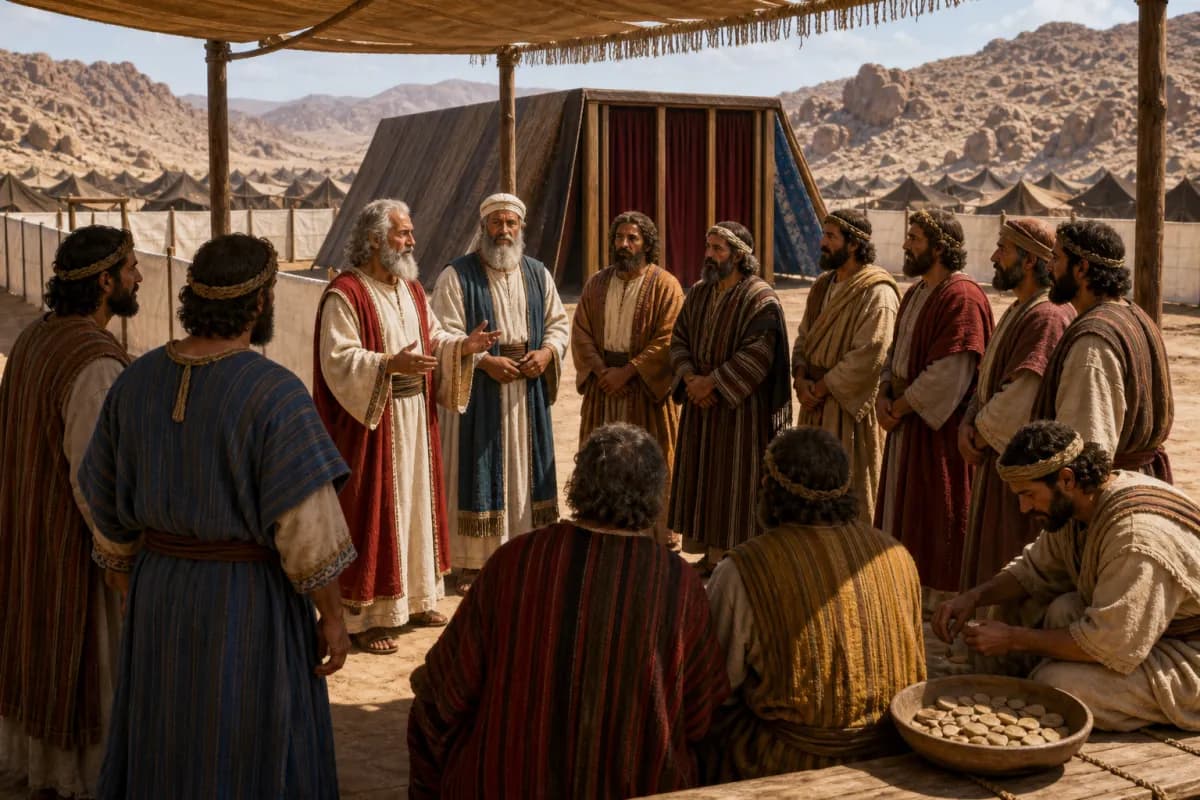
Numbers 1:1–16 opens Israel’s wilderness journey with the Lord naming a leader from every tribe to stand with Moses and Aaron for the census. The list is not filler: God orders a redeemed people for service, remembers their households, and gives them accountable representatives. It anticipates Jesus, the faithful shepherd and head who knows His people and gathers them for His saving mission.
- In this study
- 16 verses · 5 movements
Numbers 1
1:1The LORD spoke to Moses in the wilderness of Sinai, in the Tent of Meeting, on the first day of the second month, in the second year after they had come out of the land of Egypt, saying,
1:2“Take a census of all the congregation of the children of Israel, by their families, by their fathers’ houses, according to the number of the names, every male, one by one,
1:3from twenty years old and upward, all who are able to go out to war in Israel. You and Aaron shall count them by their divisions.
1:4With you there shall be a man of every tribe, each one head of his fathers’ house.
1:5These are the names of the men who shall stand with you: Of Reuben: Elizur the son of Shedeur.
1:6Of Simeon: Shelumiel the son of Zurishaddai.
1:7Of Judah: Nahshon the son of Amminadab.
1:8Of Issachar: Nethanel the son of Zuar.
1:9Of Zebulun: Eliab the son of Helon.
1:10Of the children of Joseph: of Ephraim: Elishama the son of Ammihud; of Manasseh: Gamaliel the son of Pedahzur.
1:11Of Benjamin: Abidan the son of Gideoni.
1:12Of Dan: Ahiezer the son of Ammishaddai.
1:13Of Asher: Pagiel the son of Ochran.
1:14Of Gad: Eliasaph the son of Deuel.
1:15Of Naphtali: Ahira the son of Enan.”
1:16These are those who were called of the congregation, the princes of the tribes of their fathers; they were the heads of the thousands of Israel.
CONTEXTUAL OVERVIEW
Numbers begins in the second year after Israel’s exodus, while the people remain at Sinai with the tabernacle in their midst. The Lord has redeemed former slaves and made covenant with them; now He prepares them to travel toward the land He promised. The opening command to count is therefore not bureaucracy for its own sake. It gives shape to a people whose life and movement belong to God.
Moses and Aaron do not carry out the work alone. Each tribe supplies a named man, described as the head of his ancestral house. The long list slows the reader down: before Israel becomes a marching host, it is a community of particular tribes and households, each represented before God’s command.
HISTORICAL AND LITERARY CONTEXT
The setting is the wilderness of Sinai, at the tent of meeting where the Lord speaks to Moses. Numbers follows Exodus and Leviticus: God has delivered Israel, given His law, and established the tabernacle. The census will organize the tribes for the journey and, in the verses that follow, identify men twenty years old and above who can serve in Israel’s army.
The representatives are not portrayed as kings competing for power. They assist Moses and Aaron under the Lord’s instruction. Their names also preserve the tribal order descended from Jacob’s sons. This is covenant administration: public responsibility is tied to real families, not to an anonymous mass or private ambition.
Did you know?
An eighteenth-century BCE letter from the Mari archive describes a governor using assistants to conduct a military census. Those assistants took an oath—a glimpse of the trust required when counting depended on local representatives.
Why it matters: The letter helps explain the practical responsibility carried by the tribal leaders named here.
SECTION-BY-SECTION ANALYSIS
- At the tent of meeting · Numbers 1:1The census begins where God speaks, so Israel’s public organization is ordered by His presence and word.
- One from each tribe · Numbers 1:4Each tribe is visibly included in the work, preventing the nation from being reduced to the concerns of a few dominant families.
- Named representatives · Numbers 1:2The recorded names show that leadership is concrete responsibility before God, not an abstract title.
CHRIST IN THIS PASSAGE
Numbers 1 does not predict Jesus by making each tribal leader a hidden symbol of Him. Its clearer biblical pattern is the Lord’s care to gather, name, and order His redeemed people for His purpose. Jesus fulfills that purpose as the good shepherd who knows His own and as the risen Lord who gives His church servants for its common life and witness.
Christ’s saving mission creates a people, not merely isolated forgiven individuals. By His death He reconciles sinners to God and to one another; by His Spirit He gives them different responsibilities within one body. The census’s shared responsibility therefore points forward, by pattern rather than direct prediction, to a church whose life is centered on Christ and sent in His name.
REFLECTION
It is easy to feel unseen in a large congregation, family, or task. Numbers begins by showing that God does not save a faceless crowd. He knows the actual people and households He has redeemed, and He calls some to bear identifiable responsibility for the good of the whole.
Jesus knows His people more deeply than a census can. That truth humbles leaders and comforts ordinary believers: neither visibility nor obscurity makes a person more secure before Him. Receive your place as a gift, serve faithfully where you are, and help the church display the ordered love of the Savior who gave Himself to make one people from many.
Original Hebrew Word Study
Numbers 1:4
נָשִׂיא
nasi · H5387
Usually translated: leader or prince
Nasi is a leader. Each tribe’s named representative shows that Israel’s census is ordered through accountable households rather than anonymous numbers.
Follow the Scripture trail
Leaders for the Census: A People Known by Name in the larger story
The connection: The named leaders of Numbers show that the Lord gathers His redeemed people for a real journey and a shared calling. Jesus brings that saving purpose to its fullness: He knows His people, unites them by His cross, and equips them to bear witness to His kingdom together.
Respond to the passage
Thank Jesus that you are known by name rather than lost in a crowd. Ask where you can accept responsibility for the good of His people instead of treating church as a service provided for you.
- Why does the Lord begin Israel’s journey by naming tribal representatives rather than simply issuing a total number?
- What does the setting at the tent of meeting reveal about the purpose of Israel’s organization?
- How does Jesus’ knowledge of His people reshape both the way you lead and the way you belong?
Prayer
Lord Jesus, thank You that You know Your people and gave Yourself to make us one. Free me from seeking importance for myself, and show me how to serve faithfully in the place You have given me. Build Your church in ordered love and courageous witness. Amen.