Passage Study
The Levites Set Apart: Guarding the Dwelling of God
Numbers 1:47–1:54
Numbers 1:47–54 separates the Levites from the military census and places them around the tabernacle. Their charge is to carry, tend, and guard the dwelling so that wrath does not break out against the congregation. The passage makes God’s holy presence both Israel’s greatest gift and a danger sinners cannot manage, preparing the way for Jesus, whose saving mediation brings His people near to God.
- In this study
- 8 verses · 5 movements
Numbers 1
1:47But the Levites after the tribe of their fathers were not counted among them.
1:48For the LORD spoke to Moses, saying,
1:49“Only the tribe of Levi you shall not count, neither shall you take a census of them among the children of Israel;
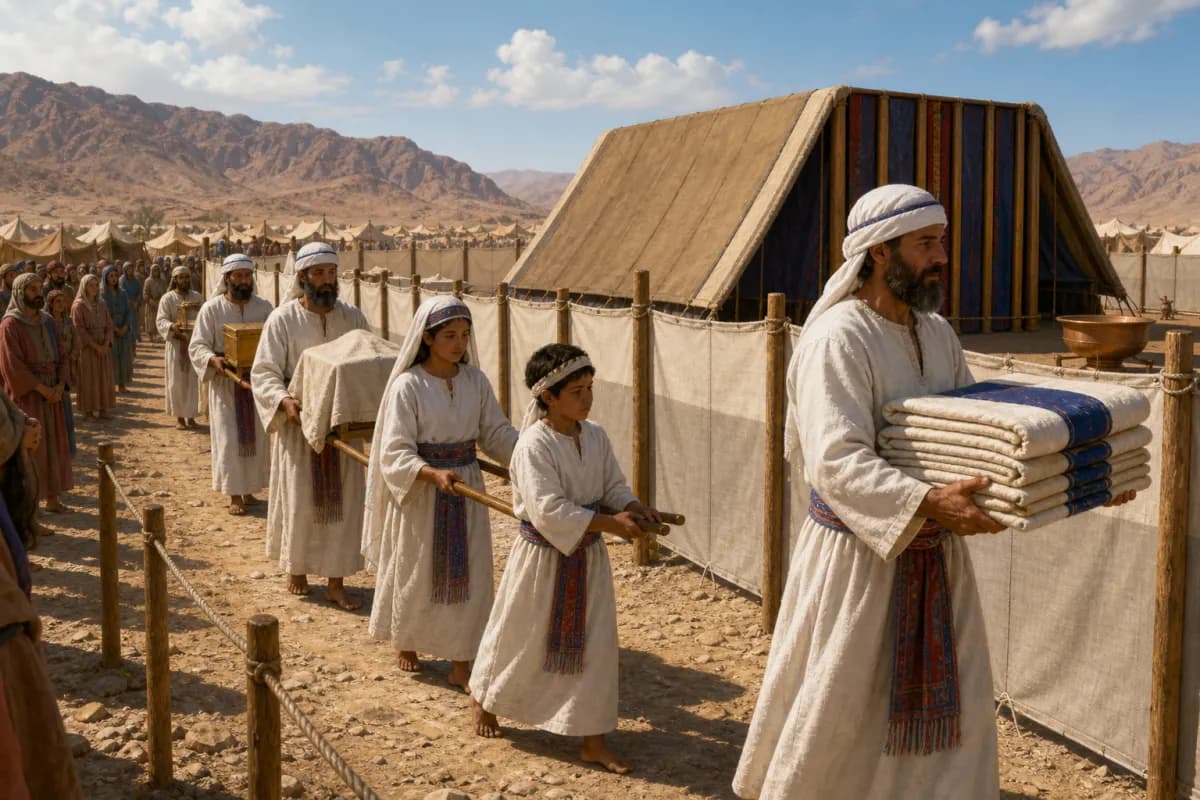
1:50but appoint the Levites over the Tabernacle of the Testimony, and over all its furnishings, and over all that belongs to it. They shall carry the tabernacle and all its furnishings; and they shall take care of it, and shall encamp around it.
1:51When the tabernacle is to move, the Levites shall take it down; and when the tabernacle is to be set up, the Levites shall set it up. The stranger who comes near shall be put to death.
1:52The children of Israel shall pitch their tents, every man by his own camp, and every man by his own standard, according to their divisions.
1:53But the Levites shall encamp around the Tabernacle of the Testimony, that there may be no wrath on the congregation of the children of Israel. The Levites shall be responsible for the Tabernacle of the Testimony.”
1:54Thus the children of Israel did. According to all that the LORD commanded Moses, so they did.
CONTEXTUAL OVERVIEW
Immediately after the military count, Numbers interrupts the list to deal with Levi. The interruption is the point. Israel’s life cannot be defined only by its readiness for war; it is organized around the tabernacle, the place where the holy God has chosen to dwell among a redeemed but still sinful people.
The Levites are assigned to the tabernacle and told to camp around it. Their service is practical—carrying, caring for, and setting up the sanctuary—but it is also protective. Unauthorized approach brings death, and the Levites’ guard prevents wrath from falling on the wider congregation. Holiness is not vague religious intensity; it has boundaries set by God for the life of His people.
HISTORICAL AND LITERARY CONTEXT
Levi’s distinct role grows out of earlier events in Exodus. The firstborn of Israel belong to the Lord because He spared them in Egypt, and the Levites are later given in their place for sanctuary service. Numbers will develop that substitution further in chapter 3, but chapter 1 already makes clear that their calling belongs to the Lord’s provision for living near Him.
The tabernacle is portable because Israel is traveling, yet its holiness does not become portable in the sense of casual. When the camp moves, the Levites dismantle and carry it; when the camp stops, they set it up and guard it. The God who leads His people in the wilderness remains holy at every stage of the journey.
SECTION-BY-SECTION ANALYSIS
- Set apart from the census · Numbers 1:49Levi’s omission from the army identifies a different calling: the protection and care of the sanctuary.
- Carry and tend · Numbers 1:50The service is holy precisely in its concrete duties, from moving the tabernacle to guarding its access.
- So that wrath may not fall · Numbers 1:53The boundary around the sanctuary protects the congregation from approaching God on unauthorized terms.
CHRIST IN THIS PASSAGE
The Levites’ guarded service reveals a problem that their service cannot finally solve: sinners need a mediator if God is to dwell with them without judgment. Jesus fulfills this need more fully than the Levitical order could. He is the holy Son who offers Himself once for sins and brings His people to God.
This is not a claim that every Levite directly represents Jesus. The stronger connection is the passage’s God-given pattern of guarded access and mediation. At the cross, the barrier is not ignored or lowered by human boldness; Christ bears sin and opens access by His own blood. His saving mission makes a people holy and sends them into the world as a dwelling place of God by the Spirit.
REFLECTION
Modern people often want divine nearness without divine holiness. Numbers refuses that division. God truly desires to dwell among His people, but He Himself establishes the way that nearness can give life rather than judgment.
Jesus is therefore not an optional spiritual addition to a self-made approach to God. He is the merciful way God has provided. Those who trust Him can draw near with confidence, not because sin is small, but because His sacrifice and priestly mediation are sufficient. That confidence should produce reverence, gratitude, and care for the holiness of the church’s common life.
Original Hebrew Word Study
Numbers 1:53
שָׁמַר
shamar · H8104
Usually translated: to keep, guard, or watch
Shamar means to guard. The Levites keep watch around the tabernacle so that the holy presence in Israel’s midst brings life rather than judgment.
Follow the Scripture trail
The Levites Set Apart: Guarding the Dwelling of God in the larger story
The connection: The Levites guarding the tabernacle show that God’s presence is a gift requiring the mediation He provides. Jesus fulfills that saving purpose as the holy mediator who bears sin, brings His people near, and makes them a dwelling place for God by His Spirit.
Respond to the passage
Do not confuse familiarity with God-language for nearness to God. Come to the Father through Jesus with reverence and confidence, and consider how your life can help protect rather than wound the holiness and peace of His people.
- Why does Numbers place the Levites’ sanctuary service immediately beside the military census?
- What does the warning about unauthorized approach teach about God’s presence?
- How does Jesus’ mediation give both confidence and reverence in worship?
Prayer
Holy Father, thank You for wanting to dwell with Your people and for providing the way through Jesus. Forgive my casual treatment of sin and worship. Draw me near through Christ, and make my life serve the peace and holiness of Your church. Amen.