Passage Study
Israel Sets Out from Sinai: A Redeemed People on the Move
Numbers 10:11–10:28
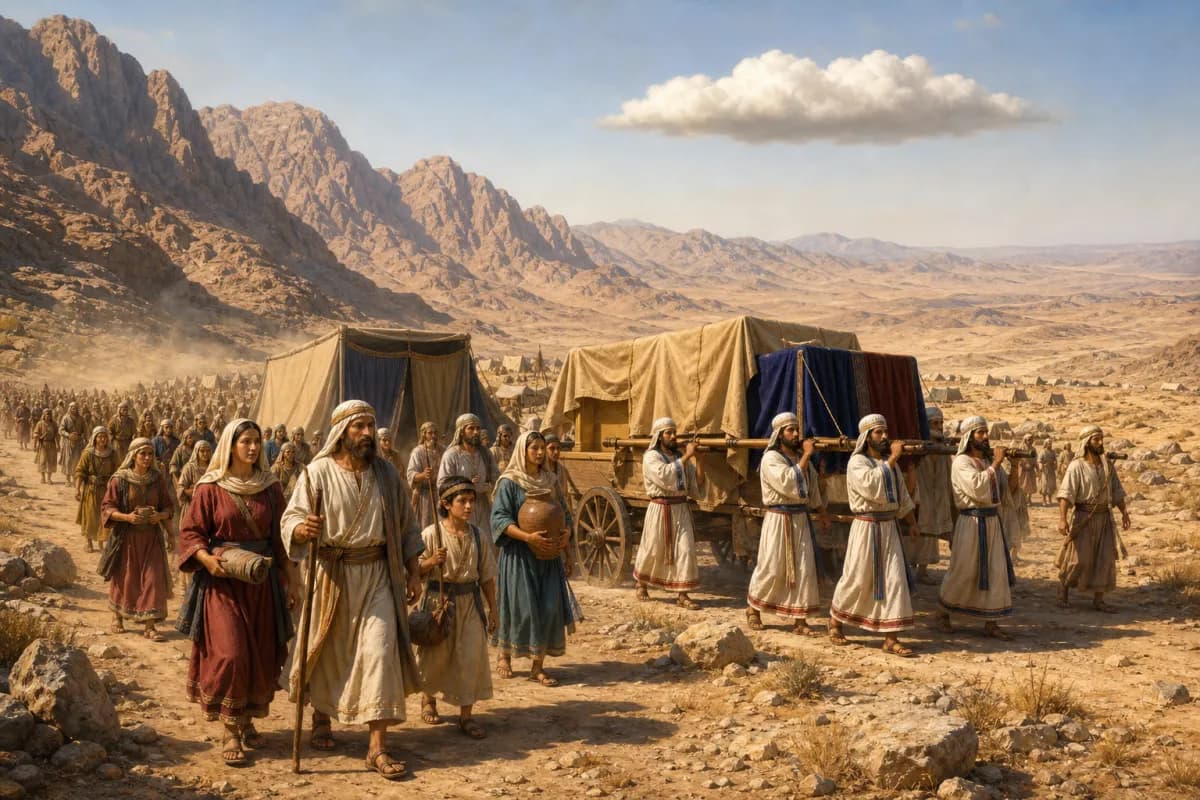
Numbers 10:11–28 records Israel’s first departure from Sinai after nearly a year at the mountain. The cloud lifts, the tribes move in their appointed order, and the tabernacle goes with them. God does not rescue His people merely to leave them standing still; He forms them into a people whose journey is governed by His presence, promise, and ordered service. Jesus leads His redeemed people as pilgrims toward God’s promised kingdom.
- In this study
- 18 verses · 5 movements
Numbers 10
10:11In the second year, in the second month, on the twentieth day of the month, the cloud was taken up from over the tabernacle of the covenant.
10:12The children of Israel went forward on their journeys out of the wilderness of Sinai; and the cloud stayed in the wilderness of Paran.
10:13They first went forward according to the commandment of the LORD by Moses.
10:14First, the standard of the camp of the children of Judah went forward according to their armies. Nahshon the son of Amminadab was over his army.
10:15Nethanel the son of Zuar was over the army of the tribe of the children of Issachar.
10:16Eliab the son of Helon was over the army of the tribe of the children of Zebulun.
10:17The tabernacle was taken down; and the sons of Gershon and the sons of Merari, who bore the tabernacle, went forward.
10:18The standard of the camp of Reuben went forward according to their armies. Elizur the son of Shedeur was over his army.
10:19Shelumiel the son of Zurishaddai was over the army of the tribe of the children of Simeon.
10:20Eliasaph the son of Deuel was over the army of the tribe of the children of Gad.
10:21The Kohathites set forward, bearing the sanctuary. The others set up the tabernacle before they arrived.
10:22The standard of the camp of the children of Ephraim set forward according to their armies. Elishama the son of Ammihud was over his army.
10:23Gamaliel the son of Pedahzur was over the army of the tribe of the children of Manasseh.
10:24Abidan the son of Gideoni was over the army of the tribe of the children of Benjamin.
10:25The standard of the camp of the children of Dan, which was the rear guard of all the camps, set forward according to their armies. Ahiezer the son of Ammishaddai was over his army.
10:26Pagiel the son of Ochran was over the army of the tribe of the children of Asher.
10:27Ahira the son of Enan was over the army of the tribe of the children of Naphtali.
10:28Thus were the travels of the children of Israel according to their armies; and they went forward.
CONTEXTUAL OVERVIEW
After long preparation—censuses, camp arrangements, purity laws, offerings, priestly blessing, Passover, and signals—Israel finally leaves Sinai. Numbers gives the exact date: the twentieth day of the second month in the second year. The detail marks a new stage in the story of a people who have been delivered from Egypt and taught to live around God’s dwelling.
The chapter does not describe a spontaneous migration. The cloud lifts from the tabernacle, Judah moves first, and each tribal division takes its place. Even the Levites are arranged so that the tabernacle’s framework travels ahead of the Kohathites carrying the holy things. Israel’s movement is built around the continued presence of the God who made covenant at Sinai.
HISTORICAL AND LITERARY CONTEXT
Numbers 10 completes the Sinai section of the Pentateuch and turns toward the wilderness journey. The destination named here is the wilderness of Paran, the broad region from which the spies will soon survey Canaan. The narrative creates hope and tension: the promised land is ahead, but Israel must learn whether it will trust the Lord who leads it there.
The marching order repeats the arrangement of Numbers 2. Judah’s division moves first, followed by Reuben; then Gershon and Merari carry the tabernacle components; then the Kohathites carry the holy objects; Ephraim and Dan follow with the remaining tribes. The order is logistical, but it is also theological: the Lord’s sanctuary stays at the heart of Israel’s life on the road.
SECTION-BY-SECTION ANALYSIS
- The lifted cloud · Numbers 10:12Israel’s journey begins with God’s initiative, not a leader’s impatience or the people’s preference.
- Named tribes · Numbers 10:11Each tribe has a real place and responsibility within the one covenant people.
- The tabernacle in transit · Numbers 10:17God’s presence remains central while Israel moves; worship is not left behind at Sinai.
CHRIST IN THIS PASSAGE
This ordered departure does not directly predict Jesus, but it advances the Bible’s larger portrait of God leading a redeemed people toward the inheritance He promises. Jesus calls disciples to follow Him, and His resurrection establishes a people whose true citizenship and final hope are in God’s coming kingdom. The Christian life is therefore a pilgrimage shaped by a Savior who has gone before His people.
Jesus does not lead a new camp around a portable sanctuary. By His death and resurrection He gives access to the Father and forms a people from every nation as God’s dwelling by the Spirit. His mission keeps the church from treating salvation as private escape: redeemed people are gathered, ordered by His word, and sent through the world as witnesses on the way to the new creation.
REFLECTION
It is possible to love a season of spiritual preparation and fear the moment of obedient movement. Israel had known God’s power at Sinai, but the wilderness would test whether it trusted Him beyond the mountain. This passage invites us to carry God’s presence and instruction into ordinary travel, work, decisions, and uncertainty.
Jesus does not ask His people to manufacture a grand future. He asks them to follow Him together. Take the next clear act of obedience, honor the particular responsibility God has given you, and resist the temptation to let busyness displace worship. The Savior who calls His people onward remains at the center of their journey.
Original Hebrew Word Study
Numbers 10:11
נָסַע
nasa · H5265
Usually translated: to set out or journey
Nasa means to set out. Israel’s first departure from Sinai is ordered by the cloud and tribal standards, showing that freedom is being formed into faithful travel with God.
Follow the Scripture trail
Israel Sets Out from Sinai: A Redeemed People on the Move in the larger story
The connection: Israel leaves Sinai as a people redeemed, instructed, and ordered around God’s dwelling, heading toward the inheritance He promised. Jesus leads His redeemed people toward the kingdom to come and sends them through the world as a worshiping, witnessing people.
Respond to the passage
Ask Jesus where you have confused preparation with obedience. Take one next step that follows His clear word, and look for a way to strengthen the shared life of His people rather than carrying the journey alone.
- Why does Numbers give so much attention to the order of Israel’s departure?
- What does the place of the tabernacle teach about carrying worship into a changing season?
- How does the church’s identity as a pilgrim people reshape ordinary obedience?
Prayer
Lord Jesus, thank You for leading Your people toward the kingdom You will complete. Keep me from settling into fear or treating worship as separate from daily life. Give me courage for the next obedient step and love for the people with whom You have called me to travel. Amen.