Passage Study
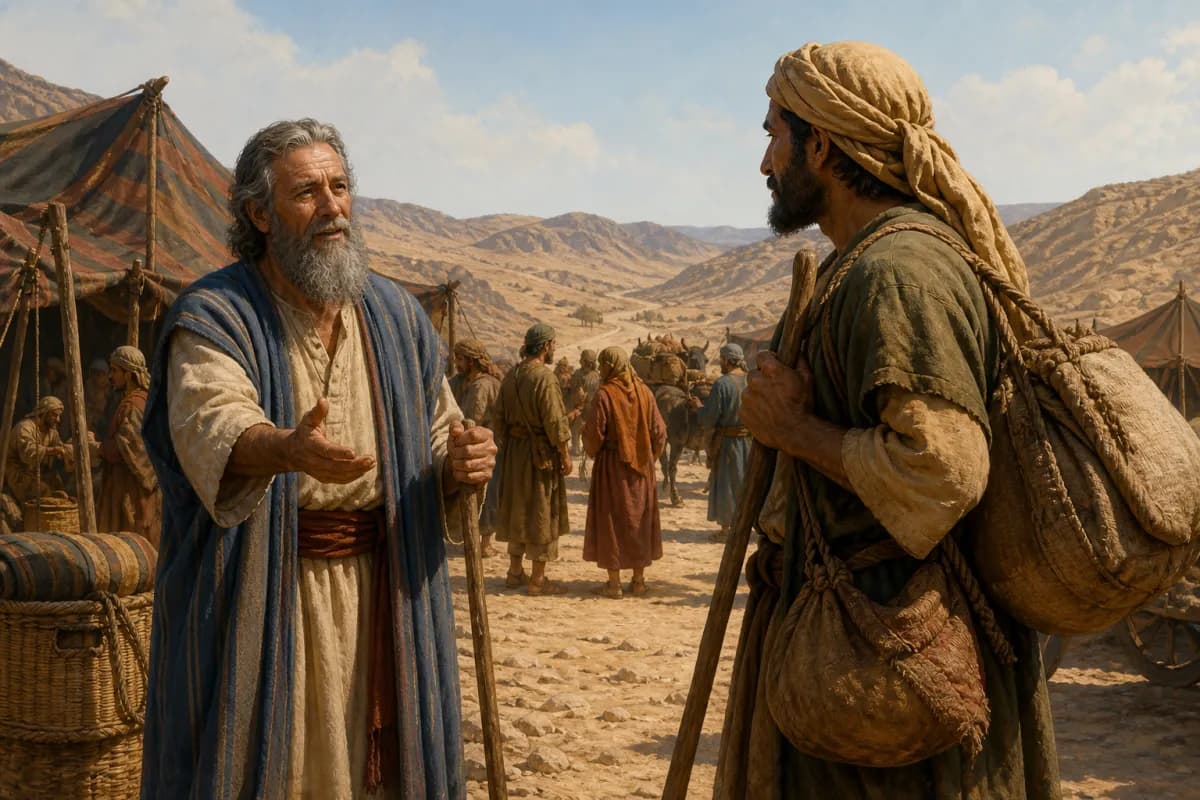
Moses Invites Hobab: Sharing the Good God Has Promised
Numbers 10:29–10:32
Numbers 10:29–32 records Moses inviting Hobab, his Midianite relative, to travel with Israel because the Lord has promised good to His people. Moses values Hobab’s wilderness knowledge, yet grounds the invitation in God’s covenant generosity. The scene points forward to Jesus’ mission of gathering outsiders by grace into the people who share in God’s promised blessing.
- In this study
- 4 verses · 5 movements
Numbers 10
10:29Moses said to Hobab, the son of Reuel the Midianite, Moses’ father-in-law, “We are journeying to the place of which the LORD said, ‘I will give it to you.’ Come with us, and we will treat you well; for the LORD has spoken good concerning Israel.”
10:30He said to him, “I will not go; but I will depart to my own land, and to my relatives.”
10:31Moses said, “Don’t leave us, please; because you know how we are to encamp in the wilderness, and you can be our eyes.
10:32It shall be, if you go with us—yes, it shall be—that whatever good the LORD does to us, we will do the same to you.”
CONTEXTUAL OVERVIEW
As Israel begins its journey, Moses turns to Hobab, identified here as a Midianite relative connected with Moses’ family. The invitation is striking because it occurs beside the nation’s carefully ordered departure. Israel is not called to hide God’s promise inside its own camp; Moses speaks of the good the Lord has promised and asks Hobab to come with them.
Moses does not deny that Hobab knows the wilderness. He asks him to serve as “eyes” for the people. Yet Hobab’s practical knowledge is not the ground of Israel’s confidence. The invitation begins and ends with the Lord’s goodness. Human skill may serve the journey, but God’s promise gives it meaning and destination.
HISTORICAL AND LITERARY CONTEXT
The text’s family designations have prompted discussion because Moses’ Midianite in-laws are named in several passages. Numbers itself identifies Hobab as son of Reuel the Midianite and Moses’ father-in-law or in-law relation, depending on how the Hebrew kinship term is rendered. The exact family reconstruction is debated, but the narrative’s central action is clear: Moses invites a Midianite kinsman into Israel’s journey.
The request follows the cloud-led departure. Some readers see tension between the cloud’s guidance and Moses’ appeal to Hobab’s experience, but the passage need not set them against each other. God’s leading does not forbid receiving ordinary wisdom and help. Israel remains dependent on the Lord while welcoming a capable companion into its wilderness life.
SECTION-BY-SECTION ANALYSIS
- Come with us · Numbers 10:29Moses extends a concrete invitation into Israel’s shared journey rather than offering only abstract approval.
- The Lord has promised good · Numbers 10:32God’s covenant generosity, not Israel’s self-importance, gives the invitation its credibility.
- Be our eyes · Numbers 10:31Receiving practical help does not displace dependence on God; it can be one means of wise communal care.
CHRIST IN THIS PASSAGE
Hobab’s invitation is not a direct prophecy of Jesus, and Numbers does not report a conversion formula. It does reveal a biblical pattern: the good God promises to His covenant people is not meant to produce closed pride. The Scriptures increasingly show God drawing the nations to share in His blessing, a promise first spoken to Abraham.
Jesus fulfills that mission by bringing those once far off near through His blood. He does not merely invite people to join a religious culture; He reconciles sinners to the Father and creates one new humanity in Himself. The church therefore speaks of Christ’s welcome with humility, offering a real place among God’s people while trusting the Holy Spirit rather than pressure to bring people to faith.
REFLECTION
Moses offers a useful pattern for witness: speak plainly about the good God has promised, invite someone into the actual life of God’s people, and make room for the gifts they bring. Evangelism is not a sales transaction. It is a truthful invitation to follow the Lord whose grace has made a people.
Ask whether your Christian community feels like a closed circle or a household ready to receive a neighbor. Jesus has welcomed you at great cost. Let that grace make you both confident in the gospel and attentive to the real questions, skills, and needs of the people you invite to walk with you.
Original Hebrew Word Study
Numbers 10:29
טוֹב
tov · H2896
Usually translated: good
Tov means good. Moses invites Hobab to share in the good the Lord has promised Israel, opening the covenant journey toward a Midianite relative who knows the wilderness.
Follow the Scripture trail
Moses Invites Hobab: Sharing the Good God Has Promised in the larger story
The connection: Moses invites a Midianite relative to share in the good the Lord promises Israel, showing that God’s covenant generosity creates room for a genuine welcome. Jesus fulfills that wide mission by bringing outsiders near through His cross and forming one people who invite the nations to share His grace.
Respond to the passage
Pray for one person outside your church circle. Ask Jesus to help you speak honestly about His goodness and extend a concrete, pressure-free invitation to hear the gospel and experience the life of His people.
- What makes Moses’ invitation to Hobab more than a request for wilderness expertise?
- How can the cloud’s guidance and Hobab’s practical knowledge both matter in the journey?
- What would it look like for your church to offer a genuine welcome grounded in Christ’s grace?
Prayer
Lord Jesus, thank You for bringing those far from God near through Your cross. Give me humility and courage to speak of Your goodness, to welcome people into the life of Your church, and to trust Your Spirit rather than pressure as I bear witness to Your saving grace. Amen.