Passage Study
Craving Egypt: Desire That Forgets Redemption
Numbers 11:4–11:35
Numbers 11:4–35 shows desire for meat spreading through Israel until the people despise the manna and remember Egypt without remembering its slavery. Moses brings his burden to the Lord, seventy elders receive the Spirit’s help, and God gives quail with severe judgment. Jesus satisfies the deeper hunger of His people and calls them to receive God’s gifts without returning in heart to the bondage from which He saves.
- In this study
- 32 verses · 5 movements
Numbers 11
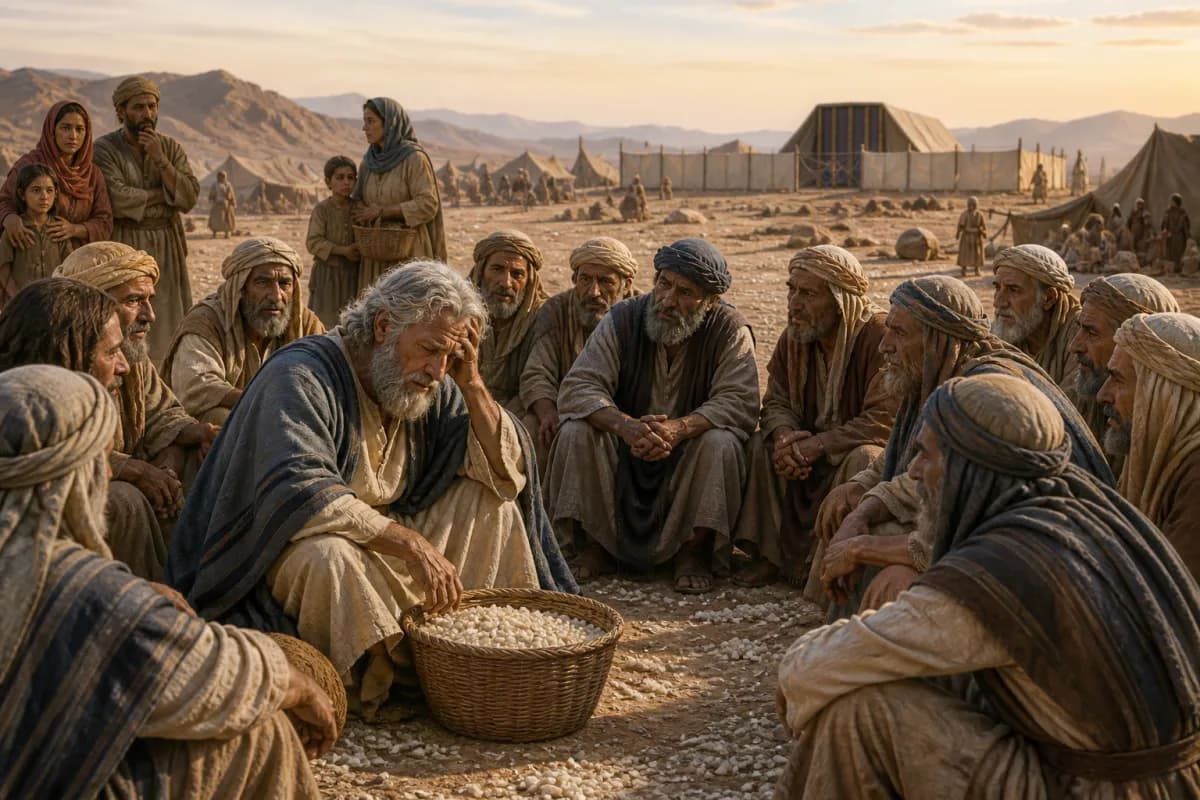
11:4The mixed multitude that was among them lusted exceedingly; and the children of Israel also wept again, and said, “Who will give us meat to eat?
11:5We remember the fish, which we ate in Egypt for nothing; the cucumbers, and the melons, and the leeks, and the onions, and the garlic;
11:6but now we have lost our appetite. There is nothing at all except this manna to look at.”
11:7The manna was like coriander seed, and it looked like bdellium.
11:8The people went around, gathered it, and ground it in mills, or beat it in mortars, and boiled it in pots, and made cakes of it. Its taste was like the taste of fresh oil.
11:9When the dew fell on the camp in the night, the manna fell on it.
11:10Moses heard the people weeping throughout their families, every man at the door of his tent; and the LORD’s anger burned greatly; and Moses was displeased.
11:11Moses said to the LORD, “Why have you treated your servant so badly? Why haven’t I found favor in your sight, that you lay the burden of all this people on me?
11:12Have I conceived all this people? Have I brought them out, that you should tell me, ‘Carry them in your bosom, as a nurse carries a nursing infant, to the land which you swore to their fathers’?
11:13Where could I get meat to give all these people? For they weep before me, saying, ‘Give us meat, that we may eat.’
11:14I am not able to bear all this people alone, because it is too heavy for me.
11:15If you treat me this way, please kill me right now, if I have found favor in your sight; and don’t let me see my wretchedness.”
11:16The LORD said to Moses, “Gather to me seventy men of the elders of Israel, whom you know to be the elders of the people and officers over them; and bring them to the Tent of Meeting, that they may stand there with you.
11:17I will come down and talk with you there. I will take of the Spirit which is on you, and will put it on them; and they shall bear the burden of the people with you, that you don’t bear it yourself alone.
11:18“Say to the people, ‘Sanctify yourselves in preparation for tomorrow, and you will eat meat; for you have wept in the ears of the LORD, saying, “Who will give us meat to eat? For it was well with us in Egypt.” Therefore the LORD will give you meat, and you will eat.
11:19You will not eat just one day, or two days, or five days, or ten days, or twenty days,
11:20but a whole month, until it comes out at your nostrils, and it is loathsome to you; because you have rejected the LORD who is among you, and have wept before him, saying, “Why did we come out of Egypt?”’”
11:21Moses said, “The people, among whom I am, are six hundred thousand men on foot; and you have said, ‘I will give them meat, that they may eat a whole month.’
11:22Shall flocks and herds be slaughtered for them, to be sufficient for them? Shall all the fish of the sea be gathered together for them, to be sufficient for them?”
11:23The LORD said to Moses, “Has the LORD’s hand grown short? Now you will see whether my word will happen to you or not.”
11:24Moses went out, and told the people the LORD’s words; and he gathered seventy men of the elders of the people, and set them around the Tent.
11:25The LORD came down in the cloud, and spoke to him, and took of the Spirit that was on him, and put it on the seventy elders. When the Spirit rested on them, they prophesied, but they did so no more.
11:26But two men remained in the camp. The name of one was Eldad, and the name of the other Medad; and the Spirit rested on them. They were of those who were written, but had not gone out to the Tent; and they prophesied in the camp.
11:27A young man ran, and told Moses, and said, “Eldad and Medad are prophesying in the camp!”
11:28Joshua the son of Nun, the servant of Moses, one of his chosen men, answered, “My lord Moses, forbid them!”
11:29Moses said to him, “Are you jealous for my sake? I wish that all the LORD’s people were prophets, that the LORD would put his Spirit on them!”
11:30Moses went into the camp, he and the elders of Israel.
11:31A wind from the LORD went out and brought quails from the sea, and let them fall by the camp, about a day’s journey on this side, and a day’s journey on the other side, around the camp, and about two cubits above the surface of the earth.
11:32The people rose up all that day, and all of that night, and all the next day, and gathered the quails. He who gathered least gathered ten homers; and they spread them all out for themselves around the camp.
11:33While the meat was still between their teeth, before it was chewed, the LORD’s anger burned against the people, and the LORD struck the people with a very great plague.
11:34The name of that place was called Kibroth Hattaavah, because there they buried the people who lusted.
11:35From Kibroth Hattaavah the people traveled to Hazeroth; and they stayed at Hazeroth.
CONTEXTUAL OVERVIEW
The complaint at Taberah grows into a named craving. Some among Israel begin to desire meat, and the weeping becomes contagious: “Who will give us meat to eat?” Their memory edits Egypt. They list fish, cucumbers, melons, leeks, onions, and garlic, but omit Pharaoh’s forced labor and the death from which God delivered them. Manna, God’s daily gift, now looks contemptible because it does not serve the desire they have chosen to magnify.
The chapter does not condemn food or ordinary enjoyment. God Himself provides quail. The issue is a desire that treats God’s redemption as worthless and demands the old world back. The place name Kibroth-hattaavah, “graves of craving,” fixes the lesson in Israel’s memory: unchecked appetite can become a graveyard for gratitude and faith.
HISTORICAL AND LITERARY CONTEXT
Manna has been Israel’s wilderness food since Exodus 16, given with enough for each day and received as bread from heaven. Numbers 11 pauses to describe its appearance and preparation before reporting that the people find its taste tiresome. The contrast is deliberate. The problem is not that God has failed to feed them, but that a redeemed people no longer value the provision that sustains them.
Moses’ distress forms the other major thread. He feels unable to carry the whole people alone, and the Lord responds by appointing seventy elders to share the burden. Their Spirit-enabled service does not replace Moses’ unique leadership; it displays God’s care for a weary mediator and His intention that the community’s weight be carried with ordered help.
SECTION-BY-SECTION ANALYSIS
- Selective memory · Numbers 11:5Israel remembers Egypt’s menu while forgetting Egypt’s bondage, turning nostalgia into unbelief.
- Seventy elders · Numbers 11:25God meets Moses’ genuine exhaustion with shared, Spirit-enabled service rather than leaving him alone beneath the people’s burden.
- Kibroth-hattaavah · Numbers 11:34The graves of craving declare that desire becomes destructive when it rules above God’s redeeming word.
CHRIST IN THIS PASSAGE
Jesus directly takes up manna’s meaning when He calls Himself the bread of life. He does not merely improve Israel’s wilderness diet; He gives Himself so that those who come to Him will have life. The crowd’s craving shows why material abundance cannot finally heal the human heart. We need reconciliation with God and the life only the Son can give.
Moses’ wish that all God’s people might receive the Spirit also finds a fuller horizon in Christ. The risen Jesus pours out the Spirit on His people, equipping the church for witness and shared service. His mission frees us from slavery to sin and from the empty promise that a returned Egypt—any old bondage dressed as comfort—can satisfy us.
REFLECTION
Pay attention to the stories your desires tell. A job, relationship, purchase, or former season can become an Egypt when memory removes its bondage and imagines it as salvation. God may give good gifts, but none of them can carry the weight of being our life. Gratitude names God’s provision without pretending it is the giver.
Moses also gives permission for honest limits. Bring the burden you cannot carry alone to Jesus, and receive the help He provides through His Spirit and His people. The church is not a place for envy over another person’s usefulness; it is a body in which Christ supplies gifts for shared service and mission.
Original Hebrew Word Study
Numbers 11:4
תַּאֲוָה
taavah · H8378
Usually translated: craving or desire
Taavah is craving. The mixed multitude’s desire becomes contagious because they remember Egypt’s food while forgetting the slavery from which the Lord rescued them.
Follow the Scripture trail
Craving Egypt: Desire That Forgets Redemption in the larger story
The connection: Israel despises God’s daily bread and longs for Egypt’s remembered comforts, but the Lord exposes craving and provides Spirit-enabled help for His people. Jesus gives Himself as the bread of life and pours out the Spirit, freeing His church from slavery to false satisfactions for a life of grateful witness.
Respond to the passage
Ask Jesus to expose one desire that has begun to rule your imagination. Thank Him for His daily care, refuse the false promise of a former bondage, and ask how you can receive or offer Spirit-given help within His people.
- What does Israel’s selective memory of Egypt reveal about craving?
- How does God’s response to Moses differ from His response to the people’s demand?
- Why does Jesus’ claim to be the bread of life address more than material need?
Prayer
Lord Jesus, You are the bread of life. Forgive me for treating Your gifts lightly and longing for false comforts that cannot save. Fill me with gratitude, share my burdens through Your people, and make me useful by Your Spirit for Your saving mission. Amen.