Passage Study
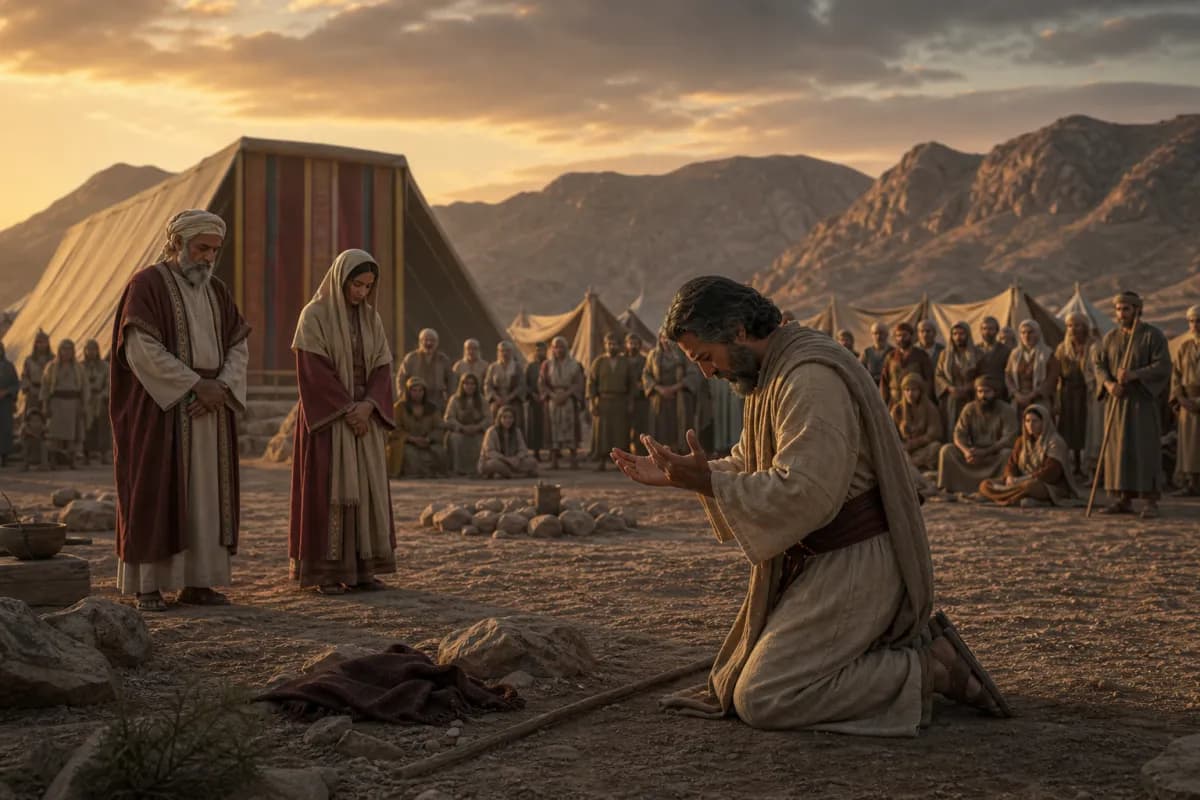
Miriam and Aaron Oppose Moses: God Defends His Servant
Numbers 12:1–12:16
Numbers 12:1–16 confronts Miriam and Aaron’s challenge to Moses’ unique calling. The Lord distinguishes Moses’ face-to-face stewardship from ordinary prophetic visions, strikes Miriam with a skin disease, and restores her after Moses intercedes. Jesus is greater than Moses, the faithful Son over God’s house, and His saving mission creates a humble people who honor God-given service without rivalry.
- In this study
- 16 verses · 5 movements
Numbers 12
12:1Miriam and Aaron spoke against Moses because of the Cushite woman whom he had married; for he had married a Cushite woman.
12:2They said, “Has the LORD indeed spoken only with Moses? Hasn’t he spoken also with us?” And the LORD heard it.
12:3Now the man Moses was very humble, more than all the men who were on the surface of the earth.
12:4The LORD spoke suddenly to Moses, to Aaron, and to Miriam, “You three come out to the Tent of Meeting!” The three of them came out.
12:5The LORD came down in a pillar of cloud, and stood at the door of the Tent, and called Aaron and Miriam; and they both came forward.
12:6He said, “Now hear my words. If there is a prophet among you, I, the LORD, will make myself known to him in a vision. I will speak with him in a dream.
12:7My servant Moses is not so. He is faithful in all my house.
12:8With him, I will speak mouth to mouth, even plainly, and not in riddles; and he shall see the LORD’s form. Why then were you not afraid to speak against my servant, against Moses?”
12:9The LORD’s anger burned against them; and he departed.
12:10The cloud departed from over the Tent; and behold, Miriam was leprous, as white as snow. Aaron looked at Miriam, and behold, she was leprous.
12:11Aaron said to Moses, “Oh, my lord, please don’t count this sin against us, in which we have done foolishly, and in which we have sinned.
12:12Let her not, I pray, be as one dead, of whom the flesh is half consumed when he comes out of his mother’s womb.”
12:13Moses cried to the LORD, saying, “Heal her, God, I beg you!”
12:14The LORD said to Moses, “If her father had but spit in her face, shouldn’t she be ashamed seven days? Let her be shut up outside of the camp seven days, and after that she shall be brought in again.”
12:15Miriam was shut up outside of the camp seven days, and the people didn’t travel until Miriam was brought in again.
12:16Afterward the people traveled from Hazeroth, and encamped in the wilderness of Paran.
CONTEXTUAL OVERVIEW
Miriam and Aaron begin by criticizing Moses’ Cushite wife, but the stated dispute quickly becomes authority: “Has the Lord spoken only through Moses?” Their question contains a true premise—God has spoken through Miriam and Aaron too—but uses it to contest the particular responsibility God has given Moses. The passage refuses both authoritarian self-assertion and envious equality that erases God’s distinct callings.
The Lord’s answer comes at the tent of meeting. He calls Moses uniquely faithful in all His house and speaks with him “mouth to mouth,” not in riddles. Moses does not defend himself in the scene. God Himself addresses the challenge, while the narrator’s description of Moses as very humble guards the reader from mistaking his authority for self-promotion.
HISTORICAL AND LITERARY CONTEXT
Miriam and Aaron are not insignificant figures. Miriam has led Israel’s song after the sea, and Aaron serves as high priest. Their prominence makes the conflict more serious: leaders can use real gifts and real spiritual experience to undermine the service God has assigned another person. The narrative will soon show wider rebellion against Moses and Aaron in Numbers 16.
The phrase about Moses’ Cushite wife raises questions about her identity and chronology. The text does not settle every historical detail, and readers have proposed different connections to Zipporah or another marriage. Its rhetorical role is clear, however: it introduces a criticism that gives way to the deeper challenge over Moses’ authority and God’s mode of revelation through him.
SECTION-BY-SECTION ANALYSIS
- A true claim misused · Numbers 12:2God has spoken through others, but that truth cannot cancel the unique service He assigns to Moses.
- Moses’ humility · Numbers 12:13His authority is received from God and exercised without the self-exaltation that his opponents assume.
- The camp waits · Numbers 12:15Miriam’s restoration matters to the whole people; discipline aims toward a repaired communal life.
CHRIST IN THIS PASSAGE
Numbers establishes Moses as uniquely faithful in God’s house, and Hebrews uses that very language to show Jesus’ greater authority. Moses is a faithful servant within God’s house; Christ is the faithful Son over God’s house. Jesus does not merely relay God’s word as Moses did. He reveals the Father and brings the covenant’s saving purpose to completion through His death and resurrection.
Moses’ prayer for Miriam also points toward the mercy fulfilled in Christ. Jesus intercedes for His people and bears the shame and exclusion sin deserves so that those who repent may be restored. His mission produces leaders and members who do not compete for spiritual status but serve under the authority of the crucified and risen Son.
REFLECTION
Spiritual rivalry often begins with a half-true sentence: “God uses me too.” The answer is not to deny God’s gifts; it is to receive them without making another person’s calling feel like a threat. Ask where comparison has made you suspicious, dismissive, or eager to be noticed.
Moses’ response to Miriam is especially searching. He prays for the person who has opposed him. Jesus calls His people to that same costly mercy. When correction is necessary, seek truth, restoration, and the health of the whole body—not private vindication.
Original Hebrew Word Study
Numbers 12:3
עָנָו
anav · H6035
Usually translated: humble or meek
Anav describes Moses as humble or meek. His authority is not self-assertion; the Lord Himself answers Miriam and Aaron’s challenge and defends His servant.
Follow the Scripture trail
Miriam and Aaron Oppose Moses: God Defends His Servant in the larger story
The connection: God defends Moses’ unique covenant stewardship while showing mercy through his prayer for Miriam’s restoration. Jesus is the faithful Son over God’s house, whose saving death and intercession form a people marked by humility, correction, and restored fellowship.
Respond to the passage
Bring one rivalry or resentment before Jesus. Thank Him for the gifts He has given others, ask for humility in your own calling, and pray for the restoration of someone with whom there is strain.
- What true statement do Miriam and Aaron misuse in their challenge to Moses?
- How do authority and humility belong together in Moses’ role?
- Why does Israel wait for Miriam’s restoration before continuing its journey?
Prayer
Lord Jesus, faithful Son over God’s house, forgive my jealousy and hunger for recognition. Teach me to honor the work You give others, to serve humbly in my own place, and to seek restoration through the mercy You have won for Your people. Amen.