Passage Study
Searching the Land: Seeing Promise Through Faith
Numbers 13:1–13:24
Numbers 13:1–24 sends twelve tribal leaders to explore the land God is giving Israel. Their forty-day journey confirms that the land is fruitful and formidable, but the chapter prepares the decisive question: will Israel treat evidence as a reason to trust God or as a reason to retreat from His promise? Jesus brings His people into a greater inheritance and calls them to follow Him in faith when obedience makes the obstacles visible.
- In this study
- 24 verses · 5 movements
Numbers 13
13:1The LORD spoke to Moses, saying,
13:2“Send men, that they may spy out the land of Canaan, which I give to the children of Israel. Of every tribe of their fathers, you shall send a man, every one a prince among them.”
13:3Moses sent them from the wilderness of Paran according to the commandment of the LORD. All of them were men who were heads of the children of Israel.
13:4These were their names: Of the tribe of Reuben, Shammua the son of Zaccur.
13:5Of the tribe of Simeon, Shaphat the son of Hori.
13:6Of the tribe of Judah, Caleb the son of Jephunneh.
13:7Of the tribe of Issachar, Igal the son of Joseph.
13:8Of the tribe of Ephraim, Hoshea the son of Nun.
13:9Of the tribe of Benjamin, Palti the son of Raphu.
13:10Of the tribe of Zebulun, Gaddiel the son of Sodi.
13:11Of the tribe of Joseph, of the tribe of Manasseh, Gaddi the son of Susi.
13:12Of the tribe of Dan, Ammiel the son of Gemalli.
13:13Of the tribe of Asher, Sethur the son of Michael.
13:14Of the tribe of Naphtali, Nahbi the son of Vophsi.
13:15Of the tribe of Gad, Geuel the son of Machi.
13:16These are the names of the men who Moses sent to spy out the land. Moses called Hoshea the son of Nun Joshua.
13:17Moses sent them to spy out the land of Canaan, and said to them, “Go up this way by the South, and go up into the hill country.
13:18See the land, what it is; and the people who dwell therein, whether they are strong or weak, whether they are few or many;
13:19and what the land is that they dwell in, whether it is good or bad; and what cities they are that they dwell in, whether in camps, or in strongholds;
13:20and what the land is, whether it is fertile or poor, whether there is wood therein, or not. Be courageous, and bring some of the fruit of the land.” Now the time was the time of the first-ripe grapes.
13:21So they went up, and spied out the land from the wilderness of Zin to Rehob, to the entrance of Hamath.
13:22They went up by the South, and came to Hebron; and Ahiman, Sheshai, and Talmai, the children of Anak, were there. (Now Hebron was built seven years before Zoan in Egypt.)
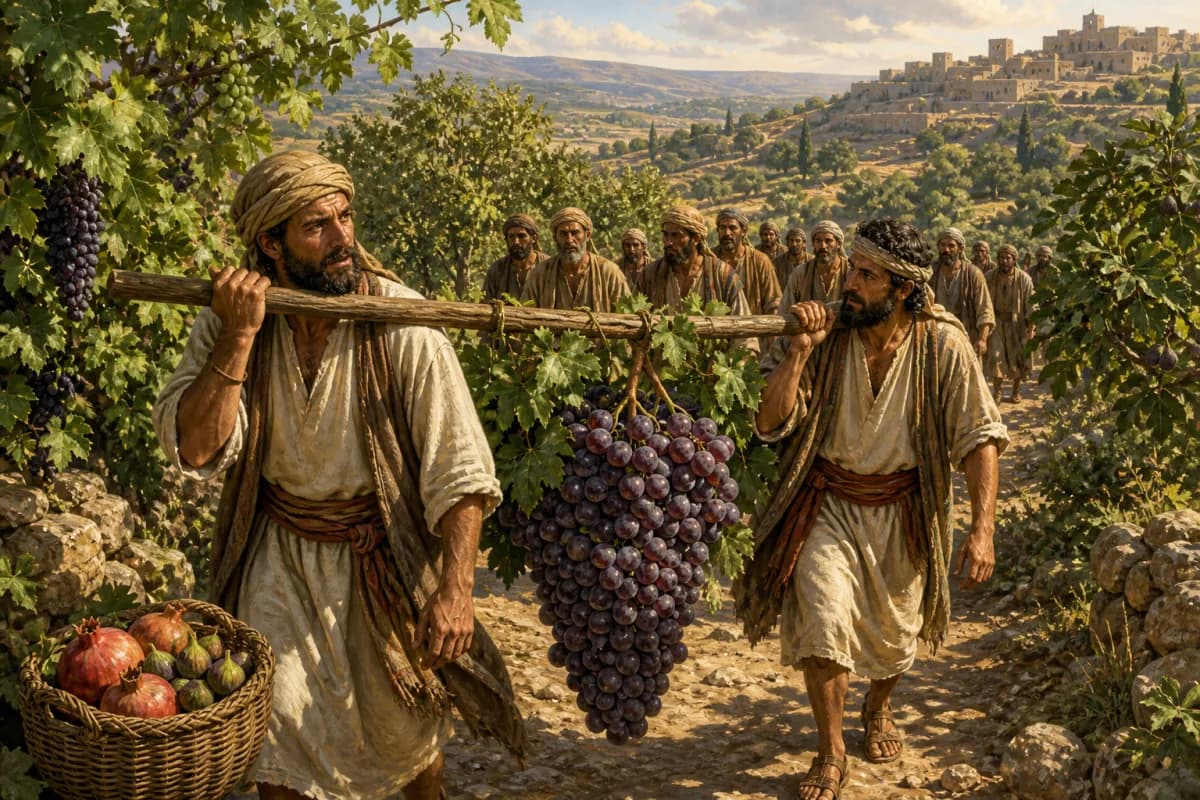
13:23They came to the valley of Eshcol, and cut down from there a branch with one cluster of grapes, and they bore it on a staff between two. They also brought some of the pomegranates and figs.
13:24That place was called the valley of Eshcol, because of the cluster which the children of Israel cut down from there.
CONTEXTUAL OVERVIEW
At the edge of Canaan, the Lord commands Moses to send representatives to explore “the land of Canaan, which I am giving to the Israelites.” That opening clause governs the mission. The scouts are not asked to decide whether God can provide the land; they are sent to see the gift they are about to receive and to gather practical knowledge for faithful obedience.
The twelve are not anonymous volunteers. They are leaders from every tribe, named one by one. Their report will carry public weight because they represent the whole people. The chapter therefore prepares for more than a military briefing. It tests whether trusted leadership will help Israel interpret a real and difficult world through God’s promise.
HISTORICAL AND LITERARY CONTEXT
Numbers 13 follows the journey from Sinai and the failures of Numbers 11–12. Israel has reached the wilderness of Paran, near the land promised to Abraham’s descendants. The scouting task includes terrain, population, fortified cities, agricultural yield, and wood. The text takes practical observation seriously; faith is not asked to deny geography, harvests, or opposition.
The route reaches Hebron, associated elsewhere with the patriarchal promise and with a Canaanite population described by ancestral names. The note that Hebron was built seven years before Zoan in Egypt is difficult to interpret with precision, but its narrative effect is to locate the scouts in an old, settled, impressive land. Israel is not entering an empty landscape; it must trust God amid visible strength and complexity.
Did you know?
A late Roman clay lamp from Carthage depicts the spies carrying the grapes of Eshcol, with an impressed bunch of grapes below them.
Why it matters: This later reception artifact does not verify the wilderness event or reconstruct Canaanite agriculture, but it shows how the passage's striking image of the scouts' fruit was made visually memorable in Christian art centuries later.
SECTION-BY-SECTION ANALYSIS
- “Which I am giving” · Numbers 13:2God’s promise comes before the reconnaissance and tells Israel how to understand what it sees.
- Twelve leaders · Numbers 13:20Representative leadership makes the report a communal spiritual responsibility, not a private adventure.
- The fruit of Eshcol · Numbers 13:23The heavy cluster becomes visible evidence of the land’s abundance and therefore of God’s trustworthy gift.
CHRIST IN THIS PASSAGE
Joshua’s name and later role are not a direct prediction of Jesus in this paragraph, but they belong to a larger biblical pattern. The Greek form of Joshua’s name is Jesus, and Joshua will eventually lead Israel into the land after Moses dies. Hebrews then declares that the deeper rest still remained, directing believers to Jesus as the one who brings God’s saving purpose to its final goal.
Christ’s mission does not ask disciples to pretend there are no fortified cities, costly decisions, or hostile powers. He conquers sin and death through His cross and resurrection, then leads His people in obedient faith toward the inheritance He has secured. The gospel gives courage rooted in the Savior’s finished work rather than confidence in our own strength.
REFLECTION
Faithful planning is not unbelief. Moses asks careful questions about the land because God’s promise does not erase wise attention to reality. The issue arrives when facts are allowed to become final, pushing God’s word to the edge of the frame. Christian discernment sees both the grapes and the fortified cities, then obeys the Lord who has spoken.
When a next act of obedience looks larger than your resources, bring the facts honestly to Jesus. Seek wise counsel, count the cost, and remember the promise that He is with His people. His saving mission sends ordinary believers into difficult places with a confidence no obstacle can manufacture.
Original Hebrew Word Study
Numbers 13:2
תּוּר
tur · H8446
Usually translated: to explore, spy out, or search
Tur means to explore. The reconnaissance is meant to help Israel receive the land God gives, not to replace trust in His promise with fear-driven calculation.
Follow the Scripture trail
Searching the Land: Seeing Promise Through Faith in the larger story
The connection: The scouts bring back proof that the promised land is fruitful, while the coming report will reveal the crisis of believing God in the face of visible resistance. Jesus leads His people toward the lasting inheritance of God’s kingdom, giving courage for obedience through His victory over sin and death.
Respond to the passage
Write down the “grapes” and the “fortified cities” in one area of obedience: the evidences of God’s goodness and the real obstacles. Bring both to Jesus, then take one wise, faithful step under His word.
- Why does the Lord’s promise come before Moses’ practical questions about the land?
- What does the fruit of Eshcol prove, and what does it not yet settle?
- How can careful planning serve faith rather than replace it?
Prayer
Lord Jesus, You have gone before Your people and secured the inheritance we cannot earn. Help me to see reality clearly without allowing fear to outrank Your word. Give me wisdom for the next step and courage to follow Your saving mission. Amen.