Passage Study
Offerings for a Future They Will Not See: Hope After Judgment
Numbers 15:1–15:31
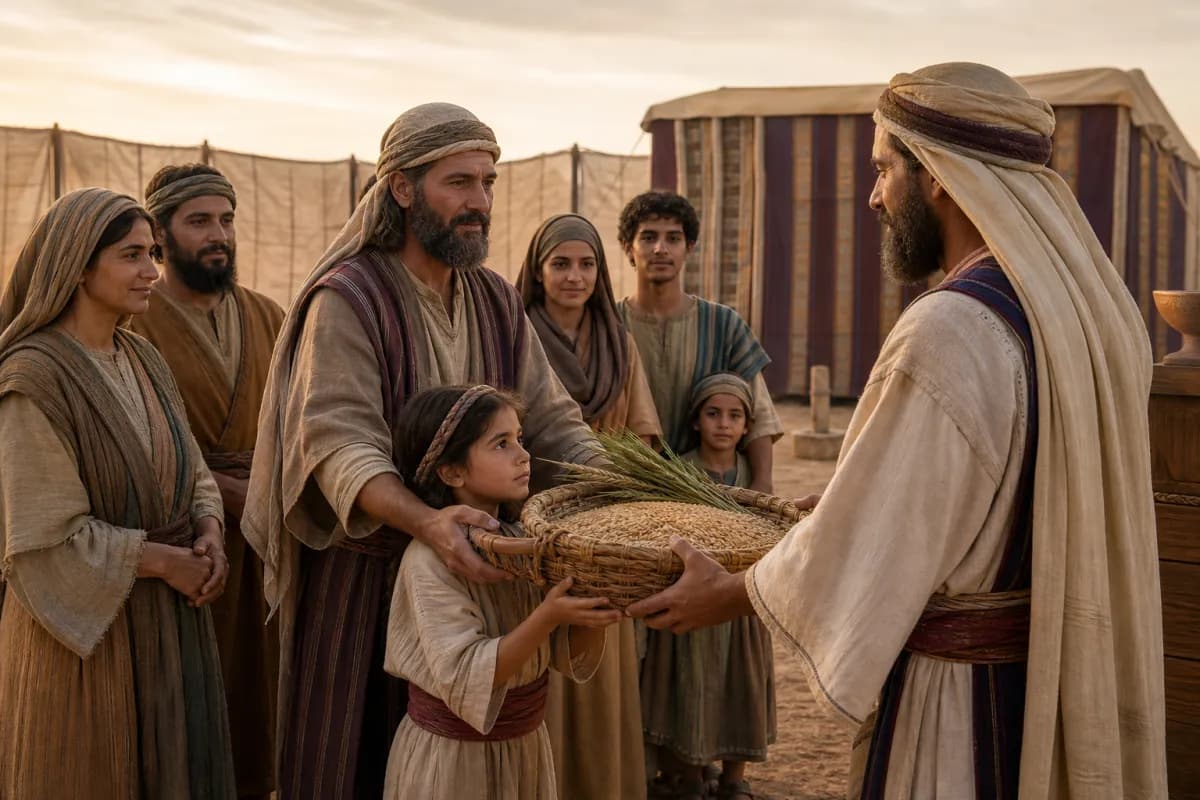
Numbers 15:1–31 gives sacrifice instructions immediately after the judgment at Kadesh, repeatedly speaking of “the land” Israel will enter. It provides offerings for worship, one law for native and resident alien, firstfruits, and a distinction between unintentional sin and defiant rejection. Jesus fulfills the sacrificial hope by bringing sinners near to God and gathering one people from every nation through His saving mission.
- In this study
- 31 verses · 5 movements
Numbers 15
15:1The LORD spoke to Moses, saying,
15:2“Speak to the children of Israel, and tell them, ‘When you have come into the land of your habitations, which I give to you,
15:3and will make an offering by fire to the LORD—a burnt offering, or a sacrifice, to accomplish a vow, or as a free will offering, or in your set feasts, to make a pleasant aroma to the LORD, of the herd, or of the flock—
15:4then he who offers his offering shall offer to the LORD a meal offering of one tenth of an ephah of fine flour mixed with one fourth of a hin of oil.
15:5You shall prepare wine for the drink offering, one fourth of a hin, with the burnt offering or for the sacrifice, for each lamb.
15:6“‘For a ram, you shall prepare for a meal offering two tenths of an ephah of fine flour mixed with the third part of a hin of oil;
15:7and for the drink offering you shall offer the third part of a hin of wine, of a pleasant aroma to the LORD.
15:8When you prepare a bull for a burnt offering or for a sacrifice, to accomplish a vow, or for peace offerings to the LORD,
15:9then he shall offer with the bull a meal offering of three tenths of an ephah of fine flour mixed with half a hin of oil;
15:10and you shall offer for the drink offering half a hin of wine, for an offering made by fire, of a pleasant aroma to the LORD.
15:11Thus it shall be done for each bull, for each ram, for each of the male lambs, or of the young goats.
15:12According to the number that you shall prepare, so you shall do to everyone according to their number.
15:13“‘All who are native-born shall do these things in this way, in offering an offering made by fire, of a pleasant aroma to the LORD.
15:14If a stranger lives as a foreigner with you, or whoever may be among you throughout your generations, and will offer an offering made by fire, of a pleasant aroma to the LORD, as you do, so he shall do.
15:15For the assembly, there shall be one statute for you and for the stranger who lives as a foreigner, a statute forever throughout your generations. As you are, so the foreigner shall be before the LORD.
15:16One law and one ordinance shall be for you and for the stranger who lives as a foreigner with you.’”
15:17The LORD spoke to Moses, saying,
15:18“Speak to the children of Israel, and tell them, ‘When you come into the land where I bring you,
15:19then it shall be that when you eat of the bread of the land, you shall offer up a wave offering to the LORD.
15:20Of the first of your dough you shall offer up a cake for a wave offering. As the wave offering of the threshing floor, so you shall heave it.
15:21Of the first of your dough, you shall give to the LORD a wave offering throughout your generations.
15:22“‘When you err, and don’t observe all these commandments which the LORD has spoken to Moses—
15:23even all that the LORD has commanded you by Moses, from the day that the LORD gave commandment and onward throughout your generations—
15:24then it shall be, if it was done unwittingly, without the knowledge of the congregation, that all the congregation shall offer one young bull for a burnt offering, for a pleasant aroma to the LORD, with its meal offering and its drink offering, according to the ordinance, and one male goat for a sin offering.
15:25The priest shall make atonement for all the congregation of the children of Israel, and they shall be forgiven; for it was an error, and they have brought their offering, an offering made by fire to the LORD, and their sin offering before the LORD, for their error.
15:26All the congregation of the children of Israel shall be forgiven, as well as the stranger who lives as a foreigner among them; for with regard to all the people, it was done unwittingly.
15:27“‘If a person sins unwittingly, then he shall offer a female goat a year old for a sin offering.
15:28The priest shall make atonement for the soul who errs when he sins unwittingly before the LORD. He shall make atonement for him; and he shall be forgiven.
15:29You shall have one law for him who does anything unwittingly, for him who is native-born among the children of Israel, and for the stranger who lives as a foreigner among them.
15:30“‘But the soul who does anything with a high hand, whether he is native-born or a foreigner, blasphemes the LORD. That soul shall be cut off from among his people.
15:31Because he has despised the LORD’s word, and has broken his commandment, that soul shall be utterly cut off. His iniquity shall be on him.’”
CONTEXTUAL OVERVIEW
After the sentence that the adult wilderness generation will not enter Canaan, Numbers 15 begins with a surprising phrase of hope: “When you come into the land that you are to inhabit.” The immediate hearers will largely die in the wilderness, but God still speaks of worship in vineyards, fields, and homes their children will receive. Judgment has not canceled the covenant promise.
The chapter’s detailed offerings can feel distant, yet their placement is pastoral. Israel is not left only with the memory of failure. The Lord gives a future pattern for drawing near, giving thanks, and dealing with sin in the land. Grace carries the story beyond one faithless generation.
HISTORICAL AND LITERARY CONTEXT
The legislation develops Leviticus’s sacrificial world in the context of settlement. Grain and drink offerings accompany animal sacrifices, connecting worship to the produce and wine of the promised land. The provisions assume a people whose life, labor, and food are gifts received from the Lord rather than possessions detached from Him.
The phrase “one law” for the native and the resident alien is especially important. The resident alien who lives among Israel and participates in worship is not held under a lesser standard or excluded from the Lord’s provision. The covenant community is ordered around the Lord’s holiness and mercy, not ethnic privilege alone.
SECTION-BY-SECTION ANALYSIS
- When you come into the land · Numbers 15:18God’s promise outlives the faithless generation and gives the next generation a worshipful future.
- One law · Numbers 15:29The resident alien stands alongside Israel in accountable worship before the one holy Lord.
- Firstfruits of dough · Numbers 15:20Daily bread becomes an occasion to confess that the land’s abundance is received from God.
CHRIST IN THIS PASSAGE
The offerings of Numbers teach that sinners need God’s appointed provision to draw near, but they do not claim to be the final removal of sin. Hebrews presents Jesus’ self-offering as the once-for-all sacrifice that accomplishes what repeated sacrifices could not complete. In Him, forgiveness and access to God are secured by His grace rather than by a person’s ability to construct a worthy approach.
The single law for native and resident alien also anticipates the gospel’s wider reach without erasing the passage’s Israelite setting. Through Jesus, Gentiles who were far off are brought near, and the church becomes one reconciled people. His mission gathers the nations into holy worship centered on His saving death and resurrection.
REFLECTION
God’s promise continuing after Kadesh is good news for people who know they have failed. The future belongs neither to despair nor to denial. The Lord disciplines His people, yet He remains faithful to His purposes and provides a way for them to live before Him.
Receive ordinary provision with worship. Thank Jesus for daily bread, work, and shelter, and ask whether gratitude has become routine or has gone missing. His grace also invites honest confession: do not hide sin behind religious activity, but come to the Savior who brings you near to the Father.
Original Hebrew Word Study
Numbers 15:3
רֵיחַ
reach · H7381
Usually translated: pleasing aroma
Reach is an aroma. The sacrifices are called a pleasing aroma because worship is received by the Lord according to the provision He has given.
Follow the Scripture trail
Offerings for a Future They Will Not See: Hope After Judgment in the larger story
The connection: After Kadesh, God speaks of a land and a worshiping people still to come, proving that His covenant purpose is not exhausted by Israel’s failure. Jesus fulfills the sacrificial hope and gathers people from every nation into forgiven, grateful worship through His saving work.
Respond to the passage
Thank Jesus for one ordinary provision you have received today, and let that gratitude become worship. If you are carrying unconfessed sin, stop treating it as manageable; come to Christ honestly, trusting His sacrifice and asking for a heart that obeys His word.
- Why does Numbers speak about life in the land immediately after the Kadesh judgment?
- What does the one-law principle reveal about worship and belonging in Israel?
- How does Christ’s final sacrifice change the way Christians receive both forgiveness and daily provision?
Prayer
Father, thank You that Your faithfulness is greater than my failure. Thank You for Jesus, whose sacrifice brings me near and whose grace gathers a people from every nation. Make me grateful for Your gifts, honest about sin, and eager to live in the worship You deserve. Amen.