Passage Study
The Man Gathering Sticks: Holiness in a Covenant Sign
Numbers 15:32–15:36
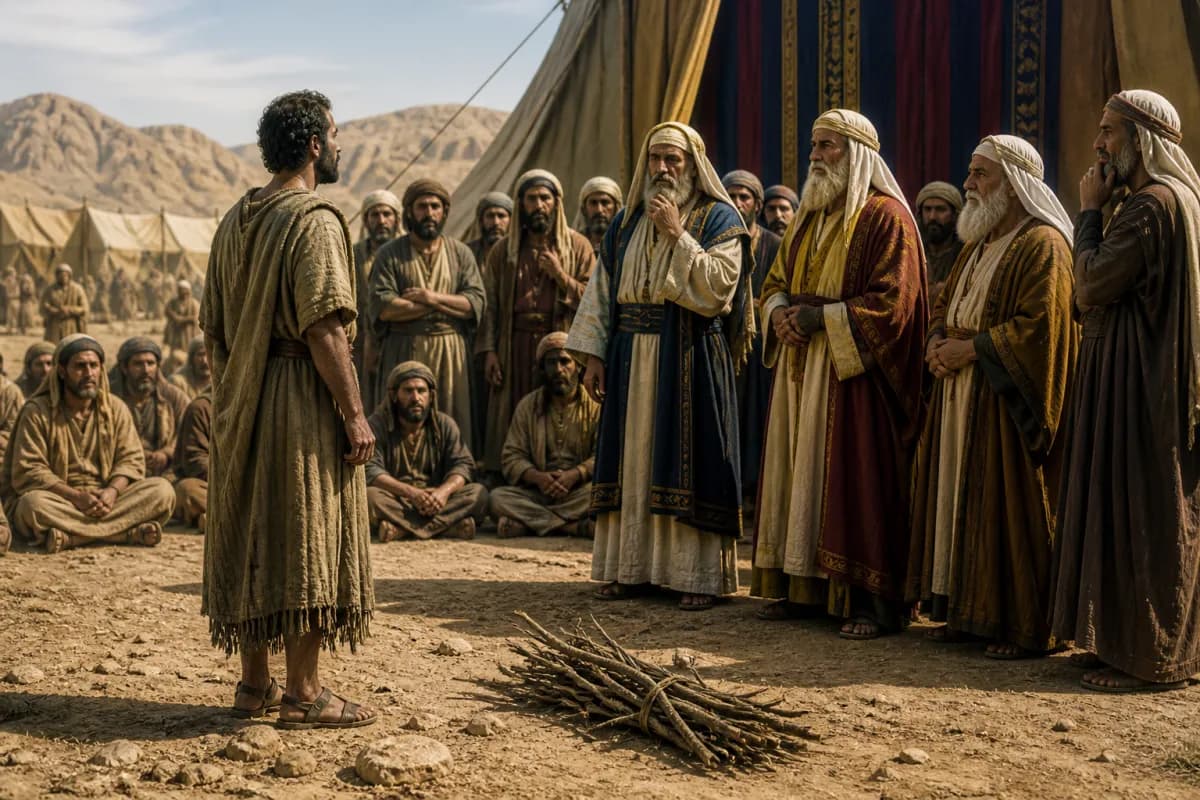
Numbers 15:32–36 records a man gathering sticks on the Sabbath, Israel holding him in custody while seeking the Lord’s direction, and his execution outside the camp. The brief account shows that Sabbath was a covenant sign whose public defiance could not be treated as trivial. Jesus is Lord of the Sabbath and gives His people the deeper rest of reconciliation with God, calling them to receive grace with reverent obedience.
- In this study
- 5 verses · 5 movements
Numbers 15
15:32While the children of Israel were in the wilderness, they found a man gathering sticks on the Sabbath day.
15:33Those who found him gathering sticks brought him to Moses and Aaron, and to all the congregation.
15:34They put him in custody, because it had not been declared what should be done to him.
15:35The LORD said to Moses, “The man shall surely be put to death. All the congregation shall stone him with stones outside of the camp.”
15:36All the congregation brought him outside of the camp, and stoned him to death with stones, as the LORD commanded Moses.
CONTEXTUAL OVERVIEW
The account is short and unsettling by design. Israel has just heard about unintentional sin and high-handed defiance; then the narrative places a concrete Sabbath violation before the congregation. The man is found gathering sticks, an ordinary task on an ordinary-looking day, but the day itself belongs to the Lord as a covenant sign.
Moses, Aaron, and the congregation do not improvise. They hold the man in custody because the required response has not been made clear to them. Their waiting matters: the community is not authorized to turn divine law into private vengeance. The Lord gives the judgment, and it is carried out outside the camp.
HISTORICAL AND LITERARY CONTEXT
Sabbath stands near the center of Israel’s covenant identity. In Exodus it remembers both God’s creation rest and Israel’s deliverance from Egypt, where Pharaoh denied slaves rest. It is therefore more than a weekly break. It is a public confession that Israel belongs to the Creator and Redeemer rather than to endless self-provision.
This incident belongs to Israel’s wilderness theocracy and must be read within its covenant setting. The church is not ancient Israel’s civil authority, and this text does not authorize Christians to punish Sabbath failures by violence. Its enduring witness concerns the holiness of God, the seriousness of covenant signs, and the danger of treating God’s word as negotiable.
SECTION-BY-SECTION ANALYSIS
- Gathering sticks · Numbers 15:32The seemingly small task is significant because it publicly violates the day God set apart as a covenant sign.
- They held him in custody · Numbers 15:34Israel waits for the Lord’s instruction instead of creating a punishment from its own anger.
- Outside the camp · Numbers 15:35The location underscores the seriousness of exclusion from the community ordered around God’s holy presence.
CHRIST IN THIS PASSAGE
Jesus does not dismiss the Sabbath’s God-given purpose. He identifies Himself as Lord of the Sabbath and confronts traditions that turned a gift of mercy into a burden. His healings on the Sabbath show that God’s rest is ordered toward life, restoration, and the good of those He has made.
Jesus also bears exclusion outside the city in order to bring sinners near to God. That does not make the man gathering sticks a direct prediction of the cross, but it clarifies the gospel’s answer to the alienation sin deserves. Christ gives the rest that remains for God’s people: reconciliation with the Father and a life of reverent trust under His gracious rule.
REFLECTION
This passage warns against choosing which commands of God are important enough to obey. We may not face Israel’s Sabbath law in the same covenant form, but the impulse to make our own convenience final is familiar. Holiness means receiving God’s authority as good, especially where His word confronts our habits and assumptions.
Come to Jesus for rest, not as an excuse to ignore Him but as the place where weary sinners are restored to the God they have resisted. Let regular worship, rest, and attention to Scripture retrain your life around His grace. His mission sends a rested, reconciled people to show the world that He is a merciful King.
Original Hebrew Word Study
Numbers 15:32
שַׁבָּת
shabbat · H7676
Usually translated: Sabbath
Shabbat names the day of covenant rest. The public violation shows that Sabbath is a sign of belonging to the Lord, not a suggestion to be reshaped at will.
Follow the Scripture trail
The Man Gathering Sticks: Holiness in a Covenant Sign in the larger story
The connection: The Sabbath violation reveals how seriously Israel’s covenant life was meant to reflect the holiness of the God who redeemed it. Jesus, Lord of the Sabbath, bears sin’s exclusion and brings His people into reconciled rest, forming them for reverent worship and His merciful mission.
Respond to the passage
Ask Jesus where convenience has quietly become your authority. Receive His mercy, then choose one concrete rhythm of worship, rest, or obedience that declares your time and life belong to Him.
- Why does the narrative emphasize that Israel waited for the Lord’s direction before acting?
- How does the Sabbath function as a covenant sign rather than merely a practical day off?
- What does Jesus being Lord of the Sabbath reveal about the kind of rest He gives?
Prayer
Lord Jesus, You are Lord of my days and the giver of true rest. Forgive me for treating Your authority as optional when it inconveniences me. Bring me near by Your grace, shape my life around worship and trust, and send me as a witness to Your restoring mercy. Amen.