Passage Study
Tassels for Remembering: A Visible Call to Covenant Faithfulness
Numbers 15:37–15:41
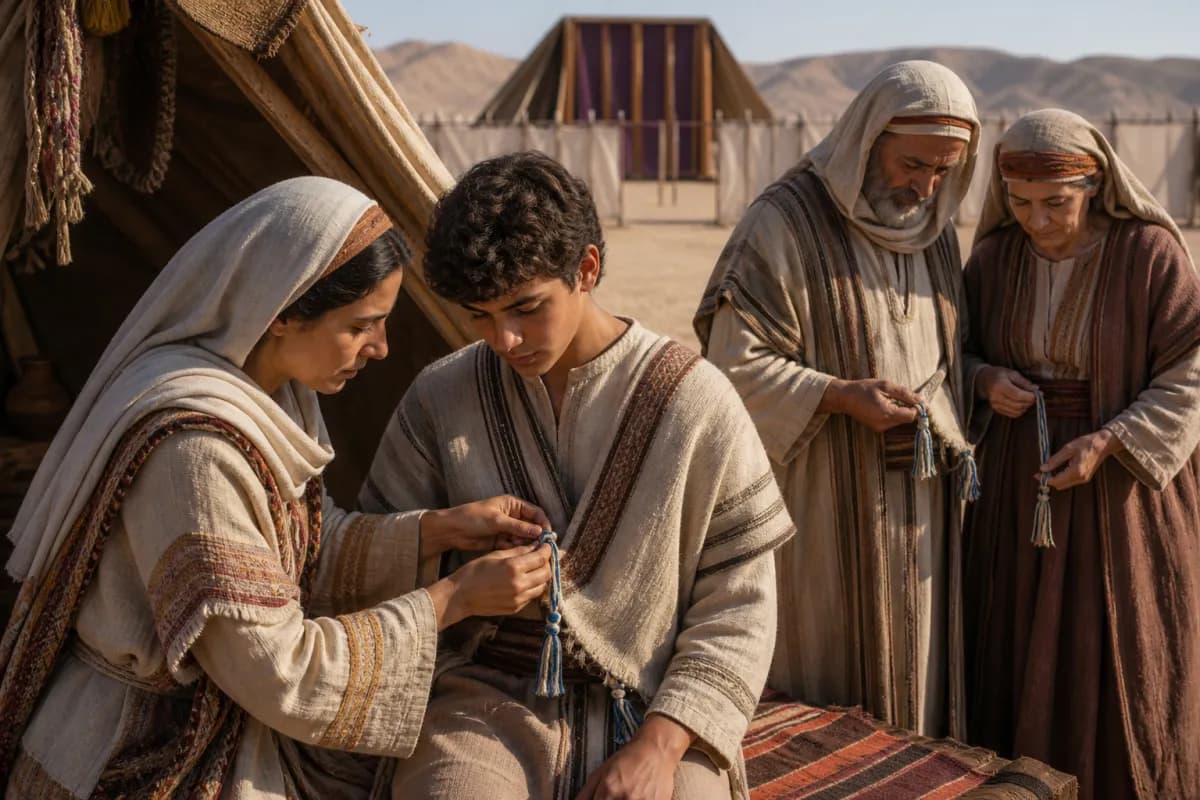
Numbers 15:37–41 gives Israel tassels with a blue cord so that seeing them will call God’s commands to mind and keep the people from following the desires of their own hearts and eyes. The outward sign cannot save them, but it trains a redeemed people to remember the Lord who brought them out of Egypt. Jesus brings His people into the new covenant and forms obedience from hearts made new by His saving grace.
- In this study
- 5 verses · 5 movements
Numbers 15
15:37The LORD spoke to Moses, saying,
15:38“Speak to the children of Israel, and tell them that they should make themselves fringes on the borders of their garments throughout their generations, and that they put on the fringe of each border a cord of blue.
15:39It shall be to you for a fringe, that you may see it, and remember all the LORD’s commandments, and do them; and that you don’t follow your own heart and your own eyes, after which you used to play the prostitute;
15:40so that you may remember and do all my commandments, and be holy to your God.
15:41I am the LORD your God, who brought you out of the land of Egypt, to be your God: I am the LORD your God.”
CONTEXTUAL OVERVIEW
This brief command follows instructions about sacrifice, unintentional sin, and defiant rebellion. Israel needs more than a remedy after forgetting God’s word; it needs a practiced way of remembering it before desire carries the heart elsewhere. Tassels on the garment’s corners make ordinary clothing serve covenant memory.
The blue cord is not presented as a charm. The Lord explains its purpose: Israel is to look at it, remember all His commandments, and do them. The immediate danger is described as following one’s own heart and eyes. In this setting, heart and eyes are not reliable guides to holiness when they are detached from the Lord’s revealed word.
HISTORICAL AND LITERARY CONTEXT
Numbers places this command in the wilderness, after a generation has refused the promised land. The people’s recent failure shows how easily sight can be misread: ten scouts saw real enemies but did not remember God’s promise. The tassels redirect sight itself, making what Israel sees each day point back to the Lord’s redemption and command.
The closing words repeat the exodus formula: “I am the Lord your God, who brought you out of the land of Egypt.” Obedience is therefore a response to rescue, not a method of earning it. Israel belongs to the Lord because He has acted first, and that belonging is to take visible shape in a holy life.
SECTION-BY-SECTION ANALYSIS
- Look and remember · Numbers 15:40A repeated visual cue turns ordinary dress into a summons to recall God’s word.
- Heart and eyes · Numbers 15:39The passage warns against desire becoming its own authority and leading Israel into unfaithfulness.
- Brought out of Egypt · Numbers 15:41The exodus is the foundation for holiness: God’s rescue creates a people who belong to Him.
CHRIST IN THIS PASSAGE
The tassels do not directly predict Jesus, but their purpose exposes a need His new-covenant work addresses: God’s people require more than visible reminders because hearts wander. Jeremiah promises a covenant in which God writes His law on the heart, and Jesus establishes that covenant through His blood, forgiving sin and creating a people who know God.
The Gospels mention the fringe of Jesus’ garment when suffering people reach toward Him in faith. That narrative does not turn Numbers 15 into a prediction of healing through fabric; it shows the Messiah’s compassionate power meeting the unclean and desperate. His saving mission gathers people to Himself and sends them to obey from gratitude, love, and the Spirit’s renewing work.
REFLECTION
We too need practices that interrupt forgetfulness. Scripture at the table, a prayer before a difficult conversation, a trusted reminder on a phone, or regular worship can direct attention back to the God whose grace has claimed us. Such practices do not replace faith; they serve faith by helping us remember what is true when desire is loud.
Ask Jesus where you have treated your own impulse as final authority. Receive His mercy, put a concrete gospel-shaped reminder in your daily path, and let that reminder lead to a specific act of obedience and witness rather than to mere religious display.
Original Hebrew Word Study
Numbers 15:38
צִיצִת
tsitsit · H6734
Usually translated: tassel or fringe
Tsitsit is a tassel. The fringes make God’s commands visible so that Israel remembers to obey rather than following the desires of heart and eyes.
Follow the Scripture trail
Tassels for Remembering: A Visible Call to Covenant Faithfulness in the larger story
The connection: The tassels teach redeemed Israel to remember the God who brought it out of Egypt and to resist the wandering of heart and eyes. Jesus inaugurates the new covenant, forgives His people, and renews them from within for holy lives that display His saving mission.
Respond to the passage
Choose one daily cue that will help you remember Christ’s rescue and one command of His to practice this week. Ask Him to turn the reminder into grateful obedience rather than empty routine.
- Why does the passage connect looking, remembering, and doing?
- What does the warning about heart and eyes reveal about the source of idolatry?
- How does the new covenant deepen the purpose for which Israel’s tassels were given?
Prayer
Lord Jesus, my heart forgets Your mercy and follows desires that cannot give life. Thank You for bringing me near through Your blood. Write Your word deeply within me, and make my ordinary life a faithful witness to Your saving grace. Amen.