Passage Study
Korah’s Revolt: Holiness Used Against God’s Calling
Numbers 16:1–16:40
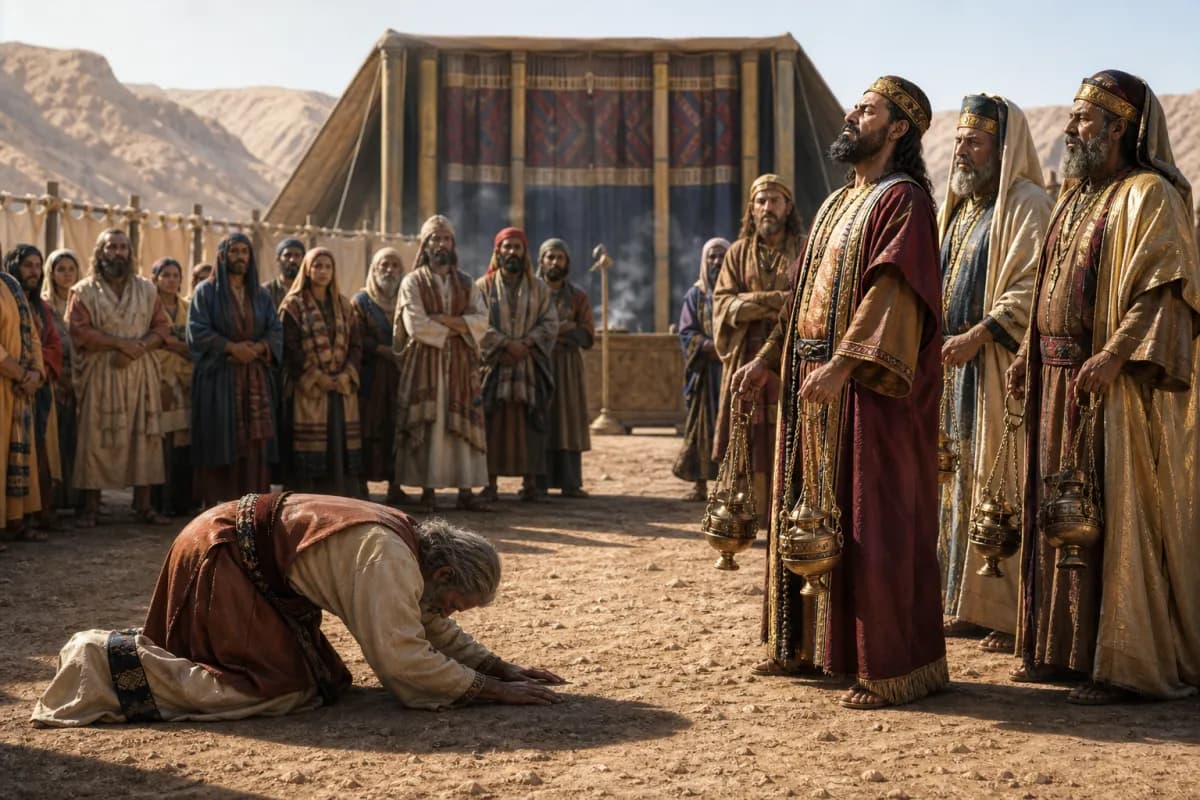
Numbers 16:1–40 records Korah, Dathan, Abiram, and two hundred fifty leaders challenging Moses and Aaron. Their claim that all Israel is holy misuses a true covenant privilege to reject the ministries God has assigned. The Lord vindicates His chosen servants with severe judgment. Jesus is the final priest and humble King who brings His people near to God without turning spiritual gifts into rivalry or self-exaltation.
- In this study
- 40 verses · 5 movements
Numbers 16
16:1Now Korah, the son of Izhar, the son of Kohath, the son of Levi, with Dathan and Abiram, the sons of Eliab, and On, the son of Peleth, sons of Reuben, took some men.
16:2They rose up before Moses, with some of the children of Israel, two hundred fifty princes of the congregation, called to the assembly, men of renown.
16:3They assembled themselves together against Moses and against Aaron, and said to them, “You take too much on yourself, since all the congregation are holy, everyone of them, and the LORD is among them! Why do you lift yourselves up above the LORD’s assembly?”
16:4When Moses heard it, he fell on his face.
16:5He said to Korah and to all his company, “In the morning, the LORD will show who are his, and who is holy, and will cause him to come near to him. Even him whom he shall choose, he will cause to come near to him.
16:6Do this: have Korah and all his company take censers,
16:7put fire in them, and put incense on them before the LORD tomorrow. It shall be that the man whom the LORD chooses, he shall be holy. You have gone too far, you sons of Levi!”
16:8Moses said to Korah, “Hear now, you sons of Levi!
16:9Is it a small thing to you that the God of Israel has separated you from the congregation of Israel, to bring you near to himself, to do the service of the LORD’s tabernacle, and to stand before the congregation to minister to them;
16:10and that he has brought you near, and all your brothers the sons of Levi with you? Do you seek the priesthood also?
16:11Therefore you and all your company have gathered together against the LORD! What is Aaron that you complain against him?”
16:12Moses sent to call Dathan and Abiram, the sons of Eliab; and they said, “We won’t come up!
16:13Is it a small thing that you have brought us up out of a land flowing with milk and honey, to kill us in the wilderness, but you must also make yourself a prince over us?
16:14Moreover you haven’t brought us into a land flowing with milk and honey, nor given us inheritance of fields and vineyards. Will you put out the eyes of these men? We won’t come up.”
16:15Moses was very angry, and said to the LORD, “Don’t respect their offering. I have not taken one donkey from them, neither have I hurt one of them.”
16:16Moses said to Korah, “You and all your company go before the LORD, you, and they, and Aaron, tomorrow.
16:17Each man take his censer and put incense on it, and each man bring before the LORD his censer, two hundred fifty censers; you also, and Aaron, each with his censer.”
16:18They each took his censer, and put fire in it, and laid incense on it, and stood at the door of the Tent of Meeting with Moses and Aaron.
16:19Korah assembled all the congregation opposite them to the door of the Tent of Meeting. The LORD’s glory appeared to all the congregation.
16:20The LORD spoke to Moses and to Aaron, saying,
16:21“Separate yourselves from among this congregation, that I may consume them in a moment!”
16:22They fell on their faces, and said, “God, the God of the spirits of all flesh, shall one man sin, and will you be angry with all the congregation?”
16:23The LORD spoke to Moses, saying,
16:24“Speak to the congregation, saying, ‘Get away from around the tent of Korah, Dathan, and Abiram!’”
16:25Moses rose up and went to Dathan and Abiram; and the elders of Israel followed him.
16:26He spoke to the congregation, saying, “Depart, please, from the tents of these wicked men, and touch nothing of theirs, lest you be consumed in all their sins!”
16:27So they went away from the tent of Korah, Dathan, and Abiram, on every side. Dathan and Abiram came out, and stood at the door of their tents with their wives, their sons, and their little ones.
16:28Moses said, “Hereby you shall know that the LORD has sent me to do all these works; for they are not from my own mind.
16:29If these men die the common death of all men, or if they experience what all men experience, then the LORD hasn’t sent me.
16:30But if the LORD makes a new thing, and the ground opens its mouth, and swallows them up with all that belong to them, and they go down alive into Sheol, then you shall understand that these men have despised the LORD.”
16:31As he finished speaking all these words, the ground that was under them split apart.
16:32The earth opened its mouth and swallowed them up with their households, all of Korah’s men, and all their goods.
16:33So they, and all that belonged to them went down alive into Sheol. The earth closed on them, and they perished from among the assembly.
16:34All Israel that were around them fled at their cry; for they said, “Lest the earth swallow us up!”
16:35Fire came out from the LORD, and devoured the two hundred fifty men who offered the incense.
16:36The LORD spoke to Moses, saying,
16:37“Speak to Eleazar the son of Aaron the priest, that he take up the censers out of the burning, and scatter the fire away from the camp; for they are holy,
16:38even the censers of those who sinned against their own lives. Let them be beaten into plates for a covering of the altar, for they offered them before the LORD. Therefore they are holy. They shall be a sign to the children of Israel.”
16:39Eleazar the priest took the bronze censers which those who were burned had offered; and they beat them out for a covering of the altar,
16:40to be a memorial to the children of Israel, to the end that no stranger who isn’t of the offspring of Aaron, would come near to burn incense before the LORD, that he not be as Korah and as his company; as the LORD spoke to him by Moses.
CONTEXTUAL OVERVIEW
Korah’s revolt follows Israel’s refusal at Kadesh and the command about tassels. The rebellion does not arise from outsiders who know nothing of God. Korah is a Levite, and the assembly leaders are named, recognized men. Their complaint sounds principled: the whole congregation is holy and the Lord is among them. Yet they use that truth to reject God’s ordering of service and to accuse Moses and Aaron of self-exaltation.
Moses falls facedown, the posture he has used in intercession during Israel’s crises. He does not defend himself through force. Instead he places the matter before the Lord, who will make known whom He has chosen and whom He will allow to draw near.
HISTORICAL AND LITERARY CONTEXT
Israel was indeed called holy at Sinai, and the Levites had been set apart for tabernacle service. Numbers has carefully distinguished the responsibilities of priests, Levites, and the wider congregation. Korah’s words therefore gain their force by taking a real covenant gift and using it to erase the particular callings God has also given.
The chapter brings together rival groups. Korah comes from the Levites; Dathan and Abiram belong to Reuben, a tribe camped nearby. Their speeches differ in emphasis, but both reject the Lord’s appointed leadership. The narrative is not a blanket defense of every human authority; it is a judgment on a concrete revolt against the leaders God has visibly commissioned in this covenant setting.
SECTION-BY-SECTION ANALYSIS
- All are holy · Numbers 16:7Korah turns a true calling of Israel into an argument against the particular ministries God assigned.
- Why do you exalt yourselves? · Numbers 16:3The rebels mistake God-given service for personal self-promotion.
- The bronze covering · Numbers 16:39The altered censers make the judgment a lasting safeguard around the altar.
CHRIST IN THIS PASSAGE
This passage does not make Moses or Aaron substitutes for Jesus in every detail. It does, however, show that drawing near to the holy God cannot be seized on human terms. Hebrews presents Jesus as the priest God has appointed, whose once-for-all sacrifice opens access to God for those who come through Him.
Christ also corrects both sides of the temptation exposed here. He does not grasp status but humbles Himself in obedience, and He gives diverse gifts to His church for its shared maturity. His saving mission creates a holy people in which every believer is welcomed by grace while no gift becomes a reason for rivalry, contempt, or self-made spiritual authority.
REFLECTION
A true doctrine can be used falsely when it becomes a weapon for ambition. The priesthood of all believers does not erase the need for humble service, tested leadership, or mutual submission. Ask whether resentment has made another person’s calling look like a theft from you, and whether you have overlooked the service God has actually entrusted to you.
Jesus meets ambition with a better way. Receive your place as a gift, honor faithful service in others, and use whatever grace He has given to build up His people and point others to Him. The church’s unity is protected not by flattening every difference but by submitting each gift to Christ’s love and mission.
Original Hebrew Word Study
Numbers 16:3
קָהַל
qahal · H6950
Usually translated: assembly or congregation
Qahal is the gathered assembly. Korah’s appeal to the people’s holiness misuses a true claim to deny the distinct service God has assigned to Moses and Aaron.
Follow the Scripture trail
Korah’s Revolt: Holiness Used Against God’s Calling in the larger story
The connection: Korah’s revolt shows the danger of using holy language to seize a place God has not given. Jesus, the Father-appointed priest and humble King, brings sinners near by His sacrifice and forms a serving people whose gifts advance His reconciling mission.
Respond to the passage
Ask Jesus to show you any rivalry or resentment hidden beneath spiritual language. Thank Him for the grace He has given you, honor another person’s faithful service this week, and use your own gifts to strengthen the church.
- What truth does Korah state, and how does he misuse it?
- Why does Moses put the dispute before the Lord rather than merely winning an argument?
- How does Jesus’ humility reshape the way believers hold responsibility and influence?
Prayer
Lord Jesus, keep me from using Your gifts to exalt myself or diminish others. Thank You for opening the way to God by Your sacrifice. Give me humility, discernment, and a willing heart to serve Your people for the sake of Your gospel. Amen.