Passage Study
Standing Between the Dead and the Living: Mercy in the Midst of Judgment
Numbers 16:41–16:50
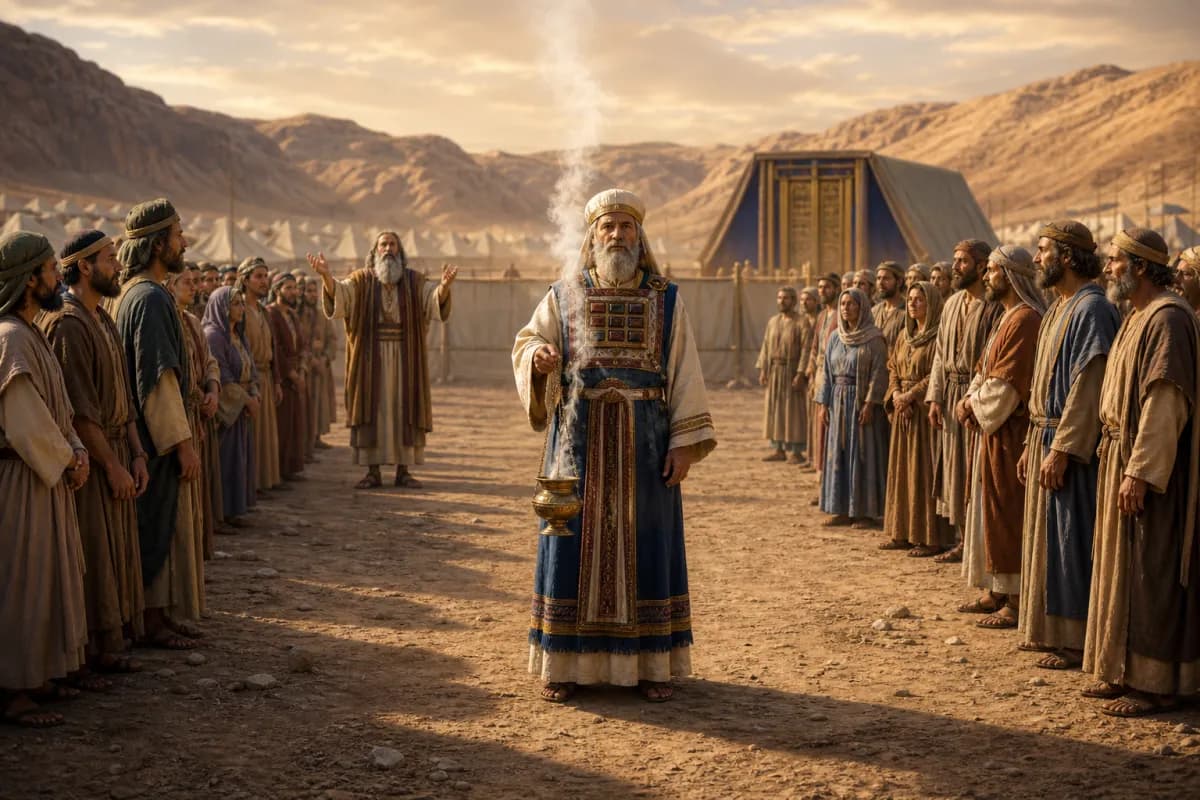
Numbers 16:41–50 records Israel complaining after Korah’s judgment and a plague breaking out among the congregation. Moses sends Aaron with incense to make atonement, and Aaron stands between the dead and the living until the plague stops. The episode does not reduce Jesus to a repeated ritual, but it vividly displays the need for a God-appointed mediator whose atoning work stays judgment. Jesus fulfills that need finally through His sacrificial death and living intercession.
- In this study
- 10 verses · 5 movements
Numbers 16
16:41But on the next day all the congregation of the children of Israel complained against Moses and against Aaron, saying, “You have killed the LORD’s people!”
16:42When the congregation was assembled against Moses and against Aaron, they looked toward the Tent of Meeting. Behold, the cloud covered it, and the LORD’s glory appeared.
16:43Moses and Aaron came to the front of the Tent of Meeting.
16:44The LORD spoke to Moses, saying,
16:45“Get away from among this congregation, that I may consume them in a moment!” They fell on their faces.
16:46Moses said to Aaron, “Take your censer, put fire from the altar in it, lay incense on it, carry it quickly to the congregation, and make atonement for them; for wrath has gone out from the LORD! The plague has begun.”
16:47Aaron did as Moses said, and ran into the middle of the assembly. The plague had already begun among the people. He put on the incense, and made atonement for the people.
16:48He stood between the dead and the living; and the plague was stayed.
16:49Now those who died by the plague were fourteen thousand seven hundred, in addition to those who died about the matter of Korah.
16:50Aaron returned to Moses to the door of the Tent of Meeting, and the plague was stopped.
CONTEXTUAL OVERVIEW
The day after the earth and fire have judged Korah’s rebellion, the congregation charges Moses and Aaron with killing the Lord’s people. Rather than receiving the warning, the people turn the Lord’s judgment into an accusation against His servants. The cloud covers the tent of meeting, and the glory of the Lord appears as another crisis overtakes the camp.
The speed of the plague matters. Moses sees that wrath has gone out and tells Aaron to take his censer, put fire from the altar on it, add incense, and hurry to the congregation. Aaron does not stand at a safe distance explaining the judgment. He moves into the threatened camp as the priestly mediator God has appointed.
HISTORICAL AND LITERARY CONTEXT
Numbers 16 links unauthorized incense to authorized incense. The previous scene condemns rebellious men who seize priestly access with censers; this scene shows Aaron using the censer in the service God has commanded. The contrast makes the theology concrete: holiness is not approached by self-appointment but through the priest God provides.
The chapter has also exposed how quickly Israel can misread judgment. The people call the rebels “the Lord’s people” without acknowledging their rebellion. Their complaint renews the same rejection of God’s appointed means of approach that Korah’s revolt expressed, and the plague shows that the issue remains communal, not merely private.
SECTION-BY-SECTION ANALYSIS
- Fire from the altar · Numbers 16:46The incense is joined to the altar, the place God has designated for sacrificial approach.
- He ran · Numbers 16:47Aaron’s priestly service is urgent and costly, moving toward a people in danger.
- Between the dead and the living · Numbers 16:48The image summarizes mediation: judgment is halted through the provision God has given.
CHRIST IN THIS PASSAGE
Aaron’s action is a limited, repeated priestly service within the old covenant. Hebrews argues that Jesus fulfills the deeper need by offering Himself once for all and by living to intercede for those who draw near to God through Him. Christ does not merely stand near death; He enters death, bears sin’s judgment, and rises as the living mediator of His people.
The gospel therefore does not encourage denial of judgment. Numbers shows that rebellion is deadly. Jesus’ saving mission announces that God’s righteous judgment has been met in the cross for those who trust Him, and it sends His church into a dying world with the message of reconciliation rather than accusation or indifference.
REFLECTION
It is easy to stand far from another person’s ruin and merely assign blame. Aaron’s movement into the assembly does not deny sin; it embodies God’s merciful provision for sinners. Followers of Jesus are not their own saviors, but they are called to move toward suffering people with prayer, truth, practical mercy, and the good news of Christ.
When you feel the weight of guilt or judgment, do not rely on your own urgency or improvement. Come to Jesus, the mediator who has made peace by His blood. Then ask where He may be sending you to stand nearby with His compassion and witness.
Original Hebrew Word Study
Numbers 16:46
כָּפַר
kaphar · H3722
Usually translated: to make atonement
Kaphar means to make atonement. Aaron stands between the dead and living with incense, displaying God’s mercy in stopping the judgment that rebellion has unleashed.
Follow the Scripture trail
Standing Between the Dead and the Living: Mercy in the Midst of Judgment in the larger story
The connection: Aaron’s censer arrests a plague among a rebellious people because God provides a mediator to make atonement. Jesus fulfills the need the scene reveals: through His death and resurrection He reconciles sinners to God and sends His people with that message of life.
Respond to the passage
Bring your guilt honestly to Jesus rather than trying to outrun it. Thank Him for His finished sacrifice, and pray for one person who needs the hope of reconciliation with God; consider one compassionate step toward that person this week.
- Why does Israel’s accusation after Korah’s judgment repeat the rebellion it has just witnessed?
- What does Aaron’s movement into the midst of the congregation reveal about mediation?
- How does Christ’s once-for-all sacrifice deepen the hope displayed in this scene?
Prayer
Lord Jesus, thank You for entering the place of judgment for sinners and for interceding for all who come to God through You. Teach me to receive Your mercy with humility and to carry Your reconciling hope toward people who need life. Amen.