Passage Study
The Staff That Blossomed: God Confirms His Chosen Priest
Numbers 17:1–17:13
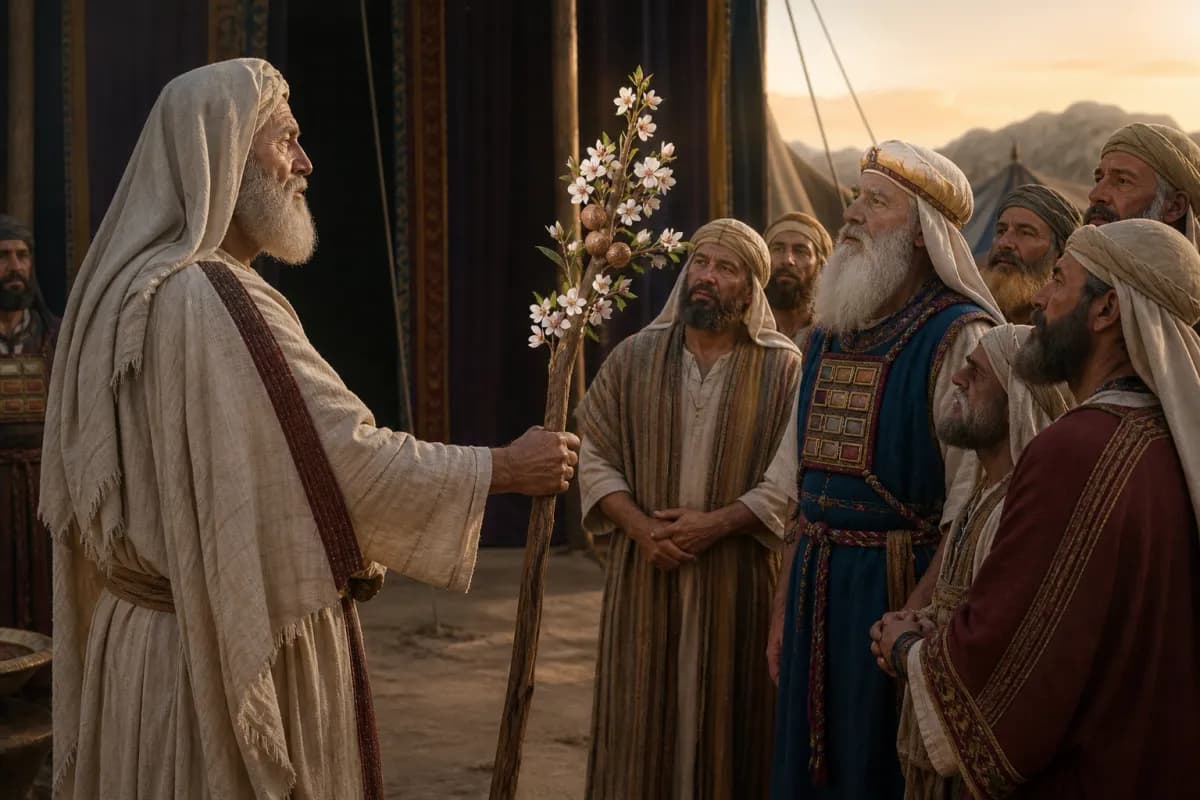
Numbers 17:1–13 answers Israel’s dispute about priesthood by placing twelve staffs before the covenant testimony. Aaron’s dead staff buds, blossoms, and bears ripe almonds overnight, confirming God’s choice and ending the people’s murmuring. The sign points beyond itself to the need for a priest God appoints. Jesus, raised from death and established as the enduring high priest, gives His people confident access to God.
- In this study
- 13 verses · 5 movements
Numbers 17
17:1The LORD spoke to Moses, saying,
17:2“Speak to the children of Israel, and take rods from them, one for each fathers’ house, of all their princes according to their fathers’ houses, twelve rods. Write each man’s name on his rod.
17:3You shall write Aaron’s name on Levi’s rod. There shall be one rod for each head of their fathers’ houses.
17:4You shall lay them up in the Tent of Meeting before the covenant, where I meet with you.
17:5It shall happen that the rod of the man whom I shall choose shall bud. I will make the murmurings of the children of Israel, which they murmur against you, cease from me.”
17:6Moses spoke to the children of Israel; and all their princes gave him rods, for each prince one, according to their fathers’ houses, a total of twelve rods. Aaron’s rod was among their rods.
17:7Moses laid up the rods before the LORD in the Tent of the Testimony.
17:8On the next day, Moses went into the Tent of the Testimony; and behold, Aaron’s rod for the house of Levi had sprouted, budded, produced blossoms, and bore ripe almonds.
17:9Moses brought out all the rods from before the LORD to all the children of Israel. They looked, and each man took his rod.
17:10The LORD said to Moses, “Put back the rod of Aaron before the covenant, to be kept for a token against the children of rebellion; that you may make an end of their complaining against me, that they not die.”
17:11Moses did so. As the LORD commanded him, so he did.
17:12The children of Israel spoke to Moses, saying, “Behold, we perish! We are undone! We are all undone!
17:13Everyone who keeps approaching the LORD’s tabernacle, dies! Will we all perish?”
CONTEXTUAL OVERVIEW
After Korah’s revolt and the plague, the people still need a clear answer about who may draw near to the sanctuary. God supplies a public, nonviolent sign. Each tribal leader contributes a staff, a dry piece of wood marked with his name. Aaron’s name is written on the staff for the house of Levi, and all twelve are placed before the testimony where the Lord meets with Moses.
The sign is designed to stop murmuring, not to entertain curiosity. Aaron’s staff produces buds, blossoms, and ripe almonds in one night. The sudden fruitfulness of dead wood identifies the priesthood as God’s gift and answers the rivalry that has endangered the whole camp.
HISTORICAL AND LITERARY CONTEXT
The staff follows the censers of Numbers 16. The bronze covering of the altar warns against unauthorized approach; the flowering staff positively identifies the priestly line God has chosen. Together the signs protect Israel from treating access to the holy God as a matter of tribal competition or personal initiative.
The staff is placed “before the testimony,” that is, before the covenant tablets in the sanctuary. Its location matters. The point is not Aaron’s charisma but the Lord’s covenant presence and decision. The people’s final fear—“Everyone who approaches the tabernacle of the Lord will die”—prepares for the clarifying priestly instructions of Numbers 18.
SECTION-BY-SECTION ANALYSIS
- Twelve staffs · Numbers 17:2Every tribe is represented, making God’s choice public to the entire congregation.
- Buds, blossoms, almonds · Numbers 17:8Life and fruit from a dead staff make the Lord’s choice unmistakable.
- A sign for rebels · Numbers 17:1The preserved staff is meant to restrain destructive murmuring and preserve life.
CHRIST IN THIS PASSAGE
Aaron’s flowering staff is not a direct prediction of the resurrection, and Numbers does not make that claim. It does establish a pattern fulfilled in Christ: access to God depends on the priest God Himself appoints. Hebrews presents Jesus as the high priest whom the Father appoints and whose life continues permanently after His resurrection.
The life from lifeless wood also harmonizes with the Bible’s larger witness that God brings life where human strength ends. Jesus’ resurrection is the decisive reality: the crucified Son is raised and lives forever to bring His people to God. His saving mission turns fearful distance into confident, reverent access through His grace.
REFLECTION
We often want access to God on terms we can control: achievement, knowledge, family history, or religious performance. Numbers removes that illusion. God supplies the priest, establishes the way of approach, and gives signs meant to stop destructive competition. The right response is humble trust, not spiritual anxiety or status seeking.
Come to God through Jesus with reverence and confidence. His priesthood is not fragile or dependent on your ability to prove yourself. Let His secure welcome free you to serve without comparison, and let the life He gives become a quiet witness to people who assume they must earn their way to God.
Original Hebrew Word Study
Numbers 17:8
פָּרַח
parach · H6524
Usually translated: to bud, blossom, or flourish
Parach means to bud or blossom. Aaron’s dead staff blossoms overnight, a God-given sign that priestly authority comes from His choice rather than human rivalry.
Follow the Scripture trail
The Staff That Blossomed: God Confirms His Chosen Priest in the larger story
The connection: God causes Aaron’s staff to flower so Israel will know that priestly access is His gift, not a prize seized by rivalry. Jesus is the Father-appointed, risen high priest whose living intercession gives sinners a secure welcome before God and equips them for witness.
Respond to the passage
Release one way you have tried to earn or control access to God. Thank Jesus for His permanent priesthood, approach the Father in prayer through Him, and encourage someone else who needs to hear that grace—not achievement—opens the way.
- Why does God use a public sign involving all twelve tribal staffs?
- What does the blossoming of Aaron’s dead staff communicate about priesthood?
- How does Jesus’ permanent priesthood change fear-driven approaches to God?
Prayer
Father, thank You for giving the priest I need in Your risen Son. Forgive my attempts to earn what Jesus has secured. Teach me to draw near with reverence, trust His intercession, and live as a witness to Your life-giving grace. Amen.