Passage Study
Water at Meribah: God’s Faithfulness and Moses’ Failure
Numbers 20:1–20:13
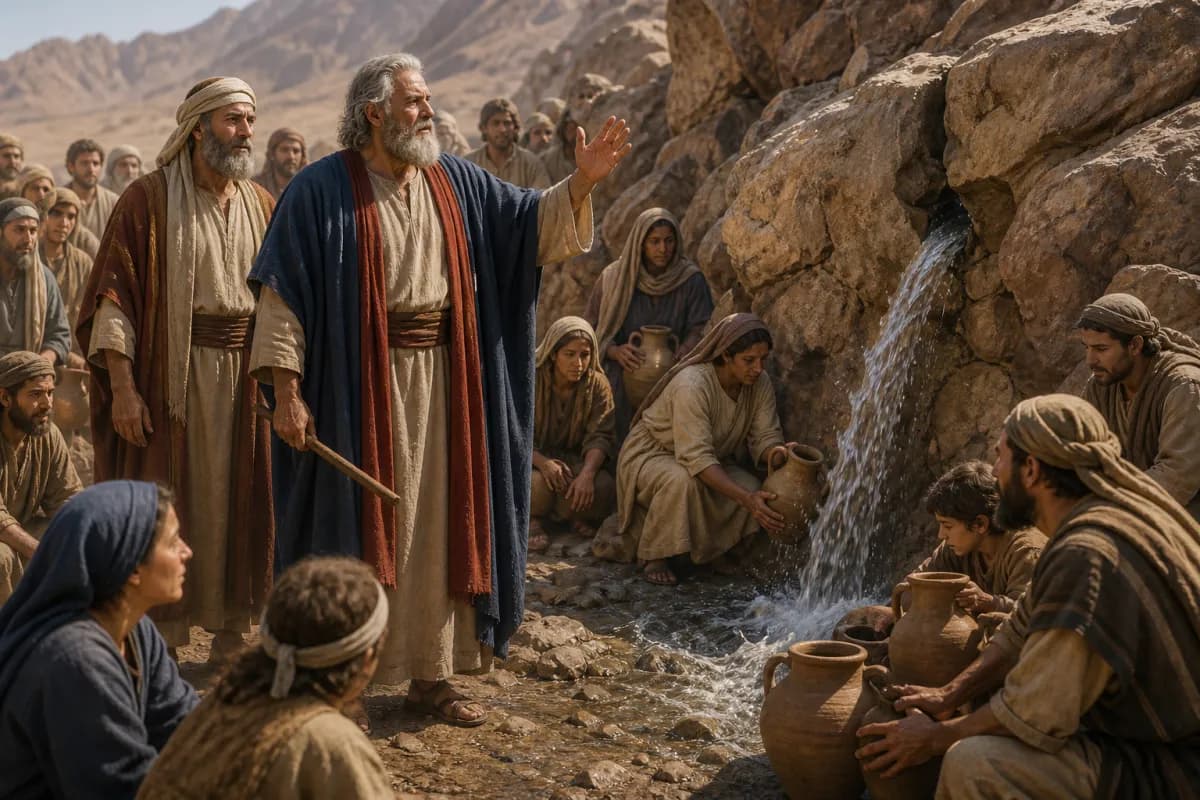
Numbers 20:1–13 places Miriam’s death beside Israel’s renewed thirst at Kadesh. God commands Moses to speak to the rock, but Moses strikes it while accusing the people, and water still comes out. The Lord’s provision displays His faithfulness, while His discipline of Moses and Aaron shows that leaders must uphold God as holy. Jesus gives living water by grace and perfectly reveals the Father’s holy character.
- In this study
- 13 verses · 5 movements
Numbers 20
20:1The children of Israel, even the whole congregation, came into the wilderness of Zin in the first month. The people stayed in Kadesh. Miriam died there, and was buried there.
20:2There was no water for the congregation; and they assembled themselves together against Moses and against Aaron.
20:3The people quarreled with Moses, and spoke, saying, “We wish that we had died when our brothers died before the LORD!
20:4Why have you brought the LORD’s assembly into this wilderness, that we should die there, we and our animals?
20:5Why have you made us to come up out of Egypt, to bring us in to this evil place? It is no place of seed, or of figs, or of vines, or of pomegranates; neither is there any water to drink.”
20:6Moses and Aaron went from the presence of the assembly to the door of the Tent of Meeting, and fell on their faces. The LORD’s glory appeared to them.
20:7The LORD spoke to Moses, saying,
20:8“Take the rod, and assemble the congregation, you, and Aaron your brother, and speak to the rock before their eyes, that it pour out its water. You shall bring water to them out of the rock; so you shall give the congregation and their livestock drink.”
20:9Moses took the rod from before the LORD, as he commanded him.
20:10Moses and Aaron gathered the assembly together before the rock, and he said to them, “Hear now, you rebels! Shall we bring water out of this rock for you?”
20:11Moses lifted up his hand, and struck the rock with his rod twice, and water came out abundantly. The congregation and their livestock drank.
20:12The LORD said to Moses and Aaron, “Because you didn’t believe in me, to sanctify me in the eyes of the children of Israel, therefore you shall not bring this assembly into the land which I have given them.”
20:13These are the waters of Meribah; because the children of Israel strove with the LORD, and he was sanctified in them.
CONTEXTUAL OVERVIEW
The new generation reaches Kadesh, a place already marked by Israel’s earlier refusal to trust God. Miriam dies there, and the narrative moves immediately to a familiar crisis: the community has no water and quarrels with Moses and Aaron. Their words recall earlier wilderness complaints, wishing they had died and accusing their leaders of bringing them into a barren place.
God’s response contains both provision and a searching test of representation. Moses and Aaron are told to assemble the people and speak to the rock before their eyes. The Lord is ready to give water, but the leaders are to show Israel that the gift comes from the holy God, not from the force, frustration, or personal authority of His servants.
HISTORICAL AND LITERARY CONTEXT
Numbers has repeatedly shown water as a wilderness necessity and a stage for Israel’s unbelief. The earlier water-from-the-rock account in Exodus 17 occurs in a different setting and includes a command to strike the rock. Numbers 20 deliberately records a new command: Moses is to speak. The parallel does not erase the distinction; it makes Moses’ failure to follow the present word of God more pointed.
Meribah means quarreling. The name preserves Israel’s conflict with the Lord, while the closing sentence says He showed Himself holy among them. God’s holiness is not a display of temper. It is the faithful truth of who He is, made known in His merciful provision and in His refusal to let even Moses and Aaron misrepresent Him without consequence.
SECTION-BY-SECTION ANALYSIS
- Kadesh again · Numbers 20:1The location recalls an earlier failure and reveals that a new generation can repeat old patterns of unbelief.
- Speak to the rock · Numbers 20:8God’s precise command makes clear that provision is to display His word and holiness.
- Water nevertheless · Numbers 20:2The gift comes despite Moses’ failure, showing that Israel’s survival rests on God’s mercy.
CHRIST IN THIS PASSAGE
Paul says that the wilderness rock accompanied Israel and that “the rock was Christ,” a theological reading of God’s sustaining provision rather than a claim that every detail of Numbers 20 is an allegory. The central gospel connection is secure: God gives life where His people cannot provide it, and Christ is the source of living water for the thirsty who come to Him in faith.
Moses’ failure also heightens the need for a mediator who never distorts God’s character. Jesus obeys the Father completely, speaks His words faithfully, and gives Himself for sinners without claiming the Father’s glory as His own. His mission provides the grace Moses could not manufacture and reveals the holy mercy of God to a quarreling world.
REFLECTION
Spiritual pressure can expose how easily frustration becomes a false portrait of God. Moses has served faithfully through severe testing, yet he still acts in anger and speaks as though the provision rests with him and Aaron. Leaders, parents, teachers, and every believer need the warning: zeal for God’s people never authorizes us to represent God carelessly.
Come thirsty to Jesus, who does not shame those who ask for living water. When you have acted from resentment or self-importance, confess it plainly. Let His mercy retrain your speech so that people encounter God’s truth and compassion through your life rather than your wounded pride.
Original Hebrew Word Study
Numbers 20:12
קָדַשׁ
qadash · H6942
Usually translated: to treat as holy
Qadash means to treat as holy. Moses and Aaron fail to uphold God as holy before Israel, showing that even leaders must represent His character faithfully.
Follow the Scripture trail
Water at Meribah: God’s Faithfulness and Moses’ Failure in the larger story
The connection: At Meribah, God gives water despite Israel’s complaint and Moses’ failure, proving that the people’s life depends on His mercy. Jesus perfectly reveals the Father and gives the living water of the Spirit, gathering thirsty people into His saving mission.
Respond to the passage
Notice one place where pressure has made your words misrepresent God. Confess it to Jesus, ask for His living water, and choose a truthful, gracious way to speak of Him to someone facing need this week.
- How does Numbers 20 differ from the earlier rock episode in Exodus 17?
- Why does God’s provision of water not remove the seriousness of Moses’ disobedience?
- What does it mean to uphold God as holy in the way we speak and lead?
Prayer
Lord Jesus, You are the source of living water. Forgive me when frustration makes me speak as though I control Your gifts or misrepresent Your heart. Make my words faithful, humble, and full of the grace that draws thirsty people to You. Amen.