Passage Study
Edom’s Refusal: A Long Road Taken in Restraint
Numbers 20:14–20:21
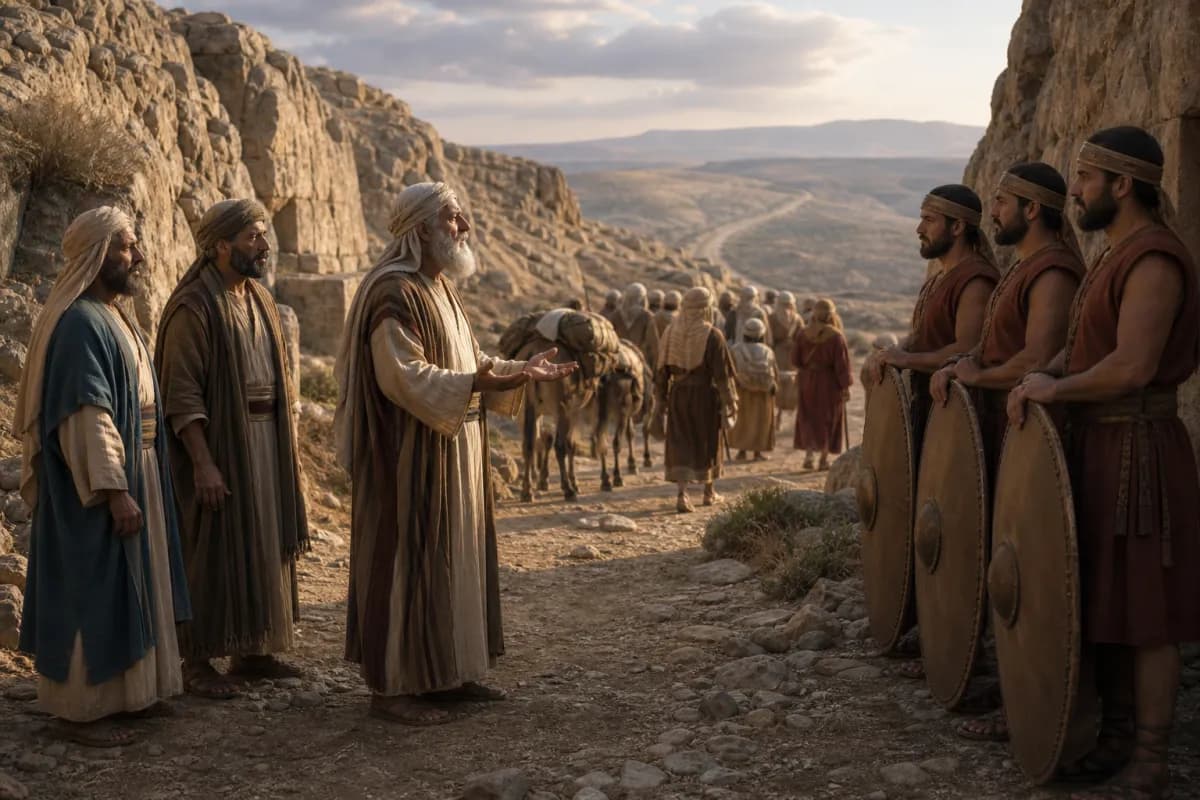
Numbers 20:14–21 records Moses asking Edom, Israel’s brother nation, for peaceful passage along the king’s highway. Israel promises not to take water or enter fields, but Edom answers with armed refusal. Israel turns away rather than force the route. The episode teaches that covenant faithfulness does not seize every desired path; Jesus fulfills God’s purpose through obedient humility and calls His people to pursue peace while trusting the Father’s direction.
- In this study
- 8 verses · 5 movements
Numbers 20
20:14Moses sent messengers from Kadesh to the king of Edom, saying: “Your brother Israel says: You know all the travail that has happened to us;
20:15how our fathers went down into Egypt, and we lived in Egypt a long time. The Egyptians mistreated us and our fathers.
20:16When we cried to the LORD, he heard our voice, sent an angel, and brought us out of Egypt. Behold, we are in Kadesh, a city in the edge of your border.
20:17“Please let us pass through your land. We will not pass through field or through vineyard, neither will we drink from the water of the wells. We will go along the king’s highway. We will not turn away to the right hand nor to the left, until we have passed your border.”
20:18Edom said to him, “You shall not pass through me, lest I come out with the sword against you.”
20:19The children of Israel said to him, “We will go up by the highway; and if we drink your water, I and my livestock, then I will give its price. Only let me, without doing anything else, pass through on my feet.”
20:20He said, “You shall not pass through.” Edom came out against him with many people, and with a strong hand.
20:21Thus Edom refused to give Israel passage through his border, so Israel turned away from him.
CONTEXTUAL OVERVIEW
After the crisis at Meribah, Israel needs a route toward the promised land. Moses calls Edom “your brother Israel,” acknowledging the family connection between Jacob and Esau. His message recounts Israel’s descent into Egypt, affliction, cry to the Lord, and deliverance. The appeal is diplomatic and restrained: Israel asks to pass through, promising not to drink from wells or turn aside into fields and vineyards.
Edom’s refusal is emphatic. It threatens military action, and a second appeal—now offering payment for water—receives the same answer. Israel’s departure is easy to overlook because it is quiet, but it is a meaningful act of restraint. The wilderness road will be longer, yet Israel does not make military pressure the means of forcing an open door.
HISTORICAL AND LITERARY CONTEXT
Edom lies south and east of the Dead Sea and is associated in Scripture with Esau. The kinship language is not sentimental; it makes the refusal painful and explains why the encounter carries more weight than an ordinary border dispute. Deuteronomy later tells Israel not to abhor an Edomite because he is a brother, even while other biblical texts remember Edom’s hostility in later generations.
The “king’s highway” is a main route through the Transjordan region. Moses’ request is carefully limited to transit. Numbers does not present Israel as entitled to plunder Edom because it has received a land promise; the scene shows a people navigating real boundaries and accepting a detour when permission is denied.
Did you know?
In P. Anastasi VI, an Egyptian frontier official reports admitting Shasu tribes of Edom past Merneptah's fortress to the pools of Per-Atum "to keep them alive and to keep their flocks alive."
Why it matters: This Egyptian report does not verify Numbers 20's embassy, route, or outcome. It is a compact primary-text comparison for the practical concern with water and livestock in an Edomite travel context—the very concerns Moses addresses when he promises not to use wells and to pay for water.
SECTION-BY-SECTION ANALYSIS
- Your brother Israel · Numbers 20:14The address remembers Jacob and Esau, making Edom’s hostility a rupture within a family history.
- We will pay · Numbers 20:19Israel seeks passage without appropriating fields, vineyards, wells, or water as if need cancelled justice.
- Israel turned away · Numbers 20:21The detour displays restraint under disappointment rather than a surrender of God’s promise.
CHRIST IN THIS PASSAGE
This passage is not a direct prophecy of Jesus. Its pattern of restrained obedience, however, belongs to the larger biblical story fulfilled in Him. Jesus does not establish His kingdom by taking power through violence or demanding vindication at every insult. He entrusts Himself to the Father while walking the road that leads through rejection to the cross and resurrection.
Christ’s saving mission also changes how His people meet closed doors and hostile responses. The church is sent to proclaim reconciliation, not to coerce faith or repay wrong in kind. Jesus gives courage to seek peace, speak truthfully about God’s rescue, and trust that the Father can lead His mission forward even when the direct road is refused.
REFLECTION
A denied request can awaken fear, entitlement, or the urge to make someone pay for obstructing us. Israel’s turn away does not make Edom’s refusal harmless, but it shows that faith can accept a costly detour without abandoning God’s promise. Sometimes obedience looks less dramatic than winning an argument and more like leaving a boundary without revenge.
Ask Jesus to show you where you are trying to force a path He has not opened. Pursue peace where you can, state your needs honestly, and refuse retaliation. Then keep walking faithfully in the direction He gives, trusting that His mission is not defeated by another person’s refusal.
Original Hebrew Word Study
Numbers 20:14
אָח
ach · H251
Usually translated: brother
Ach means brother. Moses calls Edom his brother, making Edom’s refusal to grant passage a painful reminder that kinship does not guarantee covenant faithfulness.
Follow the Scripture trail
Edom’s Refusal: A Long Road Taken in Restraint in the larger story
The connection: Israel’s detour around Edom shows that God’s promise is not advanced by seizing every route through force. Jesus walks the path of humble obedience to accomplish salvation, and He sends His people to speak peace and trust God when the road ahead is resisted.
Respond to the passage
Identify one closed door or strained relationship where you are tempted to retaliate or force an outcome. Ask Jesus for restraint, make one peaceable step available to you, and entrust the next route to His wise direction.
- Why does Moses call Edom Israel’s brother, and how does that shape the scene?
- What do Israel’s promises about fields, wells, and payment reveal about the kind of passage it seeks?
- How can Christ’s refusal to retaliate guide believers facing a costly detour?
Prayer
Lord Jesus, when my path is blocked, keep me from demanding control or returning hostility for hostility. Give me courage to seek peace, wisdom to respect boundaries, and faith to trust that Your good purpose continues even by a longer road. Amen.