Passage Study
Aaron’s Final Ascent: A Priesthood Handed On
Numbers 20:22–20:29
Numbers 20:22–29 records Aaron’s death on Mount Hor after Israel reaches its border. Because Aaron shared in the disobedience at Meribah, he will not enter the land; yet God orders his final service with dignity, transferring his garments to Eleazar before he dies. The passing priesthood highlights its mortality and prepares readers for Jesus, the risen high priest whose saving work and intercession never pass to another.
- In this study
- 8 verses · 5 movements
Numbers 20
20:22They traveled from Kadesh, and the children of Israel, even the whole congregation, came to Mount Hor.
20:23The LORD spoke to Moses and Aaron in Mount Hor, by the border of the land of Edom, saying,
20:24“Aaron shall be gathered to his people; for he shall not enter into the land which I have given to the children of Israel, because you rebelled against my word at the waters of Meribah.
20:25Take Aaron and Eleazar his son, and bring them up to Mount Hor;
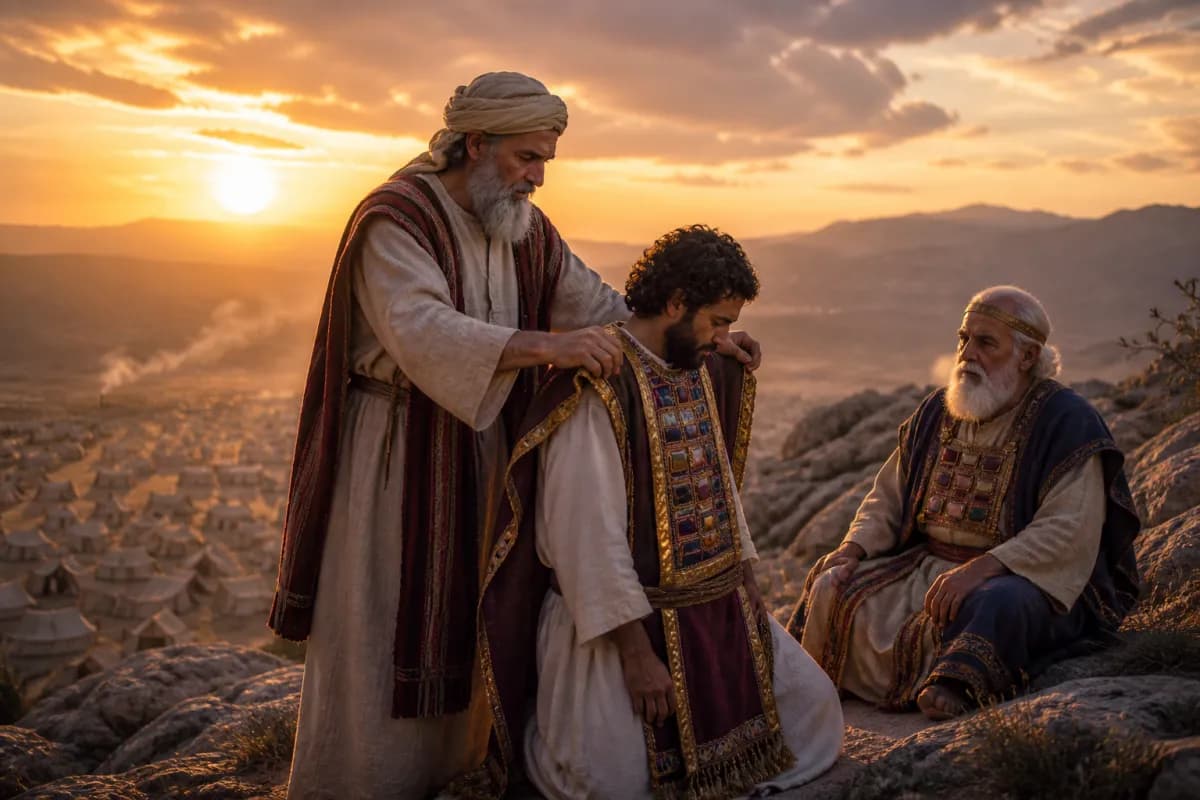
20:26and strip Aaron of his garments, and put them on Eleazar his son. Aaron shall be gathered, and shall die there.”
20:27Moses did as the LORD commanded. They went up onto Mount Hor in the sight of all the congregation.
20:28Moses stripped Aaron of his garments, and put them on Eleazar his son. Aaron died there on the top of the mountain, and Moses and Eleazar came down from the mountain.
20:29When all the congregation saw that Aaron was dead, they wept for Aaron thirty days, even all the house of Israel.
CONTEXTUAL OVERVIEW
The community has just turned away from Edom and now arrives at Mount Hor. There God announces that Aaron’s wilderness service is ending. The reason is not concealed: Aaron joined Moses in failing to uphold the Lord as holy at Meribah. The account holds together divine discipline and personal dignity. Aaron’s sin has real consequences, yet his death is not narrated as abandonment or contempt.
Moses, Aaron, and Eleazar ascend the mountain in the sight of the community. Aaron’s priestly garments are removed and placed on Eleazar before Aaron dies. The visible transfer assures Israel that God’s provision for the sanctuary will continue, even as it exposes the limitation of a priesthood in which every priest eventually dies.
HISTORICAL AND LITERARY CONTEXT
Aaron has been central to Numbers from its opening arrangements for priesthood and sacrifice. He has served during rebellion, made atonement amid plague, and been publicly vindicated through the flowering staff. Numbers 20 closes his service at a decisive transition point: the first generation is passing away, and Israel is moving toward the land under new leadership.
The phrase “gathered to his people” is a reverent biblical description of death. It does not erase the grief of the community or supply a full doctrine of the afterlife by itself. Within this narrative, it marks Aaron’s death as occurring under God’s sovereign word, while the thirty days of mourning show that faithful service can be honored even when the servant’s life includes failure.
SECTION-BY-SECTION ANALYSIS
- Mount Hor · Numbers 20:22The ascent separates the final priestly transition from the camp and places it under God’s direct command.
- Garments transferred · Numbers 20:26Eleazar’s clothing makes the succession visible: priestly service continues by God’s appointment.
- Thirty days of mourning · Numbers 20:29Israel’s shared grief honors Aaron’s place in its life without denying God’s judgment at Meribah.
CHRIST IN THIS PASSAGE
Aaron’s death makes visible a limitation that Hebrews later emphasizes: former priests were many because death prevented them from continuing in office. The transfer to Eleazar is necessary and gracious within the old covenant, but it cannot give permanent access to God. Jesus, raised from the dead, holds His priesthood permanently and intercedes for those who come to God through Him.
Christ also bears the judgment Aaron could not escape. He is the sinless priest who offers Himself, not another creature, and then lives forever. His saving mission assures grieving and failing people that their hope is not tied to the longevity or perfection of human leaders but to the risen Son who will never need a successor.
REFLECTION
Aaron’s final scene gives a sober way to think about leadership. A person can be genuinely used by God, still need discipline, and still be mourned with gratitude. This frees the church from both unrealistic hero worship and cynical dismissal. God’s work does not collapse when a faithful servant reaches the end of a season or when another person must receive responsibility.
Thank Jesus for leaders who have served you, and pray for them as mortal people accountable to God. Where you are receiving or handing on responsibility, do it openly and humbly. Let the permanence of Christ’s priesthood steady your heart and make your service a witness to Him rather than a claim to personal importance.
Original Hebrew Word Study
Numbers 20:24
אָסַף
asaph · H622
Usually translated: to gather
Asaph means to gather. Aaron is gathered to his people, a dignified phrase for death that places his end within the Lord’s just yet faithful care.
Follow the Scripture trail
Aaron’s Final Ascent: A Priesthood Handed On in the larger story
The connection: Aaron’s death and Eleazar’s succession show both God’s continuing care for Israel and the mortality of every old-covenant priest. Jesus is the risen high priest who never needs a successor, giving His people lasting access to God and a steady hope for His mission.
Respond to the passage
Thank God for one person whose faithful service has shaped you, and pray for their perseverance. If you are handing off or receiving responsibility, make one humble, concrete step that points people beyond human ability to the permanent priesthood of Jesus.
- Why does the narrative repeat the connection between Aaron’s death and Meribah?
- What does the visible transfer of garments communicate to Israel?
- How does Jesus’ permanent priesthood reshape the way we honor and depend on human leaders?
Prayer
Lord Jesus, thank You that Your priesthood does not end in death and Your intercession does not fail. Teach me to honor faithful servants without making them my hope, to receive discipline humbly, and to serve Your people for the glory of Your enduring grace. Amen.