Passage Study
The Journey to Moab: Water, Song, and God’s Steady Leading
Numbers 21:10–21:20
Numbers 21:10–20 traces Israel’s stages toward Moab, pauses at a well where the people sing, and remembers the Lord’s care through difficult terrain. The short itinerary teaches that God’s faithfulness is present in ordinary movement, water, and rest. Jesus is the Shepherd who leads His people through the wilderness of this age toward God’s promised rest.
- In this study
- 11 verses · 5 movements
Numbers 21
21:10The children of Israel traveled, and encamped in Oboth.
21:11They traveled from Oboth, and encamped at Iyeabarim, in the wilderness which is before Moab, toward the sunrise.
21:12From there they traveled, and encamped in the valley of Zered.
21:13From there they traveled, and encamped on the other side of the Arnon, which is in the wilderness that comes out of the border of the Amorites; for the Arnon is the border of Moab, between Moab and the Amorites.
21:14Therefore it is said in The Book of the Wars of the LORD , “Vaheb in Suphah, the valleys of the Arnon,
21:15the slope of the valleys that incline toward the dwelling of Ar, leans on the border of Moab.”
21:16From there they traveled to Beer; that is the well of which the LORD said to Moses, “Gather the people together, and I will give them water.”
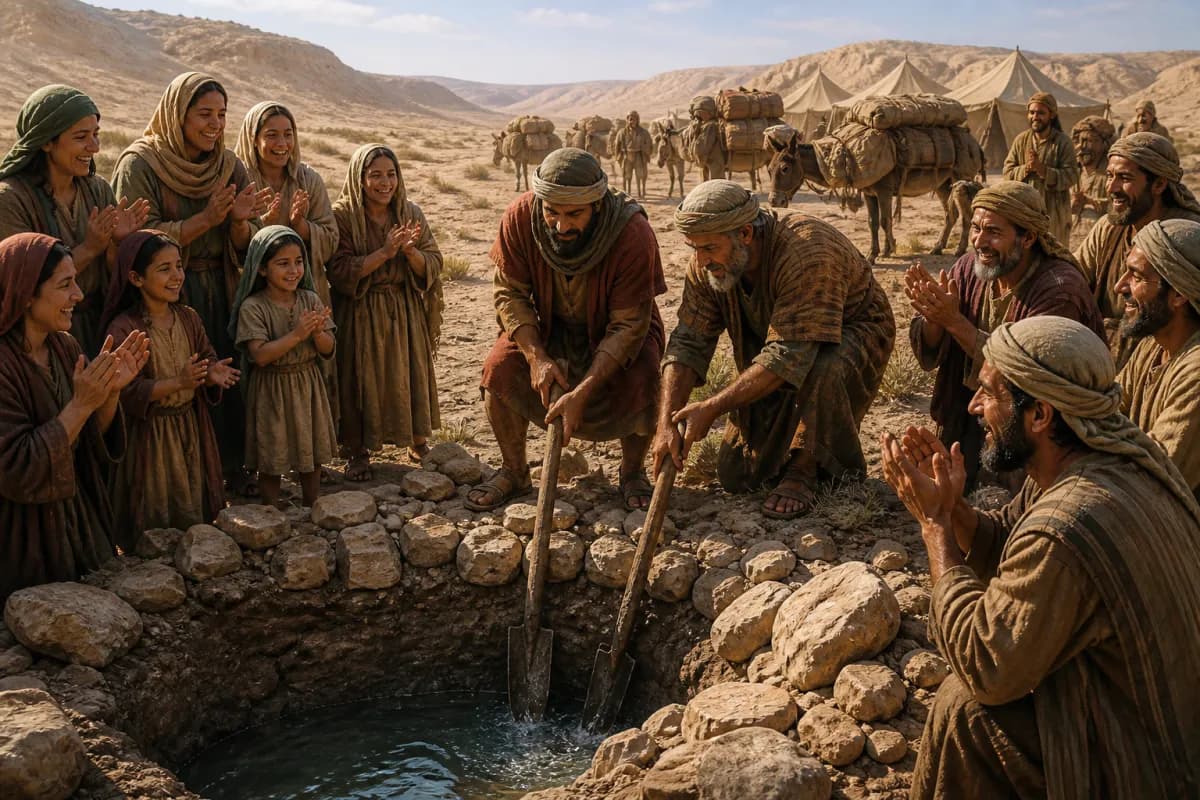
21:17Then Israel sang this song: “Spring up, well! Sing to it,
21:18the well, which the princes dug, which the nobles of the people dug, with the scepter, and with their poles.” From the wilderness they traveled to Mattanah;
21:19and from Mattanah to Nahaliel; and from Nahaliel to Bamoth;
21:20and from Bamoth to the valley that is in the field of Moab, to the top of Pisgah, which looks down on the desert.
CONTEXTUAL OVERVIEW
After the crisis of the bronze serpent, Numbers does not immediately offer another dramatic conflict. It gives place names, camps, a well, and a song. The quietness is important. Israel’s life with God is not made only of miracles and rebellions; it also consists of repeated departures, arrivals, and provisions that can be forgotten because they are ordinary.
At Beer, the Lord says He will give the people water, and Israel answers with song while leaders dig with staffs. The scene joins divine provision and human participation without confusing them. The water is God’s gift; the people receive it as a community that works, sings, and remembers.
HISTORICAL AND LITERARY CONTEXT
The itinerary leads Israel toward Moab on the eastern side of the Jordan, the setting for the book’s final movements. These names locate the people geographically, but they also mark theological progress: the generation that wandered under judgment is now being brought toward the threshold of the promised land.
The quoted fragments of travel-song and older war tradition in verses 14–15 and 17–18 are deliberately brief. They show that Israel’s memory included poetry as well as prose. The text does not explain every place or source in detail, so responsible reading should not turn the passage into a map of claims it does not make.
SECTION-BY-SECTION ANALYSIS
- Named stages · Numbers 21:10The itinerary insists that the journey has real places and real progress under God’s care.
- A well and a song · Numbers 21:17Israel praises God for water while its leaders take up the practical work set before them.
- Toward Moab · Numbers 21:11The route places the people near the setting where Moses will prepare the next generation to enter the land.
CHRIST IN THIS PASSAGE
This itinerary is not a direct prediction of Jesus, but its wilderness pattern belongs to the Bible’s larger story of God leading a redeemed people toward promised rest. The New Testament warns the church not to repeat Israel’s unbelief and then directs believers to enter God’s rest through faith in Christ. Jesus is the faithful Son who brings His people where Moses’ generation could not bring itself.
The well also gives a restrained thematic echo of Jesus’ promise of living water. He does not merely improve a difficult journey; He gives the Spirit to those who come to Him, creating worship and witness from within. His mission turns ordinary people into recipients and bearers of the life God supplies.
REFLECTION
Many seasons of faith feel like a line of place names: appointments, moves, griefs, meals, and work that appear unremarkable while they are happening. Numbers teaches us to notice that God’s leading does not cease in the uneventful stretches. A remembered provision can become a song of gratitude instead of a reason to complain.
Ask Jesus to help you name one ordinary provision from the past week. Thank Him, take the practical next step in front of you, and use that gratitude to encourage someone who feels that their long road has no direction.
Original Hebrew Word Study
Numbers 21:16
בְּאֵר
beer · H875
Usually translated: well
Beer is a well. Israel sings over water provided in the wilderness, joining the ordinary necessity of drinking to praise for the Lord’s care.
Follow the Scripture trail
The Journey to Moab: Water, Song, and God’s Steady Leading in the larger story
The connection: Israel’s stages and song at the well show God quietly bringing a redeemed people toward His promise. Jesus leads His people through the wilderness by His Spirit, gives living water, and keeps them moving toward the rest and new creation secured by His saving mission.
Respond to the passage
Thank Jesus for one provision you have treated as routine. Take the next faithful responsibility before you and share that gratitude with someone walking a weary road, pointing them to the living water He gives.
- Why might Numbers preserve a quiet itinerary after a dramatic rescue?
- What does the well-song reveal about the relationship between God’s gift and Israel’s participation?
- How does Christ’s promise of living water deepen, without flattening, this wilderness scene?
Prayer
Lord Jesus, keep me from overlooking Your care in ordinary days. Give me a grateful heart, steady obedience, and living water through Your Spirit. Lead me onward, and use my words to strengthen weary travelers around me. Amen.