Passage Study
Balak and Balaam: A Curse That Cannot Overrule God’s Blessing
Numbers 22:1–22:21
Numbers 22:1–21 introduces Balak’s fear as Israel camps in the plains of Moab and his attempt to purchase a curse through Balaam. The Lord refuses to let Israel be cursed because He has blessed them, while Balaam’s divided desire begins to show. Jesus secures God’s blessing for His people by His grace and exposes every attempt to turn spiritual power into a tool of fear, profit, or control.
- In this study
- 21 verses · 5 movements
Numbers 22
22:1The children of Israel traveled, and encamped in the plains of Moab beyond the Jordan at Jericho.
22:2Balak the son of Zippor saw all that Israel had done to the Amorites.
22:3Moab was very afraid of the people, because they were many. Moab was distressed because of the children of Israel.
22:4Moab said to the elders of Midian, “Now this multitude will lick up all that is around us, as the ox licks up the grass of the field.” Balak the son of Zippor was king of Moab at that time.
22:5He sent messengers to Balaam the son of Beor, to Pethor, which is by the River, to the land of the children of his people, to call him, saying, “Behold, there is a people who came out of Egypt. Behold, they cover the surface of the earth, and they are staying opposite me.
22:6Please come now therefore, and curse this people for me; for they are too mighty for me. Perhaps I shall prevail, that we may strike them, and that I may drive them out of the land; for I know that he whom you bless is blessed, and he whom you curse is cursed.”
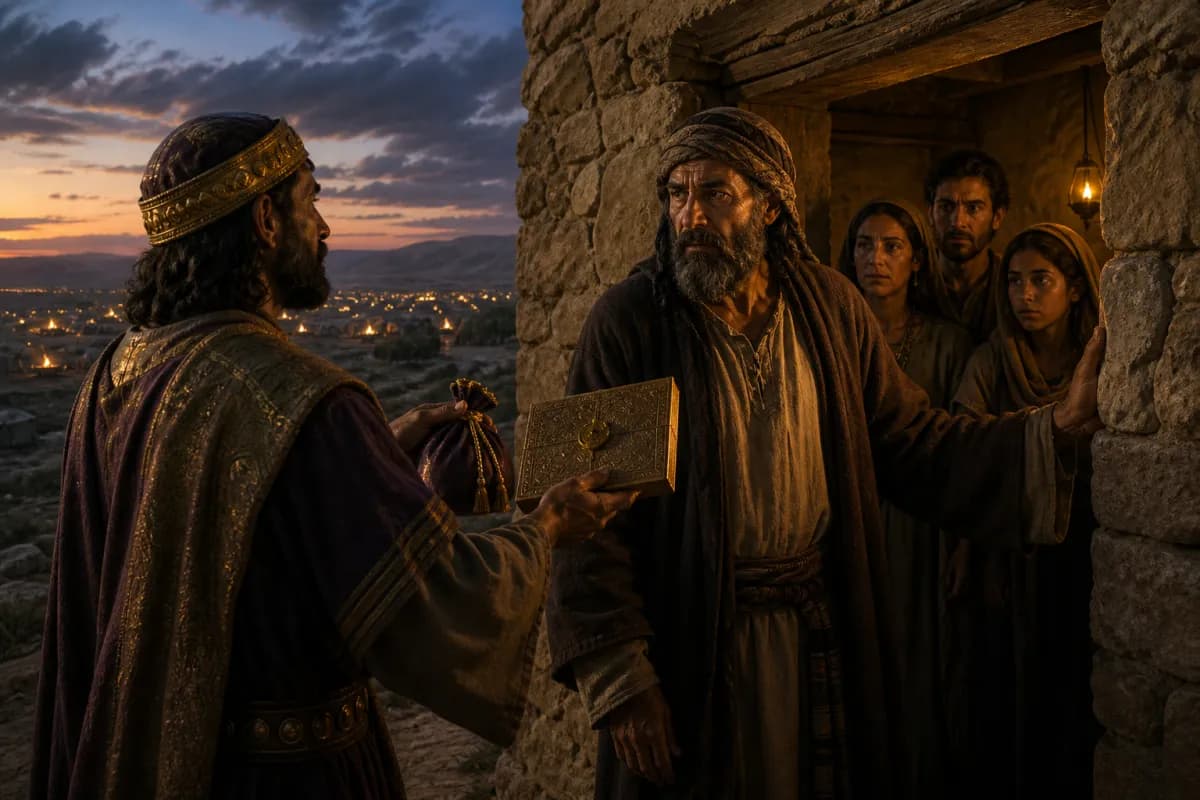
22:7The elders of Moab and the elders of Midian departed with the rewards of divination in their hand. They came to Balaam, and spoke to him the words of Balak.
22:8He said to them, “Lodge here this night, and I will bring you word again, as the LORD shall speak to me.” The princes of Moab stayed with Balaam.
22:9God came to Balaam, and said, “Who are these men with you?”
22:10Balaam said to God, “Balak the son of Zippor, king of Moab, has said to me,
22:11‘Behold, the people that has come out of Egypt covers the surface of the earth. Now, come curse them for me. Perhaps I shall be able to fight against them, and shall drive them out.’”
22:12God said to Balaam, “You shall not go with them. You shall not curse the people, for they are blessed.”
22:13Balaam rose up in the morning, and said to the princes of Balak, “Go to your land; for the LORD refuses to permit me to go with you.”
22:14The princes of Moab rose up, and they went to Balak, and said, “Balaam refuses to come with us.”
22:15Balak again sent princes, more, and more honorable than they.
22:16They came to Balaam, and said to him, “Balak the son of Zippor says, ‘Please let nothing hinder you from coming to me,
22:17for I will promote you to very great honor, and whatever you say to me I will do. Please come therefore, and curse this people for me.’”
22:18Balaam answered the servants of Balak, “If Balak would give me his house full of silver and gold, I can’t go beyond the word of the LORD my God, to do less or more.
22:19Now therefore please stay here tonight as well, that I may know what else the LORD will speak to me.”
22:20God came to Balaam at night, and said to him, “If the men have come to call you, rise up, go with them; but only the word which I speak to you, that you shall do.”
22:21Balaam rose up in the morning, and saddled his donkey, and went with the princes of Moab.
CONTEXTUAL OVERVIEW
Israel’s victories over Sihon and Og alarm Balak, king of Moab. He sees a people too numerous and powerful for his comfort and imagines that a religious specialist can change their future. His language treats blessing and curse as forces to be hired, directed, and turned against an enemy.
The Lord’s first answer cuts through the entire scheme: Balaam must not go to curse the people, “for they are blessed.” Israel’s security rests neither in its numbers nor in Balaam’s cooperation. God’s covenant purpose cannot be overturned by a king’s fear or a prophet’s fee.
HISTORICAL AND LITERARY CONTEXT
Balaam comes from Pethor near the Euphrates, far from Moab. The narrative portrays him as a figure whose reputation for blessing and cursing has traveled across regions. The “fees for divination” carried by Balak’s messengers make clear that Balak approaches this spiritual work as something purchasable.
The text’s focus is not a complete biography of Balaam but the clash between God’s word and human manipulation. Later biblical texts remember Balaam as a warning about greed and as an agent who helped draw Israel toward idolatry. Those later evaluations help readers notice that outwardly correct words cannot substitute for a heart loyal to God.
SECTION-BY-SECTION ANALYSIS
- Balak’s fear · Numbers 22:10A king tries to manage the future by recruiting spiritual power against the people God has brought near.
- God’s blessing · Numbers 22:18The Lord’s declared blessing establishes a boundary no paid curse can cross.
- Balaam’s testing · Numbers 22:8His repeated inquiry reveals the danger of looking for permission when God’s will has already been made plain.
CHRIST IN THIS PASSAGE
Numbers 22 does not directly predict Jesus, but it safeguards a covenant promise that reaches its fulfillment in Him: God’s blessing cannot finally be bought, manipulated, or revoked by hostile powers. In Christ, believers receive every spiritual blessing by grace, not because they have found a technique to control God or defeat their enemies.
Jesus also rejects the temptation to use power for self-serving gain. He gives Himself for enemies and sends His disciples to bless those who curse them. His saving mission frees people from superstition and spiritual commerce, teaching them to trust the Father’s word and to offer the gospel without price.
REFLECTION
Fear can make us want a spiritual shortcut: a formula, a personality, a transaction, or a ritual that will guarantee the outcome we prefer. Balak’s plan is recognizably religious but deeply unbelieving because it seeks mastery rather than trust. God calls His people to receive His blessing and obey His word even when they cannot control the future.
Ask Jesus where money, recognition, or anxiety has made you willing to negotiate with clear obedience. Receive again the grace that makes you God’s child, and bless someone you would rather treat as a threat or competitor.
Original Hebrew Word Study
Numbers 22:7
קָסַם
qasam · H7080
Usually translated: to practice divination
Qasam is to practice divination. Balak seeks spiritual power he can purchase, but the narrative will show that the Lord alone controls the word spoken over Israel.
Follow the Scripture trail
Balak and Balaam: A Curse That Cannot Overrule God’s Blessing in the larger story
The connection: Balak’s attempt to purchase a curse cannot overturn the blessing God has placed on His covenant people. Jesus brings that blessing to its saving goal, redeeming a people by grace and sending them to bless enemies with the truth of His kingdom.
Respond to the passage
Identify one place where fear has made you seek control through money, influence, or spiritual technique. Bring it to Jesus, obey the word you already know, and choose one concrete way to bless rather than manipulate another person.
- What does Balak assume about spiritual blessing and curse?
- Why is Balaam’s request for another word from God spiritually revealing?
- How does belonging to Christ free believers from superstition and fear-driven control?
Prayer
Lord Jesus, keep me from treating Your gifts as tools for control. Thank You that Your blessing is grace, secured by Your mercy. Make me faithful when I am afraid, honest when I am tempted by gain, and ready to bless others in Your name. Amen.