Passage Study
Balak Meets Balaam: Honor Cannot Purchase God’s Word
Numbers 22:36–22:41
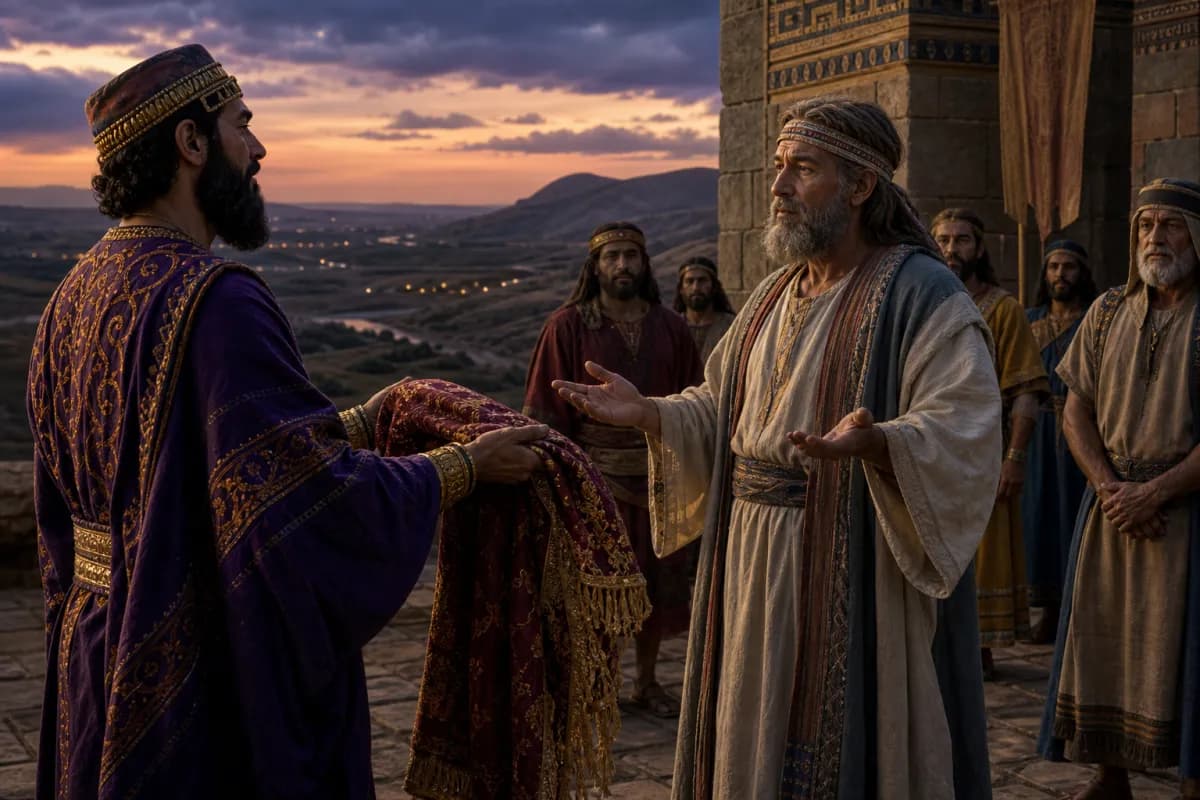
Numbers 22:36–40 brings Balaam to Moab’s border, where Balak immediately presses him with the promise of honor and hospitality. Balaam answers that he can speak only what God puts in his mouth. The scene exposes the collision between political fear, religious bargaining, and the Lord’s unpurchasable word. Jesus fulfills the faithful obedience Balaam only voices: He speaks the Father’s word without selling His mission for status or safety.
- In this study
- 6 verses · 5 movements
Numbers 22
22:36When Balak heard that Balaam had come, he went out to meet him to the City of Moab, which is on the border of the Arnon, which is in the utmost part of the border.
22:37Balak said to Balaam, “Didn’t I earnestly send for you to summon you? Why didn’t you come to me? Am I not able indeed to promote you to honor?”
22:38Balaam said to Balak, “Behold, I have come to you. Have I now any power at all to speak anything? I will speak the word that God puts in my mouth.”
22:39Balaam went with Balak, and they came to Kiriath Huzoth.
22:40Balak sacrificed cattle and sheep, and sent to Balaam, and to the princes who were with him.
22:41In the morning, Balak took Balaam, and brought him up into the high places of Baal; and he saw from there part of the people.
CONTEXTUAL OVERVIEW
Israel is camped across from Jericho, and Moab’s king sees a people he cannot control by ordinary means. Balak has summoned Balaam to curse Israel, but the earlier journey has already shown that the Lord is opposing Balaam’s crooked motives. This short arrival scene lets the reader hear the pressure in Balak’s first words before any oracle is spoken.
Balak’s complaint is revealing: he assumes delay must mean inadequate honor. Balaam’s reply places a limit on the entire arrangement. He has come, but he does not own the message. Israel’s future will be determined by the Lord who speaks, not by a frightened king’s reward.
HISTORICAL AND LITERARY CONTEXT
The meeting occurs at the boundary of Moab, near the Arnon, a concrete edge between territories. Balak treats Balaam as a specialist whose words might alter the military situation. The narrative refuses that assumption: the God of Israel is not one spiritual force among others whom a ruler can enlist against an enemy.
The sacrifices and shared food create a formal setting for what Balak hopes will be a curse. Yet the episode does not identify the meal as Israelite worship or present it as a technique that binds God. It heightens the irony that Balak provides costly hospitality while remaining unable to buy the outcome he wants.
SECTION-BY-SECTION ANALYSIS
- The border · Numbers 22:36Balak meets Balaam at Moab’s edge because he sees Israel’s arrival as an immediate threat.
- The offered honor · Numbers 22:37Status and provision become instruments of pressure when Balak tries to purchase a favorable spiritual verdict.
- The fixed limit · Numbers 22:38Balaam cannot create a message; God alone determines what may be spoken over Israel.
CHRIST IN THIS PASSAGE
This scene is not a direct prophecy of Christ, and Balaam is not presented as a model of whole-hearted faithfulness. Its contrast nevertheless points clearly to Jesus. Balaam says he must speak God’s word; Jesus perfectly does the Father’s will and refuses to reshape His mission for human applause, political power, or self-preservation.
Jesus’ saving mission cannot be bought or managed by religious exchange. He gives Himself freely for sinners, speaks truth to the powerful, and sends His people to announce reconciliation rather than manipulate outcomes. The gospel therefore frees Christians from treating God’s word as a tool for prestige, profit, or fear-driven control.
REFLECTION
Balak’s question still surfaces whenever people assume influence, generosity, or urgency should make God endorse what they want. It can surface in ministry, business, family conflict, and politics. This text calls us to receive God’s word rather than recruit it for our preferred result.
Ask Jesus where the desire for recognition has begun to bend your speech or decisions. His grace forgives divided motives and forms truthful witnesses who value faithfulness above being honored. That witness becomes part of His mission when it tells others that God is not for sale and His mercy is freely offered in Christ.
Original Hebrew Word Study
Numbers 22:37
כָּבֵד
kaved · H3513
Usually translated: to honor or make weighty
Kaved means to honor or make weighty. Balak promises Balaam great honor, exposing the pressure to trade God’s word for status and reward.
Follow the Scripture trail
Balak Meets Balaam: Honor Cannot Purchase God’s Word in the larger story
The connection: Balak tries to turn spiritual speech into a purchased weapon, but the Lord keeps His covenant blessing beyond the reach of royal pressure. Jesus completes the pattern of faithful obedience, offering salvation freely and sending His church to speak His truth without selling it for honor.
Respond to the passage
Bring to Jesus one place where approval, money, or influence tempts you to soften what is true. Ask Him to make your words and decisions serve His mission rather than your reputation.
- What does Balak’s protest reveal about the kind of power he thinks money and honor can secure?
- Why should Balaam’s truthful statement in verse 38 not cause us to ignore the warning of his wider story?
- Where might the desire to be honored make it difficult for you to speak or live faithfully for Jesus?
Prayer
Lord Jesus, You did the Father’s will without seeking human applause. Free me from treating Your word as a means to my own advantage, and make me a truthful witness to Your freely given grace. Amen.