Passage Study
Balaam’s Second Oracle: God Does Not Reverse His Blessing
Numbers 23:13–23:26
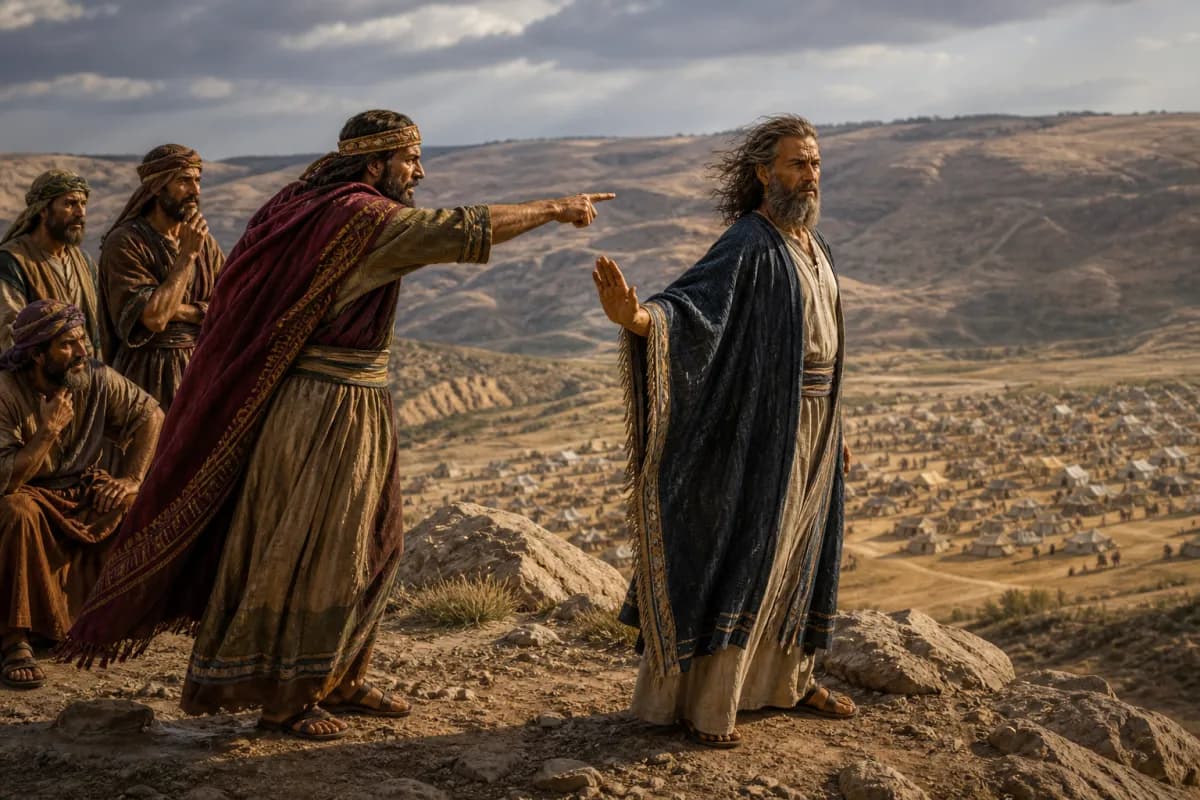
Numbers 23:13–26 follows Balak to a new lookout point, where he hopes a different view will produce a different word. Balaam’s second oracle declares that God is not a human being who lies or changes course, and that no divination can overturn the blessing He has given Israel. Jesus makes God’s faithfulness visible in history: every promise of God finds its yes in Him, and His saving mission cannot be undone by human schemes.
- In this study
- 14 verses · 5 movements
Numbers 23
23:13Balak said to him, “Please come with me to another place, where you may see them. You shall see just part of them, and shall not see them all. Curse them from there for me.”
23:14He took him into the field of Zophim, to the top of Pisgah, and built seven altars, and offered up a bull and a ram on every altar.
23:15He said to Balak, “Stand here by your burnt offering, while I meet God over there.”
23:16The LORD met Balaam, and put a word in his mouth, and said, “Return to Balak, and say this.”
23:17He came to him, and behold, he was standing by his burnt offering, and the princes of Moab with him. Balak said to him, “What has the LORD spoken?”
23:18He took up his parable, and said, “Rise up, Balak, and hear! Listen to me, you son of Zippor.
23:19God is not a man, that he should lie, nor a son of man, that he should repent. Has he said, and he won’t do it? Or has he spoken, and he won’t make it good?
23:20Behold, I have received a command to bless. He has blessed, and I can’t reverse it.
23:21He has not seen iniquity in Jacob. Neither has he seen perverseness in Israel. The LORD his God is with him. The shout of a king is among them.
23:22God brings them out of Egypt. He has as it were the strength of the wild ox.
23:23Surely there is no enchantment with Jacob; neither is there any divination with Israel. Now it shall be said of Jacob and of Israel, ‘What has God done!’
23:24Behold, a people rises up as a lioness. As a lion he lifts himself up. He shall not lie down until he eats of the prey, and drinks the blood of the slain.”
23:25Balak said to Balaam, “Neither curse them at all, nor bless them at all.”
23:26But Balaam answered Balak, “Didn’t I tell you, saying, ‘All that the LORD speaks, that I must do’?”
CONTEXTUAL OVERVIEW
Balak responds to the first blessing by changing locations, as if a partial view of Israel might persuade God to alter His verdict. The movement from one height to another is almost comic in its futility, but it names a serious human impulse: if God’s word is inconvenient, perhaps a new angle, setting, or ritual can make it say something else.
The second oracle moves beyond the statement that Israel is blessed to the character of the One who blesses. God neither lies nor makes promises He will later abandon. Israel’s present failures do not make evil unimportant, but they do not place God’s covenant faithfulness at the mercy of Balak’s manipulation.
HISTORICAL AND LITERARY CONTEXT
Zophim, on the top of Pisgah, gives Balak another vantage point over the camp. The place changes, but the same seven-altars pattern appears. The narrative gives no warrant for treating geography as a way to access a different god; it shows a ruler attempting to repeat a failed strategy without yielding to the Lord.
When the oracle says that God has not beheld trouble in Jacob or seen misery in Israel, it does not erase Israel’s sins or deny the judgments recorded in Numbers. In this immediate setting, it declares that Balak cannot locate a covenant breach he can exploit to revoke God’s blessing. The focus is God’s protective verdict against a hired curse.
SECTION-BY-SECTION ANALYSIS
- A changed viewpoint · Numbers 23:15Balak changes the location, but a different vantage point cannot revise God’s covenant purpose.
- God’s truthfulness · Numbers 23:19The oracle contrasts God’s dependable word with the deceptive and changeable calculations of human power.
- No enchantment · Numbers 23:23The Lord’s presence with Israel, not a counter-technique, makes hostile divination powerless.
CHRIST IN THIS PASSAGE
The declaration about God’s faithful word finds a strong canonical echo in Jesus Christ. The New Testament calls Him the confirmation of God’s promises and the one in whom God’s yes is spoken. The oracle does not predict each detail of Christ’s life, but it reveals the dependable divine character displayed supremely when the Father gives His Son for sinners.
Christ’s mission answers the human attempt to manage God by ritual or fear. At the cross, God acts in costly faithfulness to His promise of mercy; in the resurrection, He shows that hostile powers cannot cancel His saving purpose. Those who belong to Jesus are sent to live from that confidence rather than from superstition or panic.
REFLECTION
It is easy to imitate Balak by moving from one strategy to another while resisting the word we have already heard. This passage invites a steadier faith: God is not manipulated by our anxiety, and He does not abandon His people because circumstances look threatening.
Trusting God’s faithfulness is not passive resignation. It frees us to obey honestly, reject occult or manipulative spiritual practices, and bear witness to Jesus when outcomes are uncertain. His mission advances through people who rest in God’s true word and speak it without alteration.
Original Hebrew Word Study
Numbers 23:19
כָּזַב
kazav · H3576
Usually translated: to lie or prove false
Kazav means to lie. God is not a man who lies or changes His mind, so the blessing He has spoken over Israel cannot be overturned by ritual manipulation.
Follow the Scripture trail
Balaam’s Second Oracle: God Does Not Reverse His Blessing in the larger story
The connection: Balak cannot force God to revise the blessing He has given His covenant people. In Jesus, God’s dependable promise becomes saving reality: He bears sin, rises in victory, and sends His people into the world with hope that no hostile scheme can overturn.
Respond to the passage
Identify one anxious strategy by which you are trying to control an outcome God has not placed in your hands. Entrust it to Jesus, obey the truth you already know, and refuse any practice that treats God as a power to manipulate.
- What does Balak’s move to a new location reveal about his view of God?
- How should the statement that God does not lie or change His mind be read within Numbers’ larger story of Israel’s real accountability?
- How does Christ as God’s yes give courage when you cannot control the outcome?
Prayer
Faithful God, forgive my attempts to manage You through fear or religious technique. Ground me in Your promises fulfilled in Jesus, and make me a calm, truthful witness to Your mercy. Amen.