Passage Study
Baal of Peor: Covenant Zeal and Mercy in a Ruined Camp
Numbers 25:1–25:18
Numbers 25:1–18 shows Israel joining Moabite worship at Peor and suffering a plague until Phinehas acts decisively against a public act of rebellion. The passage treats idolatry as covenant betrayal that destroys a people from within. Jesus alone bears God’s judgment for sinners and creates a holy people whose zeal is shaped by His self-giving love, truth, and mission.
- In this study
- 18 verses · 5 movements
Numbers 25
25:1Israel stayed in Shittim; and the people began to play the prostitute with the daughters of Moab;
25:2for they called the people to the sacrifices of their gods. The people ate and bowed down to their gods.
25:3Israel joined himself to Baal Peor, and the LORD’s anger burned against Israel.
25:4The LORD said to Moses, “Take all the chiefs of the people, and hang them up to the LORD before the sun, that the fierce anger of the LORD may turn away from Israel.”
25:5Moses said to the judges of Israel, “Everyone kill his men who have joined themselves to Baal Peor.”
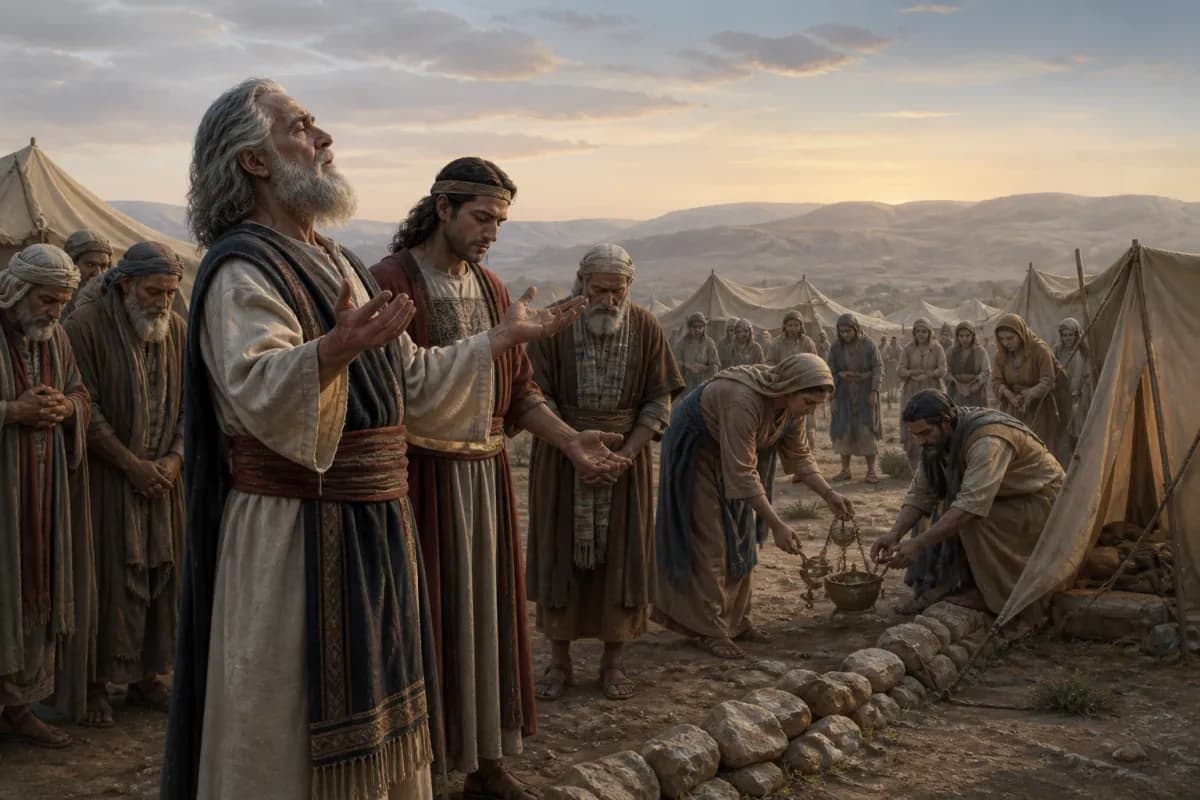
25:6Behold, one of the children of Israel came and brought to his brothers a Midianite woman in the sight of Moses, and in the sight of all the congregation of the children of Israel, while they were weeping at the door of the Tent of Meeting.
25:7When Phinehas, the son of Eleazar, the son of Aaron the priest, saw it, he rose up from the middle of the congregation, and took a spear in his hand.
25:8He went after the man of Israel into the pavilion, and thrust both of them through, the man of Israel, and the woman through her body. So the plague was stopped among the children of Israel.
25:9Those who died by the plague were twenty-four thousand.
25:10The LORD spoke to Moses, saying,
25:11“Phinehas, the son of Eleazar, the son of Aaron the priest, has turned my wrath away from the children of Israel, in that he was jealous with my jealousy among them, so that I didn’t consume the children of Israel in my jealousy.
25:12Therefore say, ‘Behold, I give to him my covenant of peace.
25:13It shall be to him, and to his offspring after him, the covenant of an everlasting priesthood, because he was jealous for his God, and made atonement for the children of Israel.’”
25:14Now the name of the man of Israel that was slain, who was slain with the Midianite woman, was Zimri, the son of Salu, a prince of a fathers’ house among the Simeonites.
25:15The name of the Midianite woman who was slain was Cozbi, the daughter of Zur. He was head of the people of a fathers’ house in Midian.
25:16The LORD spoke to Moses, saying,
25:17“Harass the Midianites, and strike them;
25:18for they harassed you with their wiles, wherein they have deceived you in the matter of Peor, and in the incident regarding Cozbi, the daughter of the prince of Midian, their sister, who was slain on the day of the plague in the matter of Peor.”
CONTEXTUAL OVERVIEW
At the edge of the land, Israel faces a danger no army has achieved: seduction into false worship. The women’s invitation to sacrificial meals draws Israel into Baal of Peor, and the people become “yoked” to the idol. The threat is covenantal before it is military; a people rescued for the Lord is being drawn into a rival allegiance.
The narrative is severe because the rebellion is severe. A plague is already moving through the camp when Zimri openly brings a Midianite woman into the community before Moses and the weeping congregation. Phinehas’ action ends the immediate defiance, but the text does not license personal violence. It records a unique covenant crisis under Israel’s theocratic administration.
HISTORICAL AND LITERARY CONTEXT
Peor lies in Moab’s territory near Israel’s camp. The narrative immediately follows Balaam’s oracles, making the irony sharp: Israel cannot be cursed from outside, yet it can be enticed toward judgment by embracing the worship the Lord forbids. Later biblical texts connect this disaster to Balaam’s counsel, though Numbers 25 keeps the focus on Israel’s own guilt.
Phinehas is Aaron’s grandson and a priest. His covenant of peace and lasting priesthood affirm that God’s holiness and the community’s preservation matter together. The passage does not erase the need for mercy; the plague stops because a decisive act addresses a rebellion that has placed the whole camp under judgment.
SECTION-BY-SECTION ANALYSIS
- A rival table · Numbers 25:3Shared meals become participation in a worshiping community opposed to the Lord.
- Public defiance · Numbers 25:8Zimri’s act is staged in front of the grieving assembly, turning private desire into open contempt for God’s command.
- Peace restored · Numbers 25:12The stopped plague displays God’s mercy toward a camp endangered by rebellion.
CHRIST IN THIS PASSAGE
Phinehas is not a simple model for Christian action. His act belongs to Israel’s unique covenant setting and cannot be transferred into the church’s mission. The lasting theological problem is how a holy God can turn away judgment without ignoring sin. Jesus answers it by giving Himself: He bears the curse sinners deserve and makes peace through His blood.
Christ also calls His people away from idolatry that mingles worship with the values of a surrounding culture. His mission does not advance by coercion, but by the gospel, repentance, holy love, and patient witness. Because He has reconciled us to God, believers can confront compromise truthfully while seeking the restoration of those caught in it.
REFLECTION
Peor warns that temptation often arrives as belonging, pleasure, or a harmless invitation rather than an open denial of God. Ask what loyalties, habits, or relationships are quietly training your heart to bow somewhere other than Jesus.
Confess compromise quickly instead of managing appearances. Christ’s mercy is sufficient for real repentance, and His church needs courage that is neither passive about sin nor cruel toward sinners. Share His invitation to freedom with someone who has been told that obedience and joy cannot coexist.
Original Hebrew Word Study
Numbers 25:1
זָנָה
zanah · H2181
Usually translated: to commit sexual unfaithfulness
Zanah names sexual unfaithfulness and becomes a fitting word for idolatry. Israel’s sin at Peor binds worship, desire, and covenant betrayal together.
Follow the Scripture trail
Baal of Peor: Covenant Zeal and Mercy in a Ruined Camp in the larger story
The connection: Israel cannot be cursed by Balak, yet its own idolatry brings deadly judgment. Jesus bears sin’s curse and makes peace with God, forming a holy people who resist compromise through repentance, love, and gospel witness.
Respond to the passage
Bring one competing loyalty into the light before Jesus. Ask Him for repentance and wise help, then offer the hope of His freeing mercy to someone trapped in a pattern of compromise.
- How does the narrative show that idolatry is more than a private preference?
- Why must Phinehas’ action be read within Israel’s unique covenant setting rather than copied by the church?
- What forms of belonging or pleasure can make compromise appear harmless today?
Prayer
Holy Lord, expose the loyalties that pull my heart away from You. Thank You that Jesus has made peace through His blood. Give me repentant courage, compassionate truthfulness, and a life that points others to His freedom. Amen.