Passage Study
The Daughters of Zelophehad: Justice for a Father’s Name
Numbers 27:1–27:11
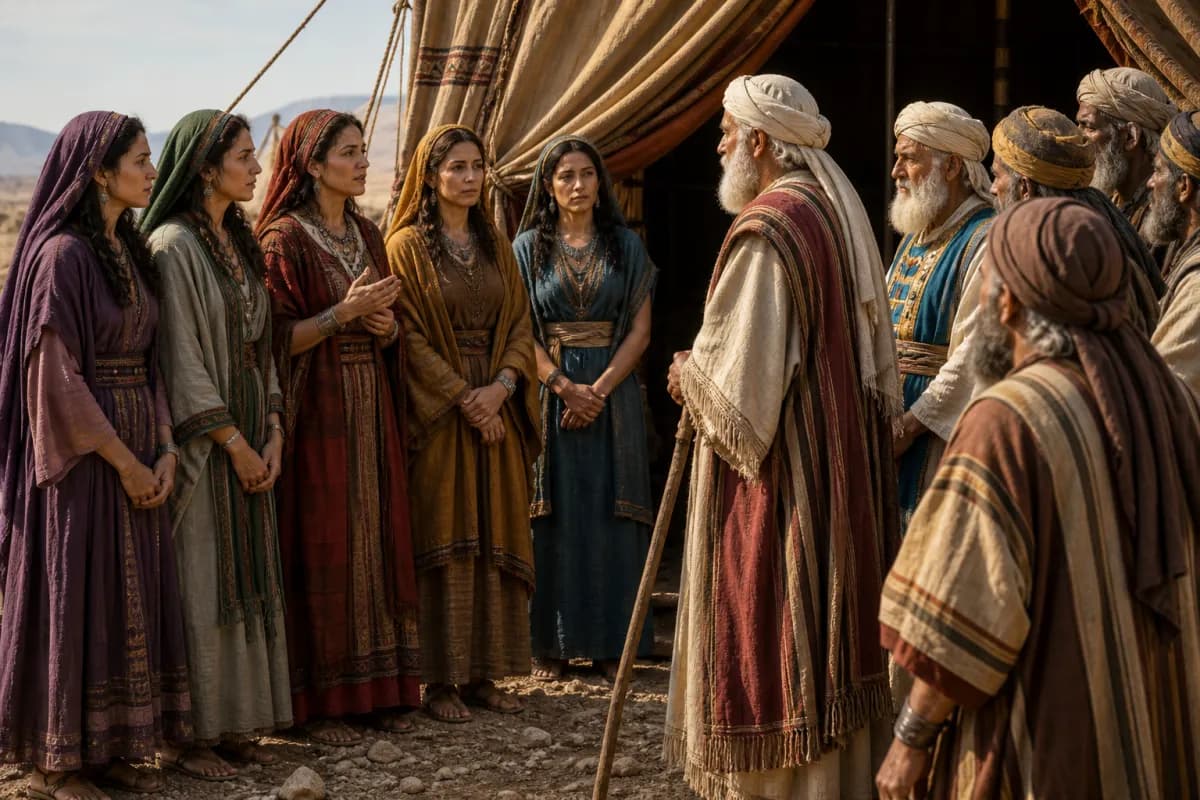
Numbers 27:1–11 brings Mahlah, Noah, Hoglah, Milcah, and Tirzah before Moses to ask why their father’s name should disappear because he had no son. The Lord calls their claim right and establishes an inheritance provision that protects families within the promised land. Jesus welcomes those who seem overlooked and gives His people an enduring inheritance as sons and daughters of God.
- In this study
- 11 verses · 5 movements
Numbers 27
27:1Then the daughters of Zelophehad, the son of Hepher, the son of Gilead, the son of Machir, the son of Manasseh, of the families of Manasseh the son of Joseph came near. These are the names of his daughters: Mahlah, Noah, Hoglah, Milcah, and Tirzah.
27:2They stood before Moses, before Eleazar the priest, and before the princes and all the congregation, at the door of the Tent of Meeting, saying,
27:3“Our father died in the wilderness. He was not among the company of those who gathered themselves together against the LORD in the company of Korah, but he died in his own sin. He had no sons.
27:4Why should the name of our father be taken away from among his family, because he had no son? Give to us a possession among the brothers of our father.”
27:5Moses brought their cause before the LORD.
27:6The LORD spoke to Moses, saying,
27:7“The daughters of Zelophehad speak right. You shall surely give them a possession of an inheritance among their father’s brothers. You shall cause the inheritance of their father to pass to them.
27:8You shall speak to the children of Israel, saying, ‘If a man dies, and has no son, then you shall cause his inheritance to pass to his daughter.
27:9If he has no daughter, then you shall give his inheritance to his brothers.
27:10If he has no brothers, then you shall give his inheritance to his father’s brothers.
27:11If his father has no brothers, then you shall give his inheritance to his kinsman who is next to him of his family, and he shall possess it. This shall be a statute and ordinance for the children of Israel, as the LORD commanded Moses.’”
CONTEXTUAL OVERVIEW
Before the land is distributed, five sisters step forward in the public assembly with a question no previous law has explicitly answered. Their father died in the wilderness without sons. If only sons receive land, his name and household lose their place among the clans of Manasseh.
Their appeal is disciplined and specific. They do not demand a new social order or accuse Moses of injustice; they identify the problem, clarify that their father did not join Korah’s rebellion, and ask for a possession among his brothers. The Lord’s answer honors their moral clarity and makes provision for cases that would otherwise leave a family without an inheritance.
HISTORICAL AND LITERARY CONTEXT
Inheritance in Numbers is tied to tribal land, family identity, and the Lord’s gift of Canaan. This is not simply a matter of private wealth; land keeps each tribe’s allotted place visible across generations. The daughters’ case appears between the second census and Joshua’s commissioning because inheritance is now an immediate question for the people about to enter the land.
The passage does not claim that every ancient inheritance custom is abolished. It addresses a precise situation and gives a legal sequence for it. Numbers 36 will return to the same family’s concern in order to protect both the daughters’ rights and the tribal boundaries of inheritance.
Did you know?
The Cuneiform Digital Library Initiative's composite of the Laws of Ur-Namma preserves a provision that, if a man dies without sons, an unmarried daughter becomes his heir.
Why it matters: This Sumerian legal comparison is not Israelite law and does not explain or source Numbers 27. It gives a concrete ancient legal backdrop for why the daughters' carefully framed appeal about a father who died without sons is such a recognizable inheritance question, while also highlighting that Numbers gives its own covenant-specific ruling.
Laws of Ur-Namma composite (P432130) — Cuneiform Digital Library Initiative
SECTION-BY-SECTION ANALYSIS
- Named daughters · Numbers 27:1The narrative preserves all five names, treating their appeal and place in Israel’s story as significant.
- A case before God · Numbers 27:5Moses models leadership that listens and seeks the Lord when a difficult question exposes an unresolved need.
- Inheritance guarded · Numbers 27:7The resulting law protects a father’s household and keeps the gift of land connected to real families.
CHRIST IN THIS PASSAGE
The passage does not make the daughters symbols to be detached from their actual legal case. It does, however, display the character of the God revealed fully in Jesus: He hears those whose place seems precarious and brings them near rather than leaving them unseen. Christ receives women and men as disciples and gives all who trust Him a place in His family.
Through Jesus, inheritance is widened beyond a plot of land to the new creation promised to God’s children. This does not erase Israel’s concrete land promises or turn the daughters’ request into mere allegory. It shows the larger saving purpose toward which God’s just care for households moves: believers become heirs with Christ by grace and are sent to embody that welcome in His name.
REFLECTION
The daughters of Zelophehad teach holy courage. They speak clearly, honor their father, and bring a real problem before the leaders God has appointed. Their example encourages people who have been overlooked to seek justice without contempt and leaders to listen without defensiveness.
Jesus gives a secure name and inheritance to people who receive Him. Look for someone whose voice or need is being missed in your church, family, or workplace. Listen carefully, act justly, and let that care point beyond you to the Savior who brings outsiders near.
Original Hebrew Word Study
Numbers 27:7
נַחֲלָה
nachalah · H5159
Usually translated: inheritance or possession
Nachalah is an inheritance. The daughters’ case brings justice within Israel’s family law, preserving both their father’s name and their rightful share in the promised land.
Follow the Scripture trail
The Daughters of Zelophehad: Justice for a Father’s Name in the larger story
The connection: Five sisters ask that their father’s place in the promised land not be erased, and God declares their claim right. Jesus gathers overlooked people into God’s family and grants an inheritance by grace that His people are sent to reflect through just, attentive love.
Respond to the passage
Ask Jesus to show you one overlooked need you can hear with care. Where appropriate, speak truthfully and act justly, remembering that your own secure inheritance is a gift of His grace.
- What makes the daughters’ appeal both courageous and respectful?
- Why does Moses bring the question before the Lord rather than decide it from custom?
- How can Christ’s welcome of heirs by grace shape the way a church listens to overlooked people?
Prayer
Lord Jesus, thank You for giving me a place in Your family by grace. Make me attentive to those who are overlooked, courageous in seeking what is right, and faithful in showing Your welcoming mercy. Amen.