Passage Study
Joshua Commissioned: Leadership Under God’s Hand
Numbers 27:12–27:23
Numbers 27:12–23 prepares Israel for Moses’ death and commissions Joshua, a man in whom is the Spirit, before the whole congregation. Moses will see the land but not enter because he failed to uphold God’s holiness at Meribah. Jesus is greater than Moses and Joshua: the sinless Shepherd who leads His people through death into God’s promised rest and equips them for His mission.
- In this study
- 12 verses · 5 movements
Numbers 27
27:12The LORD said to Moses, “Go up into this mountain of Abarim, and see the land which I have given to the children of Israel.
27:13When you have seen it, you also shall be gathered to your people, as Aaron your brother was gathered;
27:14because in the strife of the congregation, you rebelled against my word in the wilderness of Zin, to honor me as holy at the waters before their eyes.” (These are the waters of Meribah of Kadesh in the wilderness of Zin.)
27:15Moses spoke to the LORD, saying,
27:16“Let the LORD, the God of the spirits of all flesh, appoint a man over the congregation,
27:17who may go out before them, and who may come in before them, and who may lead them out, and who may bring them in, that the congregation of the LORD may not be as sheep which have no shepherd.”
27:18The LORD said to Moses, “Take Joshua the son of Nun, a man in whom is the Spirit, and lay your hand on him.
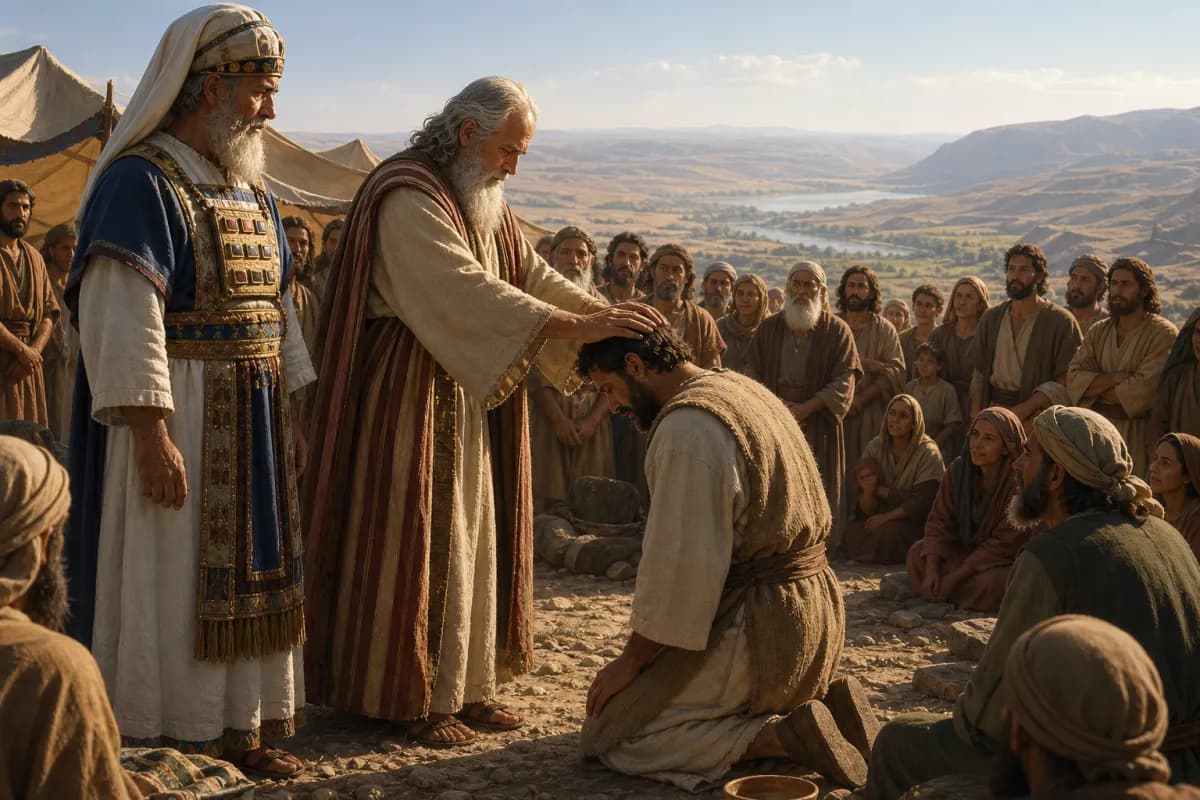
27:19Set him before Eleazar the priest, and before all the congregation; and commission him in their sight.
27:20You shall give authority to him, that all the congregation of the children of Israel may obey.
27:21He shall stand before Eleazar the priest, who shall inquire for him by the judgment of the Urim before the LORD. At his word they shall go out, and at his word they shall come in, both he and all the children of Israel with him, even all the congregation.”
27:22Moses did as the LORD commanded him. He took Joshua, and set him before Eleazar the priest and before all the congregation.
27:23He laid his hands on him and commissioned him, as the LORD spoke by Moses.
CONTEXTUAL OVERVIEW
The second census and inheritance questions make one fact impossible to avoid: Moses will not lead Israel into Canaan. God tells him to climb the mountain, see the land, and prepare to be gathered to his people because of the failure at the waters of Meribah. The scene is both tender and solemn; even Israel’s greatest leader remains answerable to God’s holiness.
Moses’ response reveals his pastoral heart. He does not ask for a reprieve or protect his own position. He asks the Lord to appoint a leader so the congregation will not be like sheep without a shepherd. God answers by naming Joshua and giving a public commissioning that protects the people during a vulnerable transition.
HISTORICAL AND LITERARY CONTEXT
The commission occurs on the plains of Moab, shortly before Deuteronomy and the entrance into the land. Joshua has already appeared as Moses’ assistant, military leader, and one of the faithful spies. Here the Lord’s choice makes clear that Israel’s future does not rest on a succession contest or merely on Joshua’s prior experience.
Eleazar the priest is included because Joshua will seek judgment through the Urim before the Lord. Civil and military leadership remain accountable to God’s revealed direction and priestly ministry. The passage thereby resists both leader worship and the fantasy that a capable successor can replace the Lord’s own presence.
SECTION-BY-SECTION ANALYSIS
- Moses sees but does not enter · Numbers 27:12His discipline teaches that God’s holiness cannot be casually represented, even by a faithful servant.
- Sheep without a shepherd · Numbers 27:17Moses’ concern is not a vacant office but a vulnerable people who need God-given care and direction.
- A public commission · Numbers 27:19Joshua receives authority before the community so Israel can recognize God’s provision in the transition.
CHRIST IN THIS PASSAGE
Joshua is a real successor to Moses, but he is not the final Shepherd. Moses’ plea that Israel not be sheep without a shepherd finds its clearest fulfillment in Jesus, who looks on the crowds with compassion and identifies Himself as the good Shepherd. Jesus does not merely lead Israel across a river; He lays down His life and rises to bring His people into lasting fellowship with God.
The contrast also matters: Moses is disciplined for sin, while Jesus is sinless. Christ fulfills the law’s holy demand, bears the judgment of His people, and sends His church in the power of the Spirit. His mission continues through servant leaders, but their authority remains derivative and accountable to the Shepherd who alone saves.
REFLECTION
Leadership transitions can expose fear, pride, or grief. Moses shows a better response: accept God’s discipline, care about the people, and ask the Lord to provide what the next season requires. Churches and families need this posture when a trusted leader leaves or a new responsibility emerges.
Follow Jesus as your Shepherd rather than fastening your faith to a human leader. Pray for those who lead, support accountable succession, and use your own gifts to serve the flock. In that ordinary faithfulness, Christ continues to care for His people and sends them into His world.
Original Hebrew Word Study
Numbers 27:18
רוּחַ
ruach · H7307
Usually translated: spirit, wind, or breath
Ruach is spirit. Joshua is a man in whom is the Spirit, marking leadership for the next stage of the journey as God-given rather than merely inherited.
Follow the Scripture trail
Joshua Commissioned: Leadership Under God’s Hand in the larger story
The connection: Moses asks God to provide a shepherd for Israel, and Joshua is publicly commissioned for the land ahead. Jesus fulfills the deeper hope as the sinless good Shepherd who gives His life, gathers His flock, and sends them in the power of His Spirit.
Respond to the passage
Entrust one leadership transition or concern to Jesus the Shepherd. Pray for the people who lead you, and take one concrete step to serve rather than merely critique the flock He loves.
- What does Moses’ response to his coming death reveal about his priorities?
- Why is the phrase “sheep without a shepherd” more than a description of a leadership vacancy?
- How does Jesus fulfill the shepherd hope in a deeper way than Joshua can?
Prayer
Good Shepherd, thank You for caring for Your people when human leaders change and fail. Form humility in those who lead, faithful service in those who follow, and confidence in Your saving presence and mission. Amen.