Passage Study
The Redemption of the Firstborn: Belonging Remembered
Numbers 3:40–3:51
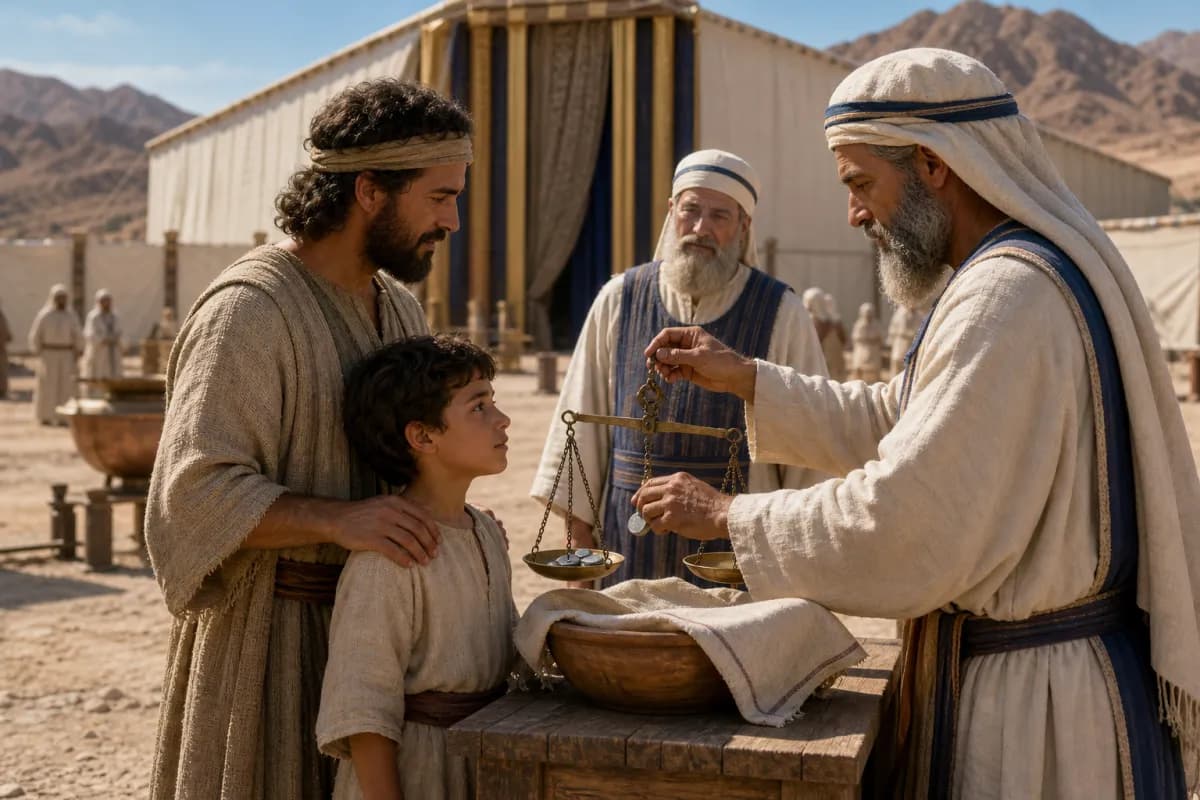
Numbers 3:40–51 counts Israel’s firstborn and provides silver redemption for those exceeding the Levites’ number. The arithmetic preserves a theological memory: Israel’s firstborn belong to the Lord because He spared them at Passover. This representative redemption points to Jesus, whose saving mission gives Himself as the ransom that brings His people to God.
- In this study
- 12 verses · 5 movements
Numbers 3
3:40The LORD said to Moses, “Count all the firstborn males of the children of Israel from a month old and upward, and take the number of their names.
3:41You shall take the Levites for me—I am the LORD—instead of all the firstborn among the children of Israel; and the livestock of the Levites instead of all the firstborn among the livestock of the children of Israel.”
3:42Moses counted, as the LORD commanded him, all the firstborn among the children of Israel.
3:43All the firstborn males according to the number of names from a month old and upward, of those who were counted of them, were twenty-two thousand two hundred seventy-three.
3:44The LORD spoke to Moses, saying,
3:45“Take the Levites instead of all the firstborn among the children of Israel, and the livestock of the Levites instead of their livestock; and the Levites shall be mine. I am the LORD.
3:46For the redemption of the two hundred seventy-three of the firstborn of the children of Israel who exceed the number of the Levites,
3:47you shall take five shekels apiece for each one; according to the shekel of the sanctuary you shall take them (the shekel is twenty gerahs );
3:48and you shall give the money, with which their remainder is redeemed, to Aaron and to his sons.”
3:49Moses took the redemption money from those who exceeded the number of those who were redeemed by the Levites;
3:50from the firstborn of the children of Israel he took the money, one thousand three hundred sixty-five shekels, according to the shekel of the sanctuary;
3:51and Moses gave the redemption money to Aaron and to his sons, according to the LORD’s word, as the LORD commanded Moses.
CONTEXTUAL OVERVIEW
The Levites have been claimed in place of Israel’s firstborn, but Numbers does not leave that claim as a broad idea. The Lord orders an actual count of firstborn males from one month old and upward. The result is precise: the firstborn number 22,273, while the Levites total 22,000.
The excess 273 are redeemed with five shekels each, according to the sanctuary shekel, and the money is given to Aaron and his sons. The small numerical difference keeps the substitution from becoming merely symbolic. Each unmatched firstborn is accounted for, because God’s claim on Israel’s life is neither vague nor forgettable.
HISTORICAL AND LITERARY CONTEXT
The background is the final plague in Egypt. The Lord struck Egypt’s firstborn and spared Israel’s households under the sign of the Passover sacrifice. From that day, Israel’s firstborn were claimed as belonging to Him. Numbers 3 turns that exodus memory into an ongoing sanctuary practice as Israel travels toward the promised land.
The payment does not purchase a private escape from an arbitrary deity. It acknowledges a rescue already given and maintains the substitute relationship between the Levites and Israel’s firstborn. The priestly receipt of the silver places the redemption within the worship God Himself established.
Did you know?
A recent archaeological synthesis reports that, before coins, silver in the ancient Near East circulated by local weight standards in forms such as rings, coils, ax heads, cut ingots, and scrap. In the southern Levant, forty pre-coinage silver hoards date from roughly 1700/1650 to 600 BCE.
Why it matters: Numbers specifies five sanctuary shekels for each unmatched firstborn. This evidence helps readers picture measured silver rather than modern coinage, without claiming that the later hoards document the wilderness payment.
SECTION-BY-SECTION ANALYSIS
- Counted firstborn · Numbers 3:43The exact number makes God’s claim personal; the people spared in Egypt are not lost in a crowd.
- Levites in their place · Numbers 3:41The substitution preserves Passover’s message that Israel lives before God by a provision He supplies.
- Five shekels for the excess · Numbers 3:50The redemption price completes the representation where the Levite total does not match the firstborn total.
CHRIST IN THIS PASSAGE
The silver payment in Numbers 3 is not the same as Christ’s atoning death, and the text does not say that every detail predicts Jesus. Its strong canonical contribution is the language of belonging, substitute representation, and redemption. The firstborn live as those spared by God and therefore claimed by Him.
Jesus fulfills the saving reality that this pattern keeps before Israel. He gives His life as a ransom for many, not as a silver fee but as the self-giving sacrifice that deals with sin and brings people to God. Those He redeems belong to Him because He has rescued them from a judgment they could not avert or repay.
REFLECTION
Modern life often treats belonging as a matter of personal preference. Numbers answers with the memory of mercy: Israel’s firstborn belong to the Lord because He spared them. Gratitude begins when we stop speaking as if our life, time, and future originated with us.
Jesus’ ransom gives this truth its deepest comfort. Christians are not redeemed into anxious debt, but into the Father’s family. Let that grace shape your stewardship and witness. Speak of Christ’s costly mercy plainly to people who carry guilt or strive to prove their worth; His rescue is received, not earned.
Original Hebrew Word Study
Numbers 3:46
פָּדָה
padah · H6299
Usually translated: to redeem or ransom
Padah means to redeem by paying a ransom. The firstborn are redeemed through the Levites and silver, keeping Passover deliverance before Israel as an ongoing claim of God.
Follow the Scripture trail
The Redemption of the Firstborn: Belonging Remembered in the larger story
The connection: The numbered firstborn and their redemption silver make Passover mercy permanent in Israel’s life. Jesus fulfills that saving pattern by giving Himself as the ransom for sinners, claiming them as His own, and sending them out as grateful witnesses to His grace.
Respond to the passage
Name one area of life you have treated as self-owned. Offer it back to Jesus in gratitude, and tell one person this week that His rescue is a gift no one can earn.
- Why does the passage count the firstborn so carefully before speaking of redemption money?
- How does the Passover background protect this payment from being understood as buying God’s favor?
- What changes when you understand yourself as someone redeemed by Christ rather than self-made?
Prayer
Father, thank You for the mercy by which You claim Your people. Lord Jesus, thank You for giving Yourself to ransom sinners. Teach me to receive my life as Your gift, to use it for Your purposes, and to speak of Your saving grace with humility and hope. Amen.