Passage Study
The War Against Midian: The Lord’s Judgment and Israel’s Defilement
Numbers 31:1–31:24
Numbers 31:1–24 records the Lord’s commanded judgment on Midian after Midian’s role in leading Israel into the idolatry of Peor. Israel fights under priestly direction, returns with captives and spoil, and then faces Moses’ rebuke and purification laws. The passage does not license private vengeance or religious violence; it exposes the seriousness of covenant corruption and directs readers to Christ, who bears judgment for sinners and will finally judge evil with perfect justice.
- In this study
- 24 verses · 5 movements
Numbers 31
31:1The LORD spoke to Moses, saying,
31:2“Avenge the children of Israel on the Midianites. Afterward you shall be gathered to your people.”
31:3Moses spoke to the people, saying, “Arm men from among you for war, that they may go against Midian, to execute the LORD’s vengeance on Midian.
31:4You shall send one thousand out of every tribe, throughout all the tribes of Israel, to the war.”
31:5So there were delivered, out of the thousands of Israel, a thousand from every tribe, twelve thousand armed for war.
31:6Moses sent them, one thousand of every tribe, to the war with Phinehas the son of Eleazar the priest, to the war, with the vessels of the sanctuary and the trumpets for the alarm in his hand.
31:7They fought against Midian, as the LORD commanded Moses. They killed every male.
31:8They killed the kings of Midian with the rest of their slain: Evi, Rekem, Zur, Hur, and Reba, the five kings of Midian. They also killed Balaam the son of Beor with the sword.
31:9The children of Israel took the women of Midian captive with their little ones; and all their livestock, all their flocks, and all their goods, they took as plunder.
31:10All their cities in the places in which they lived, and all their encampments, they burned with fire.
31:11They took all the captives, and all the plunder, both of man and of animal.
31:12They brought the captives with the prey and the plunder, to Moses, and to Eleazar the priest, and to the congregation of the children of Israel, to the camp at the plains of Moab, which are by the Jordan at Jericho.
31:13Moses and Eleazar the priest, with all the princes of the congregation, went out to meet them outside of the camp.
31:14Moses was angry with the officers of the army, the captains of thousands and the captains of hundreds, who came from the service of the war.
31:15Moses said to them, “Have you saved all the women alive?
31:16Behold, these caused the children of Israel, through the counsel of Balaam, to commit trespass against the LORD in the matter of Peor, and so the plague was among the congregation of the LORD.
31:17Now therefore kill every male among the little ones, and kill every woman who has known man by lying with him.
31:18But all the girls, who have not known man by lying with him, keep alive for yourselves.
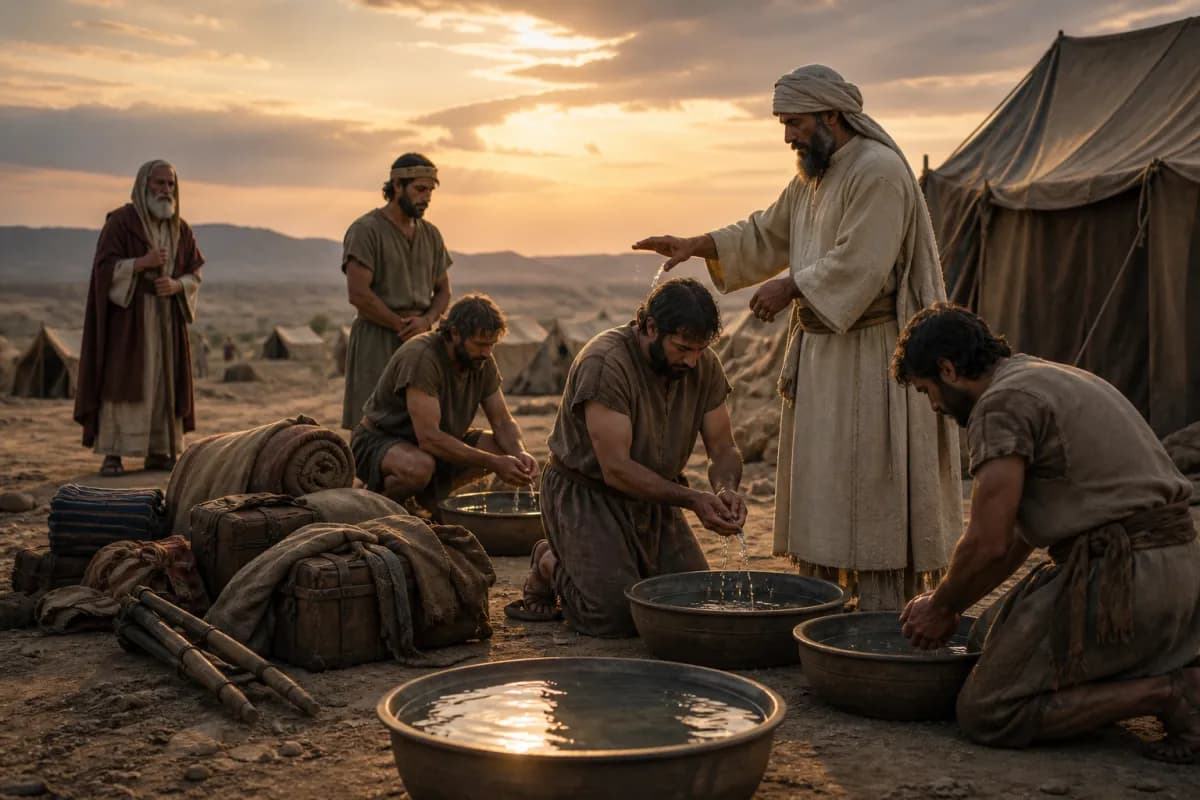
31:19“Encamp outside of the camp for seven days. Whoever has killed any person, and whoever has touched any slain, purify yourselves on the third day and on the seventh day, you and your captives.
31:20You shall purify every garment, and all that is made of skin, and all work of goats’ hair, and all things made of wood.”
31:21Eleazar the priest said to the men of war who went to the battle, “This is the statute of the law which the LORD has commanded Moses.
31:22However the gold, and the silver, the bronze, the iron, the tin, and the lead,
31:23everything that may withstand the fire, you shall make to go through the fire, and it shall be clean; nevertheless it shall be purified with the water for impurity. All that doesn’t withstand the fire you shall make to go through the water.
31:24You shall wash your clothes on the seventh day, and you shall be clean. Afterward you shall come into the camp.”
CONTEXTUAL OVERVIEW
Numbers 31 is one of Scripture’s most morally grave passages. Its immediate context is Numbers 25, where Midianite involvement in the counsel of Balaam led Israel into sexual immorality and idolatry at Peor, bringing a plague on the camp. The war is described as the Lord’s vengeance, not Israel’s private retaliation or expansionist policy.
The narrative also refuses to portray Israel as morally clean warriors. After the battle, the soldiers and the articles taken from Midian must remain outside the camp and undergo purification. Even in a war commanded within this unique covenant setting, death and contact with the dead bring defilement before the holy God who dwells among His people.
HISTORICAL AND LITERARY CONTEXT
Midian in Numbers is associated with the seduction of Israel into Baal worship at Peor, though Midianites appear elsewhere in Scripture in different relationships and places. This chapter’s judgment is tied to the named act of leading Israel away from the Lord; it is not a timeless declaration that every Midianite person or later people is an enemy of God.
Israel is still on the plains of Moab, and Moses is told this will be his final military task before he is gathered to his people. Phinehas, whose zeal halted the Peor plague, goes with the force carrying sacred vessels and trumpets. The details mark this action as an exceptional act under direct divine command in Israel’s theocratic history, not a model for the church’s mission.
SECTION-BY-SECTION ANALYSIS
- Vengeance for the Lord · Numbers 31:3The text locates the judgment in God’s response to the Peor apostasy; it does not authorize personal revenge.
- Balaam’s counsel · Numbers 31:16The narrator links the battle to the earlier scheme that enticed Israel into idolatry and brought covenant judgment.
- Purification after battle · Numbers 31:21Israel’s own need for cleansing shows that contact with death cannot be treated as spiritually neutral.
CHRIST IN THIS PASSAGE
There is no simple one-to-one typology in which Israel’s army represents the church. Jesus forbids His disciples from advancing His kingdom by the sword and commands them to love enemies and announce repentance. The church’s mission is not to repeat Israel’s holy wars but to bear witness to the crucified and risen King among every people.
The chapter does, however, speak truthfully about evils modern readers may soften: idolatry destroys communities, God judges covenant betrayal, and human violence leaves no one able to boast in purity. At the cross, Christ bears the judgment sinners deserve; at His return, He will judge evil without the ignorance, cruelty, or self-interest that corrupts human courts. Until then, His people seek justice through truthful witness, lawful authority, mercy, and prayer for enemies.
REFLECTION
Do not use this chapter to sanctify anger against a rival, another ethnicity, or a political opponent. Its specificity is part of its meaning: it names a historical judgment after a named assault on Israel’s covenant loyalty. It confronts us first with our own attraction to idols and our own need for cleansing.
Bring resentment to Jesus rather than calling it righteous vengeance. Take seriously any influence that draws you or your community toward sexual exploitation, false worship, or contempt for God. Then remember that the Judge who will set things right has made a way for guilty people to be forgiven through His Son.
Original Hebrew Word Study
Numbers 31:2
נָקָם
naqam · H5360
Usually translated: vengeance or just retribution
Naqam is just retribution. The judgment on Midian follows its role in leading Israel into Peor’s idolatry and is carried out under the Lord’s command, not private revenge.
Follow the Scripture trail
The War Against Midian: The Lord’s Judgment and Israel’s Defilement in the larger story
The connection: The Midian judgment belongs to Israel’s singular covenant history and exposes the deadly reach of idolatry. Jesus bears judgment for those who repent and sends His church without the sword to call every people, including enemies, into the mercy and final justice of God.
Respond to the passage
Name any resentment you have been nursing and release its judgment to God. Examine one influence that competes for your worship, and ask Jesus to make your response to evil truthful, courageous, merciful, and free from vengeance.
- How does Numbers 25 explain why this judgment occurs?
- What does the required purification after battle reveal about Israel itself?
- Why can Christians not treat this chapter as permission for violence against enemies?
Prayer
Holy Judge, I confess that I too am vulnerable to idols and anger. Thank You that Jesus bore judgment for sinners and will one day set all things right. Keep me from revenge, cleanse what sin has defiled, and make me a faithful witness of Your mercy. Amen.