Passage Study
Spoil Counted Before the Lord: Victory, Stewardship, and Atonement
Numbers 31:25–31:54
Numbers 31:25–54 counts Midian’s captured people and animals, divides them between the warriors and the congregation, assigns a levy to the Lord for priests and Levites, and ends with officers bringing gold as atonement after discovering no soldier is missing. The passage treats what follows conflict as accountable before God. In Christ, victory cannot become self-congratulation: all that believers receive is held as stewardship before the Savior who gave Himself for them.
- In this study
- 30 verses · 5 movements
Numbers 31
31:25The LORD spoke to Moses, saying,
31:26“Count the plunder that was taken, both of man and of animal, you, and Eleazar the priest, and the heads of the fathers’ households of the congregation;
31:27and divide the plunder into two parts: between the men skilled in war, who went out to battle, and all the congregation.
31:28Levy a tribute to the LORD of the men of war who went out to battle: one soul of five hundred; of the persons, of the cattle, of the donkeys, and of the flocks.
31:29Take it from their half, and give it to Eleazar the priest, for the LORD’s wave offering.
31:30Of the children of Israel’s half, you shall take one drawn out of every fifty, of the persons, of the cattle, of the donkeys, and of the flocks, of all the livestock, and give them to the Levites, who perform the duty of the LORD’s tabernacle.”
31:31Moses and Eleazar the priest did as the LORD commanded Moses.
31:32Now the plunder, over and above the booty which the men of war took, was six hundred seventy-five thousand sheep,
31:33seventy-two thousand head of cattle,
31:34sixty-one thousand donkeys,
31:35and thirty-two thousand persons in all, of the women who had not known man by lying with him.
31:36The half, which was the portion of those who went out to war, was in number three hundred thirty-seven thousand five hundred sheep;
31:37and the LORD’s tribute of the sheep was six hundred seventy-five.
31:38The cattle were thirty-six thousand, of which the LORD’s tribute was seventy-two.
31:39The donkeys were thirty thousand five hundred, of which the LORD’s tribute was sixty-one.
31:40The persons were sixteen thousand, of whom the LORD’s tribute was thirty-two persons.
31:41Moses gave the tribute, which was the LORD’s wave offering, to Eleazar the priest, as the LORD commanded Moses.
31:42Of the children of Israel’s half, which Moses divided off from the men who fought
31:43(now the congregation’s half was three hundred thirty-seven thousand five hundred sheep,
31:44thirty-six thousand head of cattle,
31:45thirty thousand five hundred donkeys,
31:46and sixteen thousand persons),
31:47even of the children of Israel’s half, Moses took one drawn out of every fifty, both of man and of animal, and gave them to the Levites, who performed the duty of the LORD’s tabernacle, as the LORD commanded Moses.
31:48The officers who were over the thousands of the army, the captains of thousands, and the captains of hundreds, came near to Moses.
31:49They said to Moses, “Your servants have taken the sum of the men of war who are under our command, and there lacks not one man of us.
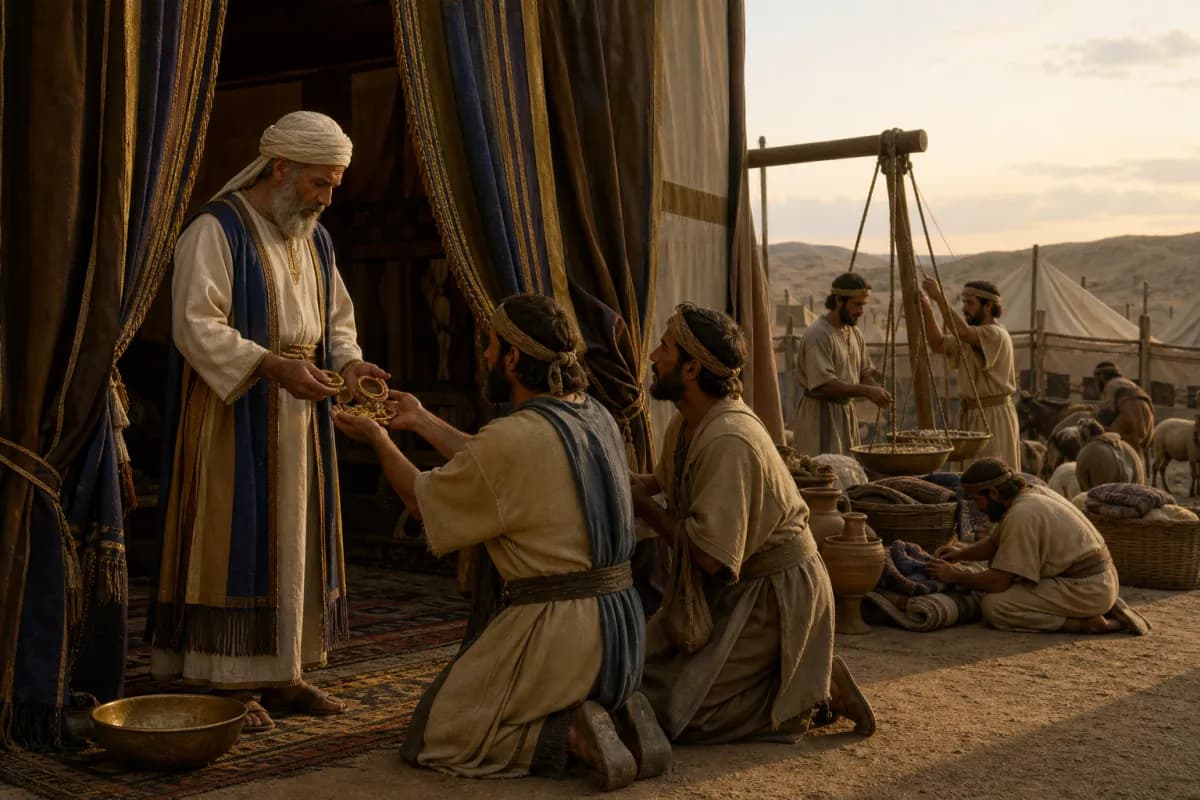
31:50We have brought the LORD’s offering, what every man found: gold ornaments, armlets, bracelets, signet rings, earrings, and necklaces, to make atonement for our souls before the LORD.”
31:51Moses and Eleazar the priest took their gold, even all worked jewels.
31:52All the gold of the wave offering that they offered up to the LORD, of the captains of thousands, and of the captains of hundreds, was sixteen thousand seven hundred fifty shekels.
31:53The men of war had taken booty, every man for himself.
31:54Moses and Eleazar the priest took the gold of the captains of thousands and of hundreds, and brought it into the Tent of Meeting for a memorial for the children of Israel before the LORD.
CONTEXTUAL OVERVIEW
After the battle and purification, Numbers does not simply let Israel keep what it has taken. Moses, Eleazar, and the clan leaders count the people and animals, divide them in a regulated way, and set aside portions for those who serve at the sanctuary. The spoil is subjected to the Lord’s order before it becomes anyone’s possession.
The unexpected final scene centers on the officers. They count their companies and find that not one soldier is missing. In response they bring articles of gold, not as a payment for military success, but as atonement before the Lord. Gratitude is expressed with fear and humility before the God who preserved them.
HISTORICAL AND LITERARY CONTEXT
The distribution follows the Midian conflict in the previous section and belongs to Israel’s unique wilderness legislation. Soldiers receive half and the congregation half, while the Lord’s levies are administered through Eleazar for the priests and through the Levites for their care of the tabernacle. The arrangement prevents military force from becoming a private enrichment project.
The numbers are large and carefully repeated. Their literary function is administrative and theological: the community can see that its gains, labor, and worship are counted in the presence of God. The passage should not be read as a general Christian formula for profits from war; it is part of Israel’s ancient covenant order after a specific judgment.
SECTION-BY-SECTION ANALYSIS
- A counted distribution · Numbers 31:30The goods are not seized into private hands; Israel receives and allocates them under accountable leadership.
- Levies for priest and Levite · Numbers 31:41The community’s gains support the worshiping service through which Israel remembers God’s presence.
- Gold as memorial · Numbers 31:54The officers answer unexpected preservation with a gift before God, acknowledging dependence rather than claiming invulnerability.
CHRIST IN THIS PASSAGE
This account does not establish a way for Christians to earn atonement by giving gold. The officers’ gift belongs within Israel’s sacrificial order, and the New Testament is clear that Christ’s self-offering is sufficient for forgiveness. Yet their response exposes a lasting question: what do people do when they realize they have been preserved through danger they did not control?
Jesus receives no tribute because He needs our wealth; He has given Himself first. His grace turns possessions, influence, and even survival into stewardship. The church can therefore support gospel ministry, relieve need, and confess publicly that its security is not the result of superior strength but the mercy of the crucified and risen Lord.
REFLECTION
Success can obscure dependence. The officers have authority and wealth, yet their first recorded response to the count is not self-praise. They bring their gold before the Lord because every returned soldier is a mercy they cannot finally explain or control.
Consider what God has entrusted to you after a difficult season: money, influence, recovered health, a team, a home, or simply another day. Thank Christ specifically, account for it honestly, and direct part of it toward His people and His mission rather than treating it as proof that you are self-made.
Original Hebrew Word Study
Numbers 31:28
מֶכֶס
mekhes · H4371
Usually translated: levy or tribute
Mekhes is a levy. The distribution of spoil includes a portion for the Lord, acknowledging that victory and its proceeds do not belong to Israel alone.
Follow the Scripture trail
Spoil Counted Before the Lord: Victory, Stewardship, and Atonement in the larger story
The connection: The counted spoil and sanctuary levy teach Israel that even the outcome of conflict remains under the Lord’s claim. Jesus gives the final atonement and turns every preserved life and entrusted resource into an occasion for grateful stewardship and mission.
Respond to the passage
List one resource or protection you have treated as self-made. Thank Jesus for it, account for it honestly, and choose a concrete way to use it for the good of His people or the spread of His gospel.
- Why does the text count and divide the spoil rather than leaving it to individual warriors?
- What does the officers’ gold offering say about their response to preservation?
- How does Christ’s sufficient atonement change the meaning of Christian generosity?
Prayer
Generous God, all I have is held before You. Thank You for preserving me in ways I cannot measure and for giving Jesus as the sufficient sacrifice for my sin. Keep me from pride, make me an honest steward, and use what I hold for Your glory. Amen.