Passage Study
East of the Jordan: Possession and Shared Promise
Numbers 32:1–32:42
Numbers 32:1–42 tests whether Reuben and Gad will let desirable pastureland separate them from Israel’s shared mission to receive the promised land. Moses confronts their request because the memory of Kadesh makes hesitation dangerous. Their eventual pledge to fight alongside their brothers shows that inheritance must be received within covenant solidarity. Jesus gives His people a better inheritance and sends them to seek the good of others rather than settling into self-protective comfort.
- In this study
- 42 verses · 5 movements
Numbers 32
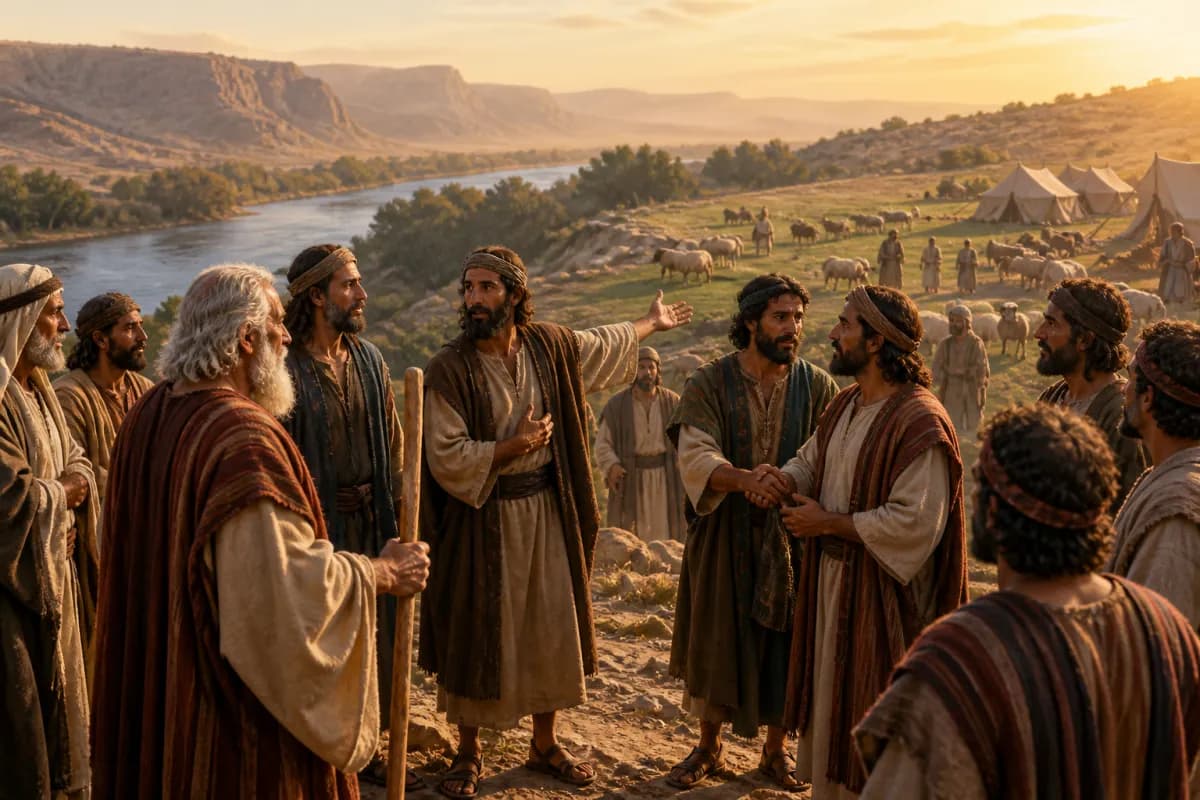
32:1Now the children of Reuben and the children of Gad had a very great multitude of livestock. They saw the land of Jazer, and the land of Gilead. Behold, the place was a place for livestock.
32:2Then the children of Gad and the children of Reuben came and spoke to Moses, and to Eleazar the priest, and to the princes of the congregation, saying,
32:3“Ataroth, Dibon, Jazer, Nimrah, Heshbon, Elealeh, Sebam, Nebo, and Beon,
32:4the land which the LORD struck before the congregation of Israel, is a land for livestock; and your servants have livestock.”
32:5They said, “If we have found favor in your sight, let this land be given to your servants for a possession. Don’t bring us over the Jordan.”
32:6Moses said to the children of Gad, and to the children of Reuben, “Shall your brothers go to war while you sit here?
32:7Why do you discourage the heart of the children of Israel from going over into the land which the LORD has given them?
32:8Your fathers did so when I sent them from Kadesh Barnea to see the land.
32:9For when they went up to the valley of Eshcol, and saw the land, they discouraged the heart of the children of Israel, that they should not go into the land which the LORD had given them.
32:10The LORD’s anger burned in that day, and he swore, saying,
32:11‘Surely none of the men who came up out of Egypt, from twenty years old and upward, shall see the land which I swore to Abraham, to Isaac, and to Jacob; because they have not wholly followed me,
32:12except Caleb the son of Jephunneh the Kenizzite, and Joshua the son of Nun, because they have followed the LORD completely.’
32:13The LORD’s anger burned against Israel, and he made them wander back and forth in the wilderness forty years, until all the generation who had done evil in the LORD’s sight was consumed.
32:14“Behold, you have risen up in your fathers’ place, an increase of sinful men, to increase the fierce anger of the LORD toward Israel.
32:15For if you turn away from after him, he will yet again leave them in the wilderness; and you will destroy all these people.”
32:16They came near to him, and said, “We will build sheepfolds here for our livestock, and cities for our little ones;
32:17but we ourselves will be ready armed to go before the children of Israel, until we have brought them to their place. Our little ones shall dwell in the fortified cities because of the inhabitants of the land.
32:18We will not return to our houses until the children of Israel have all received their inheritance.
32:19For we will not inherit with them on the other side of the Jordan and beyond, because our inheritance has come to us on this side of the Jordan eastward.”
32:20Moses said to them: “If you will do this thing, if you will arm yourselves to go before the LORD to the war,
32:21and every one of your armed men will pass over the Jordan before the LORD until he has driven out his enemies from before him,
32:22and the land is subdued before the LORD; then afterward you shall return, and be clear of obligation to the LORD and to Israel. Then this land shall be your possession before the LORD.
32:23“But if you will not do so, behold, you have sinned against the LORD; and be sure your sin will find you out.
32:24Build cities for your little ones, and folds for your sheep; and do that which has proceeded out of your mouth.”
32:25The children of Gad and the children of Reuben spoke to Moses, saying, “Your servants will do as my lord commands.
32:26Our little ones, our wives, our flocks, and all our livestock shall be there in the cities of Gilead;
32:27but your servants will pass over, every man who is armed for war, before the LORD to battle, as my lord says.”
32:28So Moses commanded concerning them to Eleazar the priest, and to Joshua the son of Nun, and to the heads of the fathers’ households of the tribes of the children of Israel.
32:29Moses said to them, “If the children of Gad and the children of Reuben will pass with you over the Jordan, every man who is armed to battle before the LORD, and the land is subdued before you, then you shall give them the land of Gilead for a possession;
32:30but if they will not pass over with you armed, they shall have possessions among you in the land of Canaan.”
32:31The children of Gad and the children of Reuben answered, saying, “As the LORD has said to your servants, so will we do.
32:32We will pass over armed before the LORD into the land of Canaan, and the possession of our inheritance shall remain with us beyond the Jordan.”
32:33Moses gave to them, even to the children of Gad, and to the children of Reuben, and to the half-tribe of Manasseh the son of Joseph, the kingdom of Sihon king of the Amorites, and the kingdom of Og king of Bashan; the land, according to its cities and borders, even the cities of the surrounding land.
32:34The children of Gad built Dibon, Ataroth, Aroer,
32:35Atroth-shophan, Jazer, Jogbehah,
32:36Beth Nimrah, and Beth Haran: fortified cities and folds for sheep.
32:37The children of Reuben built Heshbon, Elealeh, Kiriathaim,
32:38Nebo, and Baal Meon, (their names being changed), and Sibmah. They gave other names to the cities which they built.
32:39The children of Machir the son of Manasseh went to Gilead, took it, and dispossessed the Amorites who were therein.
32:40Moses gave Gilead to Machir the son of Manasseh; and he lived therein.
32:41Jair the son of Manasseh went and took its villages, and called them Havvoth Jair.
32:42Nobah went and took Kenath and its villages, and called it Nobah, after his own name.
CONTEXTUAL OVERVIEW
Reuben and Gad see that the conquered land east of the Jordan is excellent for livestock, and they own much livestock. Their request sounds practical: let this land become their property and do not take them across the Jordan. But Numbers has trained readers to hear more than economics. Israel stands at the edge of the promise, and a request to remain behind may expose a deeper reluctance to trust and move with the people of God.
Moses responds with the memory of Kadesh. Forty years earlier, fearful speech discouraged the people and delayed entry into the land. The question is larger than where two tribes will graze their flocks: will their private advantage weaken the courage and obedience of the entire covenant community?
HISTORICAL AND LITERARY CONTEXT
The events follow Israel’s victories over Sihon and Og, which brought substantial territory east of the Jordan under Israelite control. Reuben, Gad, and later half of Manasseh receive land there, but the central inheritance narrative remains tied to the land west of the Jordan promised to the patriarchs.
The passage uses Moses’ final leadership to connect a new generation with the failure of the old one. His sharp language is pastoral as well as judicial: he recognizes how fear spreads through a people. The negotiation that follows shows that the tribes’ request is not automatically rejected, but it must be placed under the shared covenant task.
SECTION-BY-SECTION ANALYSIS
- Much livestock · Numbers 32:16A legitimate material need becomes the occasion for testing where the tribes will locate their deepest loyalty.
- Will your brothers go to war? · Numbers 32:6Moses names the communal cost of a decision that could leave others to bear the covenant task alone.
- Before the Lord · Numbers 32:20The revised pledge is not merely military cooperation; it is service performed under God’s authority.
CHRIST IN THIS PASSAGE
Numbers 32 does not turn east-of-Jordan pastureland into a secret symbol of heaven. Its enduring pattern is covenant solidarity: God’s gifts are not meant to detach His people from one another’s obedience and flourishing. Jesus embodies this solidarity perfectly. Though He has all authority, He does not secure comfort for Himself at the expense of those He came to save.
By His cross Jesus brings believers into one body and gives them a shared mission to make disciples. His inheritance is not scarce territory to be guarded from others; it is life with God, received by grace and announced to the nations. Christians may make wise local decisions, but they should ask whether those decisions strengthen or discourage the church’s witness.
REFLECTION
Comfort, location, security, and financial opportunity are real goods. This passage asks whether we will hold them as servants of God’s larger purpose or allow them to excuse us from the costly good of others. A decision may be lawful and still require examination if it leaves brothers and sisters carrying the burden alone.
Ask Jesus where self-protection has narrowed your vision. You may not be called to cross a river with an army, but you are called to share the church’s mission through prayer, generosity, service, and courageous witness. Receive His inheritance with open hands.
Original Hebrew Word Study
Numbers 32:5
אֲחֻזָּה
achuzzah · H272
Usually translated: property or permanent holding
Achuzzah is a permanent holding. Reuben and Gad’s request for land east of the Jordan tests whether they will separate their prosperity from the shared covenant mission.
Follow the Scripture trail
East of the Jordan: Possession and Shared Promise in the larger story
The connection: The eastern tribes learn that an inheritance cannot be pursued as private comfort while the covenant people still need help. Jesus gives His people a shared inheritance through His saving death and sends them to seek one another’s good and carry His gospel to the world.
Respond to the passage
Identify one comfort or opportunity that could make you less available to Christ’s people. Ask how you can hold it in a way that strengthens the church’s mission rather than withdrawing from it.
- Why does Moses immediately connect this request to the failure at Kadesh?
- What changes in Reuben and Gad’s proposal after Moses’ warning?
- How does Christ’s self-giving service challenge the way we pursue legitimate personal goods?
Prayer
Lord Jesus, forgive me for treating Your gifts as reasons to withdraw from Your people. Give me the courage to serve where the need is costly, the humility to seek the good of others, and the joy of sharing Your saving mission. Amen.