Passage Study
The Kohathites and the Holy Things: Nearness with Reverence
Numbers 4:1–4:20
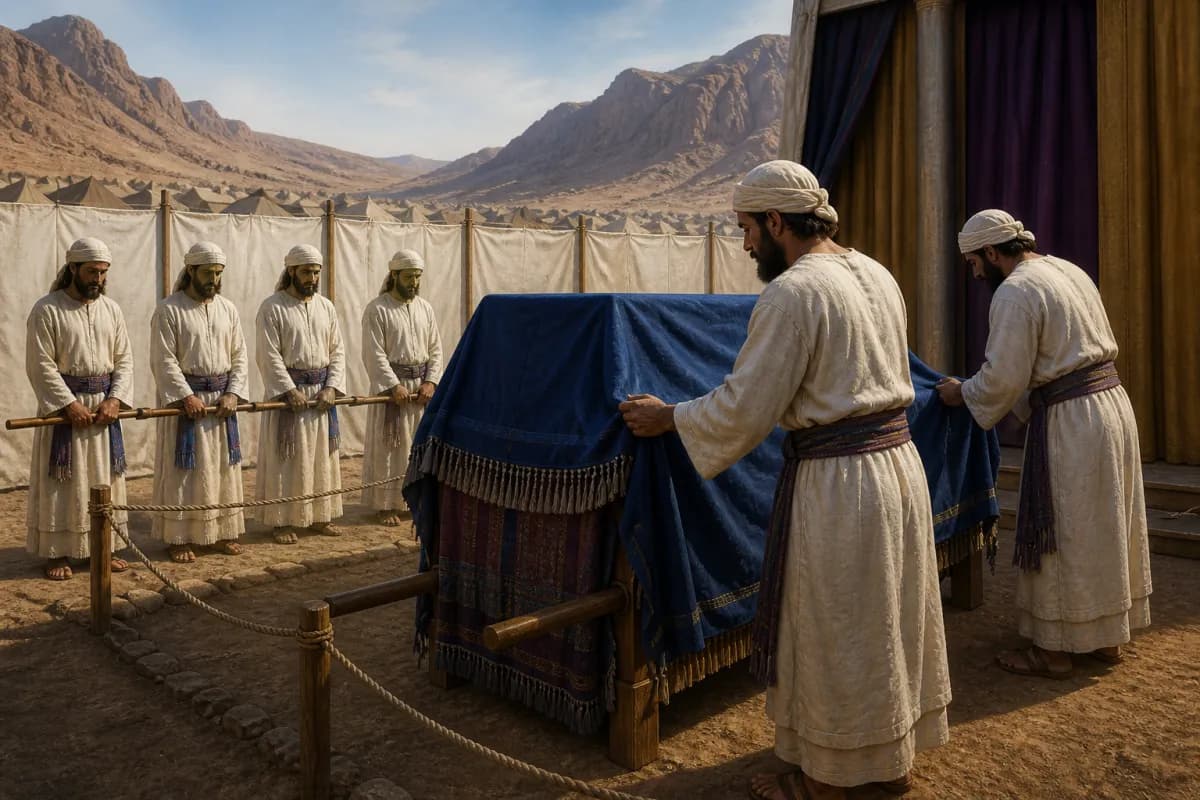
Numbers 4:1–20 assigns the Kohathites to carry the most holy furnishings after Aaron and his sons have carefully covered them. The strict boundaries protect the Kohathites from death and teach Israel that God’s presence is a gift requiring His appointed mediation. Jesus fulfills this need by bringing sinners near to the Father through His once-for-all saving sacrifice.
- In this study
- 20 verses · 5 movements
Numbers 4
4:1The LORD spoke to Moses and to Aaron, saying,
4:2“Take a census of the sons of Kohath from among the sons of Levi, by their families, by their fathers’ houses,
4:3from thirty years old and upward even until fifty years old, all who enter into the service to do the work in the Tent of Meeting.
4:4“This is the service of the sons of Kohath in the Tent of Meeting, regarding the most holy things.
4:5When the camp moves forward, Aaron shall go in with his sons; and they shall take down the veil of the screen, cover the ark of the Testimony with it,
4:6put a covering of sealskin on it, spread a blue cloth over it, and put in its poles.
4:7“On the table of show bread they shall spread a blue cloth, and put on it the dishes, the spoons, the bowls, and the cups with which to pour out; and the continual bread shall be on it.
4:8They shall spread on them a scarlet cloth, and cover it with a covering of sealskin, and shall put in its poles.
4:9“They shall take a blue cloth and cover the lamp stand of the light, its lamps, its snuffers, its snuff dishes, and all its oil vessels, with which they minister to it.
4:10They shall put it and all its vessels within a covering of sealskin, and shall put it on the frame.
4:11“On the golden altar they shall spread a blue cloth, and cover it with a covering of sealskin, and shall put in its poles.
4:12“They shall take all the vessels of ministry with which they minister in the sanctuary, and put them in a blue cloth, cover them with a covering of sealskin, and shall put them on the frame.
4:13“They shall take away the ashes from the altar, and spread a purple cloth on it.
4:14They shall put on it all its vessels with which they minister about it, the fire pans, the meat hooks, the shovels, and the basins—all the vessels of the altar; and they shall spread on it a covering of sealskin, and put in its poles.
4:15“When Aaron and his sons have finished covering the sanctuary and all the furniture of the sanctuary, as the camp moves forward; after that, the sons of Kohath shall come to carry it; but they shall not touch the sanctuary, lest they die. The sons of Kohath shall carry these things belonging to the Tent of Meeting.
4:16“The duty of Eleazar the son of Aaron the priest shall be the oil for the light, the sweet incense, the continual meal offering, and the anointing oil, the requirements of all the tabernacle, and of all that is in it, the sanctuary, and its furnishings.”
4:17The LORD spoke to Moses and to Aaron, saying,
4:18“Don’t cut off the tribe of the families of the Kohathites from among the Levites;
4:19but do this to them, that they may live, and not die, when they approach the most holy things: Aaron and his sons shall go in and appoint everyone to his service and to his burden;
4:20but they shall not go in to see the sanctuary even for a moment, lest they die.”
CONTEXTUAL OVERVIEW
Numbers 4 moves from the Levites’ placement around the tabernacle to their work when Israel breaks camp. Kohath receives the most dangerous and honored assignment: carrying the ark and the furnishings associated with Israel’s worship. Yet the passage repeatedly insists that these things must first be covered by Aaron and his sons.
The warning is severe. Kohath must not touch the holy things or even look on them while they are uncovered, “lest they die.” The point is not that God’s furniture is magical. The objects are set apart because they serve His dwelling among a sinful people, and He provides specific boundaries so that His presence does not consume those called to serve near it.
HISTORICAL AND LITERARY CONTEXT
The tabernacle is portable because Israel is still in the wilderness. Its furnishings must travel, but they cannot travel as ordinary cargo. Priests prepare them; Kohath carries them; each role is given by the Lord. This division continues the lesson of Nadab and Abihu: zeal for sacred work does not authorize a person to ignore God’s command.
The census is limited to men from thirty to fifty years old who enter the service of the tent of meeting. The age range describes this assigned transport duty, not the total value or spiritual standing of all other Levites. The literary focus remains the protection of a clan whose work brings it nearest to the holy furnishings.
SECTION-BY-SECTION ANALYSIS
- Priests cover first · Numbers 4:5Aaron’s family prepares each furnishing before Kohath approaches, preserving the distinct roles God assigns.
- Kohath carries · Numbers 4:2The clan’s task is indispensable, but it is performed under boundaries that acknowledge the holiness of what it bears.
- Do not touch or look · Numbers 4:15The warning protects servants from treating God’s appointed signs of presence as common objects.
CHRIST IN THIS PASSAGE
Numbers 4 should not be used to turn every colored covering into a coded prediction of Jesus. Its clear theological direction is the need for holy mediation. The Kohathites can serve near the sanctuary only because God appoints priests to prepare the way and commands a protected manner of approach.
Jesus fulfills this saving need as the final high priest and sacrifice. In Him, sinners do not seize access to God; they receive it through the One who deals with sin and opens the way to the Father. His cross does not make God less holy. It reveals the costly mercy by which holy love makes a people clean and able to serve God without fear of condemnation.
REFLECTION
Familiarity can make holy things feel ordinary. This passage trains readers to resist that drift. Its care over coverings, poles, and roles teaches that worship is neither casual performance nor a field for spiritual self-assertion. Reverence listens to God’s word and receives the way He provides.
Because Jesus brings us near, reverence need not become dread. We come confidently to God through Him, with cleansed consciences and grateful hearts. That confidence should also make us careful with spiritual leadership: serve Christ’s people as those entrusted with a holy gift, never as owners of access, truth, or influence.
Original Hebrew Word Study
Numbers 4:4
קֹדֶשׁ
qodesh · H6944
Usually translated: holy things
Qodesh names what belongs to God. Kohath’s work with the most holy things requires careful covering and boundaries because service near God’s presence is never casual.
Follow the Scripture trail
The Kohathites and the Holy Things: Nearness with Reverence in the larger story
The connection: Kohath’s guarded service shows that God must provide the way for His people to live near His holiness. Jesus fulfills that saving purpose as priest and sacrifice, opening access to the Father and forming reverent servants for His mission.
Respond to the passage
Approach God today with both confidence in Jesus and real reverence. Ask whether familiarity has made you careless with worship, leadership, or the needs of people Christ died to bring near.
- Why must Aaron’s family cover the furnishings before Kohath begins to carry them?
- How do the warnings in this passage function as protection rather than mere restriction?
- How does Jesus give confidence before God without emptying holiness of its weight?
Prayer
Holy Father, thank You that Jesus has opened the way to You by His blood. Keep me from treating Your presence lightly. Give me humble confidence, a clean conscience, and a servant’s heart as I follow Christ in worship and mission. Amen.