Passage Study
The Merarites: Bearing the Framework of the Tabernacle
Numbers 4:29–4:33
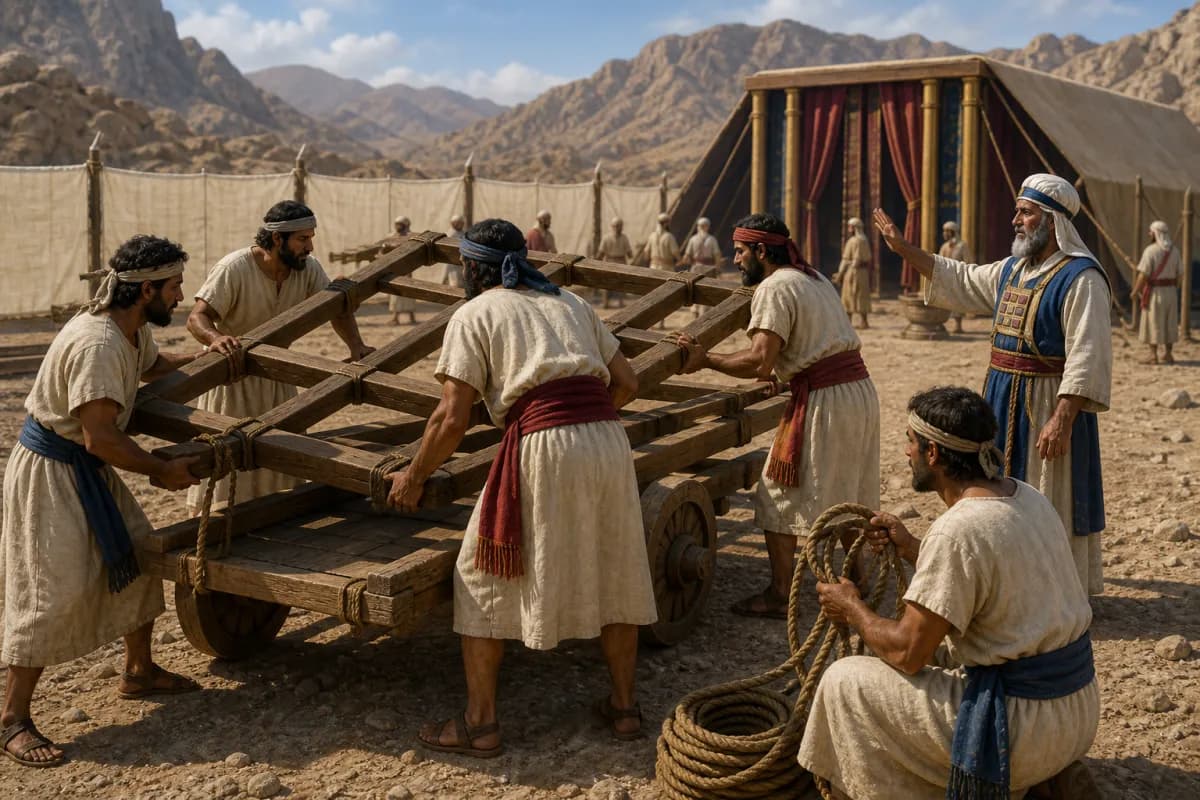
Numbers 4:29–33 assigns Merari’s clans the frames, bars, pillars, bases, pegs, and cords of the tabernacle under Ithamar’s oversight. Their heavy structural work supports the dwelling of God as Israel travels. The passage directs readers to Jesus, who by His saving work builds and sustains a people as God’s dwelling and gives every member meaningful service in His mission.
- In this study
- 5 verses · 5 movements
Numbers 4
4:29“As for the sons of Merari, you shall count them by their families, by their fathers’ houses;
4:30you shall count them from thirty years old and upward even to fifty years old—everyone who enters on the service, to do the work of the Tent of Meeting.
4:31This is the duty of their burden, according to all their service in the Tent of Meeting: the tabernacle’s boards, its bars, its pillars, its sockets,
4:32the pillars of the court around it, their sockets, their pins, their cords, with all their instruments, and with all their service. You shall appoint the instruments of the duty of their burden to them by name.
4:33This is the service of the families of the sons of Merari, according to all their service in the Tent of Meeting, under the hand of Ithamar the son of Aaron the priest.”
CONTEXTUAL OVERVIEW
Merari receives the heaviest material assignment among the Levite clans. Whereas Gershon carries fabrics and Kohath bears covered holy furnishings, Merari handles the tabernacle’s frames, bars, pillars, bases, pegs, and cords. The inventory sounds technical because the work is concrete: a portable dwelling must be taken down, carried, and raised again without losing what makes it stand.
The instruction ends unusually specifically: the Merarites are to be assigned “by name” the objects they are required to carry. God’s worship is not built on vague goodwill. Particular people receive particular loads, and Ithamar oversees that work under Aaron’s priestly authority.
HISTORICAL AND LITERARY CONTEXT
The wilderness tabernacle was designed for a people who had no permanent sanctuary yet. Its structure had to be stable enough for worship and mobile enough for a journey governed by the cloud of God’s presence. Merari’s service gives physical reality to that tension: the Lord’s dwelling is central in Israel’s life even when Israel is moving.
Numbers has already separated priestly duties from Levitical support. Merari neither enters the sanctuary as priest nor handles the most holy items as Kohath does. Its distinct service demonstrates that God’s covenant life depends on more than visible roles. The frames and bases support the space where Israel meets with God according to His word.
SECTION-BY-SECTION ANALYSIS
- Frames and bars · Numbers 4:31Merari carries the primary pieces that give the tabernacle its standing structure.
- Pillars, bases, pegs, and cords · Numbers 4:32The inventory includes supports and fastenings that can seem minor but are indispensable to a secure dwelling.
- Assigned by name · Numbers 4:29Specific accountability honors both the person carrying the load and the sacred purpose the load serves.
CHRIST IN THIS PASSAGE
Merari’s beams and bases do not directly predict details of Jesus’ life. The biblical pattern is that God makes a dwelling among His redeemed people and provides concrete, shared service to sustain it. The passage refuses a spirituality that praises God’s presence while despising the labor required to support the community shaped around that presence.
Jesus fulfills the tabernacle’s deepest purpose by reconciling sinners to God and forming them into a people indwelt by the Spirit. He is the foundation no human effort can replace, yet He also gives gifts to His body so it is built up in love. His mission includes both proclamation of the gospel and the durable, often unseen faithfulness that supports a community of disciples.
REFLECTION
Some Christian service feels like carrying beams: necessary, demanding, and rarely celebrated. Numbers 4 names each part because God does not overlook material burdens borne for the good of His people. Faithful administration, preparation, maintenance, and care can be acts of worship when they are offered to the Lord.
Jesus is not asking you to hold up His church by private strength. He is the foundation and sustainer. Still, He calls His people to carry real responsibilities together. Receive a difficult assignment with dependence on Him, ask for help when the load requires it, and use your steady service to make the gospel community more durable and welcoming.
Original Hebrew Word Study
Numbers 4:31
מַשָּׂא
massa · H4853
Usually translated: load, burden, or carrying task
Massa is a carrying burden. Merari’s heavy structural work gives weight to the truth that every part of the tabernacle depends on assigned, faithful service.
Follow the Scripture trail
The Merarites: Bearing the Framework of the Tabernacle in the larger story
The connection: Merari bears the framework that supports God’s dwelling during Israel’s journey. Jesus fulfills the dwelling’s saving purpose by bringing people to God, becoming their unshakable foundation, and building them together for a durable gospel witness.
Respond to the passage
Bring one weighty, ordinary responsibility to Jesus instead of carrying it as proof of your worth. Ask how your steady service can make His people more secure, cared for, and ready to share His good news.
- Why does the passage name even the pegs and cords assigned to Merari?
- How does the instruction to assign objects by name reshape your view of accountability in shared service?
- What helps you remember that Jesus is the church’s foundation while you carry a real responsibility within it?
Prayer
Lord Jesus, You are the foundation and sustainer of Your people. Thank You for every task that supports worship, care, and witness. Give me strength without self-reliance, humility to receive help, and joy in serving the community You are building by Your grace. Amen.