Passage Study
The Levite Census: Every Burden Accounted For
Numbers 4:34–4:49
Numbers 4:34–49 completes the census of Kohath, Gershon, and Merari, counting each clan’s men for its appointed tabernacle service. The total of 8,580 is not a display of religious bureaucracy; it shows that God knows the workers and loads required for His dwelling to travel with Israel. In Jesus, God gathers a redeemed people, gives them distinct service, and sends them together in His saving mission.
- In this study
- 16 verses · 5 movements
Numbers 4
4:34Moses and Aaron and the princes of the congregation counted the sons of the Kohathites by their families, and by their fathers’ houses,
4:35from thirty years old and upward even to fifty years old, everyone who entered into the service for work in the Tent of Meeting.
4:36Those who were counted of them by their families were two thousand seven hundred fifty.
4:37These are those who were counted of the families of the Kohathites, all who served in the Tent of Meeting, whom Moses and Aaron counted according to the commandment of the LORD by Moses.
4:38Those who were counted of the sons of Gershon, by their families, and by their fathers’ houses,
4:39from thirty years old and upward even to fifty years old—everyone who entered into the service for work in the Tent of Meeting,
4:40even those who were counted of them, by their families, by their fathers’ houses, were two thousand six hundred thirty.
4:41These are those who were counted of the families of the sons of Gershon, all who served in the Tent of Meeting, whom Moses and Aaron counted according to the commandment of the LORD.
4:42Those who were counted of the families of the sons of Merari, by their families, by their fathers’ houses,
4:43from thirty years old and upward even to fifty years old—everyone who entered into the service for work in the Tent of Meeting,
4:44even those who were counted of them by their families, were three thousand two hundred.
4:45These are those who were counted of the families of the sons of Merari, whom Moses and Aaron counted according to the commandment of the LORD by Moses.
4:46All those who were counted of the Levites whom Moses and Aaron and the princes of Israel counted, by their families and by their fathers’ houses,
4:47from thirty years old and upward even to fifty years old, everyone who entered in to do the work of service and the work of bearing burdens in the Tent of Meeting,
4:48even those who were counted of them, were eight thousand five hundred eighty.
4:49According to the commandment of the LORD they were counted by Moses, everyone according to his service and according to his burden. Thus they were counted by him, as the LORD commanded Moses.
CONTEXTUAL OVERVIEW
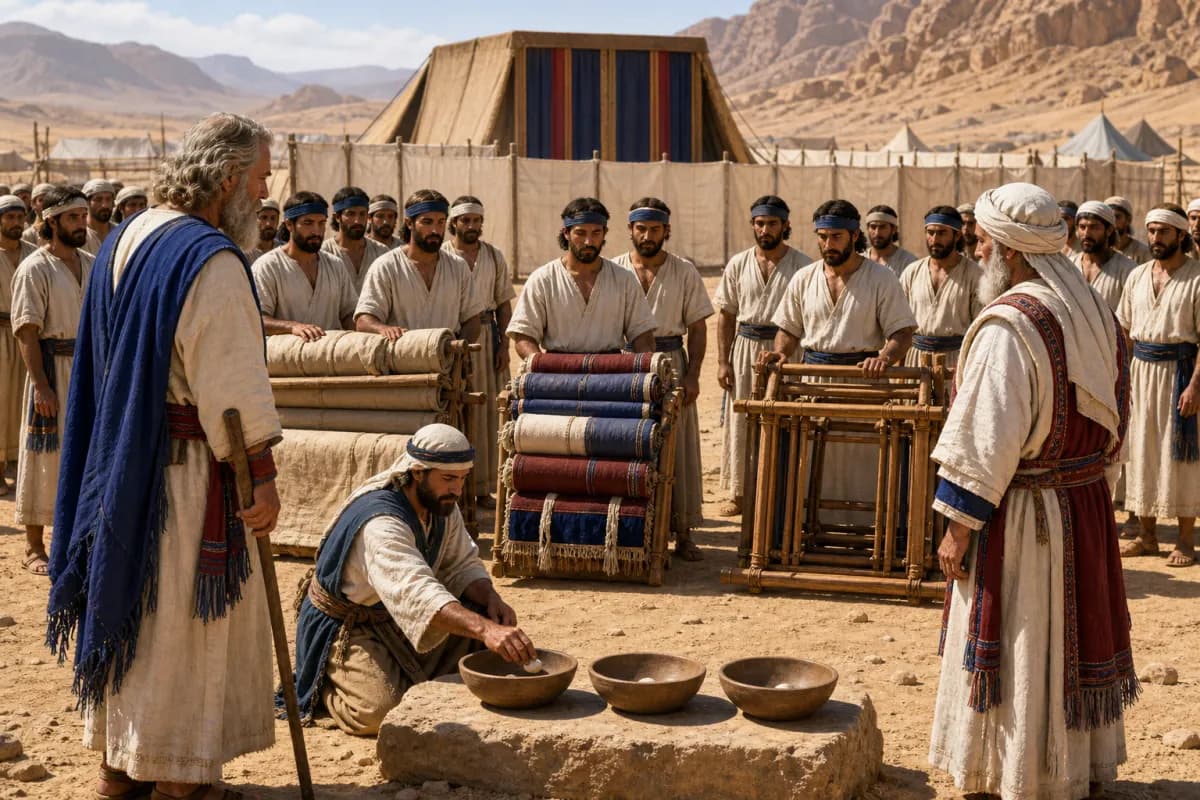
The earlier parts of Numbers 4 have assigned very different work to the three Levitical clans. Kohath bears the covered holy furnishings, Gershon carries the curtains and coverings, and Merari transports the frames, bases, pillars, and cords. Here the narrative brings those separate inventories to a close by counting the workers who will perform them.
The final total, 8,580 men from thirty to fifty years old, gives concrete scale to Israel’s worshiping life in the wilderness. God’s presence at the camp’s center requires neither vague enthusiasm nor a few celebrated individuals. It calls for an ordered people, known by family and entrusted with real responsibilities as the camp moves toward the promised land.
HISTORICAL AND LITERARY CONTEXT
Israel has been at Sinai, where the Lord established the tabernacle and set the Levites apart to guard and serve it. Numbers now prepares the nation to leave Sinai. The Levites are counted only for the strenuous, mobile work connected with the tent of meeting; the age range defines this duty and should not be read as a measure of the value of every other Levite.
The repeated wording, “according to their tasks and their burdens,” links number to vocation. Kohath, Gershon, and Merari do not compete for the same role. The Lord gives each clan a defined share in carrying the sanctuary, and Moses counts them according to the command received through him.
Did you know?
A Ur III yearly labor account published by the Cuneiform Digital Library Initiative records a thirty-three-man crew under a foreman. It names the workers individually, classifying twenty-four at a half work norm and the others as porters expected to meet a full norm.
Why it matters: This Mesopotamian account is not Israel's census, but it gives a concrete ancient example of a work crew whose members, expected output, and completed tasks were preserved in one yearly record. That helps readers see why Numbers 4 joins its totals to named responsibilities and burdens.
Cuneiform Digital Library Initiative: The Year: Nissen returns joyous from a distant island
SECTION-BY-SECTION ANALYSIS
- Kohath, Gershon, and Merari · Numbers 4:38The three clans are counted together only after their different sacred transport duties have been carefully distinguished.
- 8,580 workers · Numbers 4:35The total makes visible the large community of service required to keep the tabernacle at the center of Israel’s journey.
- Task and burden · Numbers 4:49God assigns work concretely, joining accountability to the strength and calling of real people.
CHRIST IN THIS PASSAGE
The Levite totals do not conceal a numerical code about Jesus. Their clearer canonical force is that the God who dwells with His redeemed people also orders their shared service. The tabernacle itself points to God’s desire to live among His people; Jesus brings that purpose to its fullness by coming among us and reconciling sinners to the Father.
The risen Christ forms one body with many members and gives grace for different kinds of service. His saving mission is carried forward by the whole church, not only by conspicuous leaders. In that sense, Numbers 4 prepares readers to see faithful, ordered service as a response to redemption: people rescued by Christ bear one another’s burdens and make His gospel visible together.
REFLECTION
Some believers feel that their work for Christ is too ordinary to count. Others carry a burden that has never been clearly named or shared. This census honors both the visibility of each load and the need for wise distribution. God is not confused about what His people need, and He does not ask one person to become the whole body.
Jesus knows His servants more personally than Moses could count them. Ask Him to clarify the work you have been given and to show where you can strengthen another person’s load. His church reflects His saving love when gifts are used without rivalry and burdens are carried without resentment.
Original Hebrew Word Study
Numbers 4:35
צָבָא
tsava · H6633
Usually translated: service, company, or host
Tsava can describe an ordered company for service. The Levites are counted for tabernacle duty, presenting worship as disciplined, shared service before God.
Follow the Scripture trail
The Levite Census: Every Burden Accounted For in the larger story
The connection: The census of Levite workers shows God ordering every burden needed for His dwelling to travel with His redeemed people. Jesus fulfills that dwelling purpose, gathers a diverse church by His cross, and equips it to bear His saving message together.
Respond to the passage
Thank Jesus for the particular people who make your church’s worship and care possible. Receive your own service as a gift from Him, and ask one practical question this week: whose burden can I help carry for the good of Christ’s people?
- Why does the text connect the census to particular tasks and burdens instead of recording one undifferentiated Levitical total?
- What danger arises when a congregation admires visible gifts but overlooks the work that sustains its common life?
- How does Christ’s care for every member of His body shape your willingness to serve and receive help?
Prayer
Lord Jesus, thank You for gathering Your people and giving us work to share in Your mission. Keep me from envy, isolation, and resentment. Show me the burden You have entrusted to me, and make me ready to strengthen others with the grace You supply. Amen.