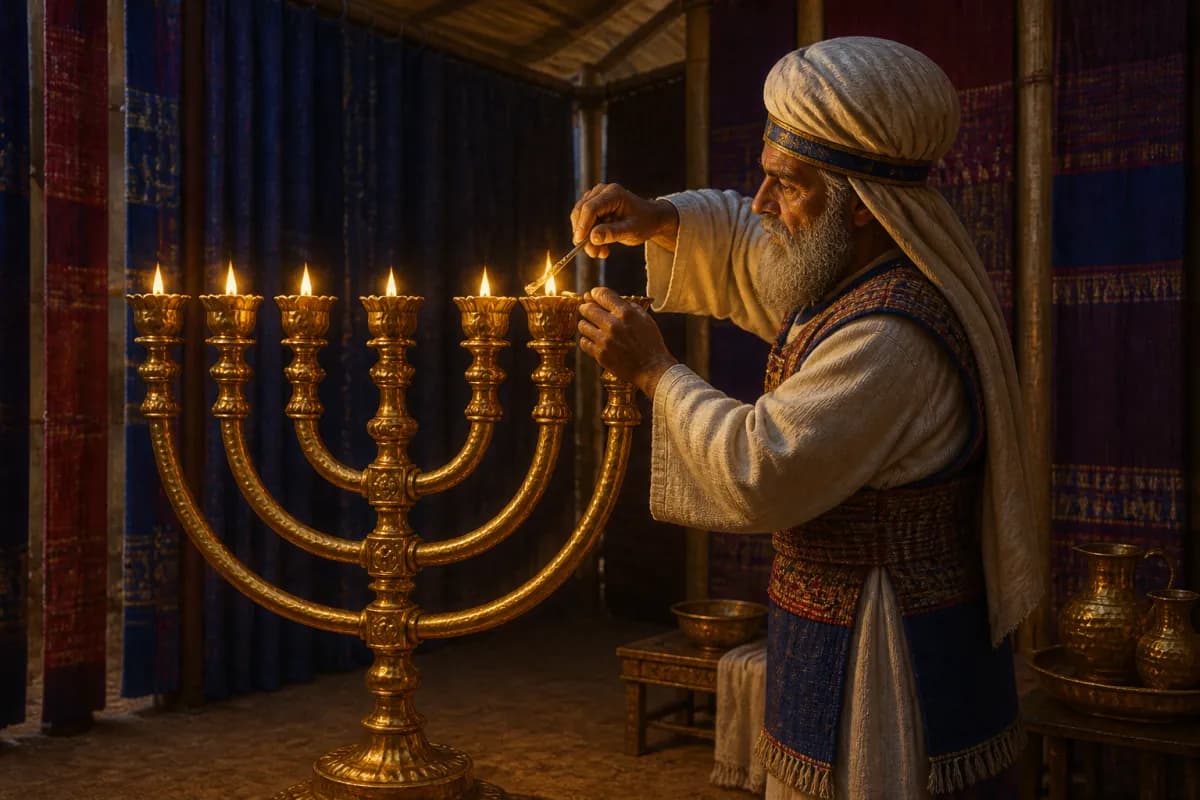
Passage Study
The Lampstand: Light Ordered Before the Lord
Numbers 8:1–8:4
Numbers 8:1–4 tells Aaron to set the seven lamps of the lampstand so that they cast light in front of it, and it recalls that the lampstand was made exactly as the Lord showed Moses. This small instruction makes worship’s details matter because God’s presence is holy. Jesus is the light of the world; through His saving mission He brings people out of darkness and forms them to shine as His faithful witnesses.
- In this study
- 4 verses · 5 movements
Numbers 8
8:1The LORD spoke to Moses, saying,
8:2“Speak to Aaron, and tell him, ‘When you light the lamps, the seven lamps shall give light in front of the lamp stand.’”
8:3Aaron did so. He lit its lamps to light the area in front of the lamp stand, as the LORD commanded Moses.
8:4This was the workmanship of the lamp stand, beaten work of gold. From its base to its flowers, it was beaten work. He made the lamp stand according to the pattern which the LORD had shown Moses.
CONTEXTUAL OVERVIEW
After the long altar dedication, Numbers narrows to one furnishing inside the tabernacle: the seven-lamped stand. Aaron is told to arrange the lamps so that their light falls before the stand. The scene is quiet, but it is not incidental. The Lord who receives Israel’s public offerings also directs the daily light within His dwelling.
The lampstand itself had been made of hammered gold according to the pattern shown to Moses. The text emphasizes both the crafted object and obedient use of it. Israel’s worship is not a matter of human taste; its form is shaped by the God who chooses to dwell among His people.
HISTORICAL AND LITERARY CONTEXT
The lampstand stands in the holy place of the tabernacle, opposite the table of bread. Its seven lamps provide light in a tent otherwise closed to daylight. Exodus had given its design; Numbers now records Aaron’s placement of the lamps as Israel begins the journey from Sinai.
This is not a command to treat light as an abstract spiritual symbol divorced from the tabernacle. The immediate issue is faithful priestly service. Yet throughout Scripture light naturally becomes a way of speaking about God’s life, truth, and saving presence, especially when darkness describes alienation and sin.
Did you know?
A bronze prutah of Mattathias Antigonus, minted in Jerusalem in 40–37 BCE, bears a seven-branched menorah. The Jewish Museum identifies it as one of the rare images of the lampstand made while the Jerusalem Temple was still standing.
Why it matters: This small coin gives readers a concrete later visual witness to the lampstand's public significance, while neither reconstructing the tabernacle object nor proving its exact appearance in Numbers.
Prutah of King Mattathias Antigonus — The Jewish Museum Online Collection
SECTION-BY-SECTION ANALYSIS
- Seven lamps · Numbers 8:2The lamps provide ordered light for service in the holy place.
- Aaron obeyed · Numbers 8:3The priest’s simple obedience models reverence in details that could be dismissed as minor.
- Shown to Moses · Numbers 8:4The pattern grounds tabernacle worship in God’s initiative and instruction.
CHRIST IN THIS PASSAGE
The lampstand is not a direct prediction that every feature must be decoded as Christ. Its setting does, however, contribute to the biblical theme of God giving light where His people cannot create it for themselves. Jesus explicitly calls Himself the light of the world and says that those who follow Him will have the light of life.
His saving mission delivers people from the darkness of sin and brings them into the Father’s kingdom. The church does not become the source of that light, but it bears witness to it. As believers live in Christ’s truth and mercy, they point beyond themselves to the One whose death and resurrection bring light to the nations.
REFLECTION
Faithfulness often appears in details no audience applauds: preparing a room, keeping a promise, praying regularly, or caring for a task entrusted by others. Aaron’s obedience with the lamps reminds us that ordinary faithfulness is still worship when it answers God’s word.
Jesus does not ask us to manufacture spiritual brightness. He asks us to follow Him and remain in His truth. Let His light expose the places you hide, then ask for courage to live openly enough that others can see the goodness of the Savior rather than a performance of religious competence.
Original Hebrew Word Study
Numbers 8:2
מוּל
mul · H4136
Usually translated: in front of or opposite
Mul means in front of or opposite. The lamps are arranged to cast light before the lampstand, a small but deliberate detail of worship ordered toward God’s presence.
Follow the Scripture trail
The Lampstand: Light Ordered Before the Lord in the larger story
The connection: The tabernacle lamp gives God-appointed light where His people serve before Him. Jesus is the true light who rescues people from darkness, and He sends His church to reflect His saving truth before the world.
Respond to the passage
Name one ordinary responsibility you have treated as spiritually insignificant. Offer it to Jesus as faithful service, and ask Him to make your life a clear witness to His light.
- Why does the passage care about the direction and pattern of the lampstand?
- What does Aaron’s brief act of obedience teach about worship in ordinary details?
- How can Christians reflect Jesus’ light without claiming to be its source?
Prayer
Lord Jesus, You are the light of the world. Bring Your truth into the places I avoid and make me faithful in the ordinary work You give. Let my life direct others to the Father and to Your saving mercy. Amen.