Passage Study
Passover in the Wilderness: Remembering the Rescue That Made a People
Numbers 9:1–9:14
Numbers 9:1–14 commands Israel to keep Passover in the wilderness on its appointed date and provides a second observance for those temporarily unclean or away on a journey. The feast keeps the exodus rescue at the center of a people now preparing to travel. Jesus fulfills Passover as the Lamb whose death brings redemption, and His saving mission welcomes all who come to God through Him.
- In this study
- 14 verses · 5 movements
Numbers 9
9:1The LORD spoke to Moses in the wilderness of Sinai, in the first month of the second year after they had come out of the land of Egypt, saying,
9:2“Let the children of Israel keep the Passover in its appointed season.
9:3On the fourteenth day of this month, at evening, you shall keep it in its appointed season. You shall keep it according to all its statutes and according to all its ordinances.”
9:4Moses told the children of Israel that they should keep the Passover.
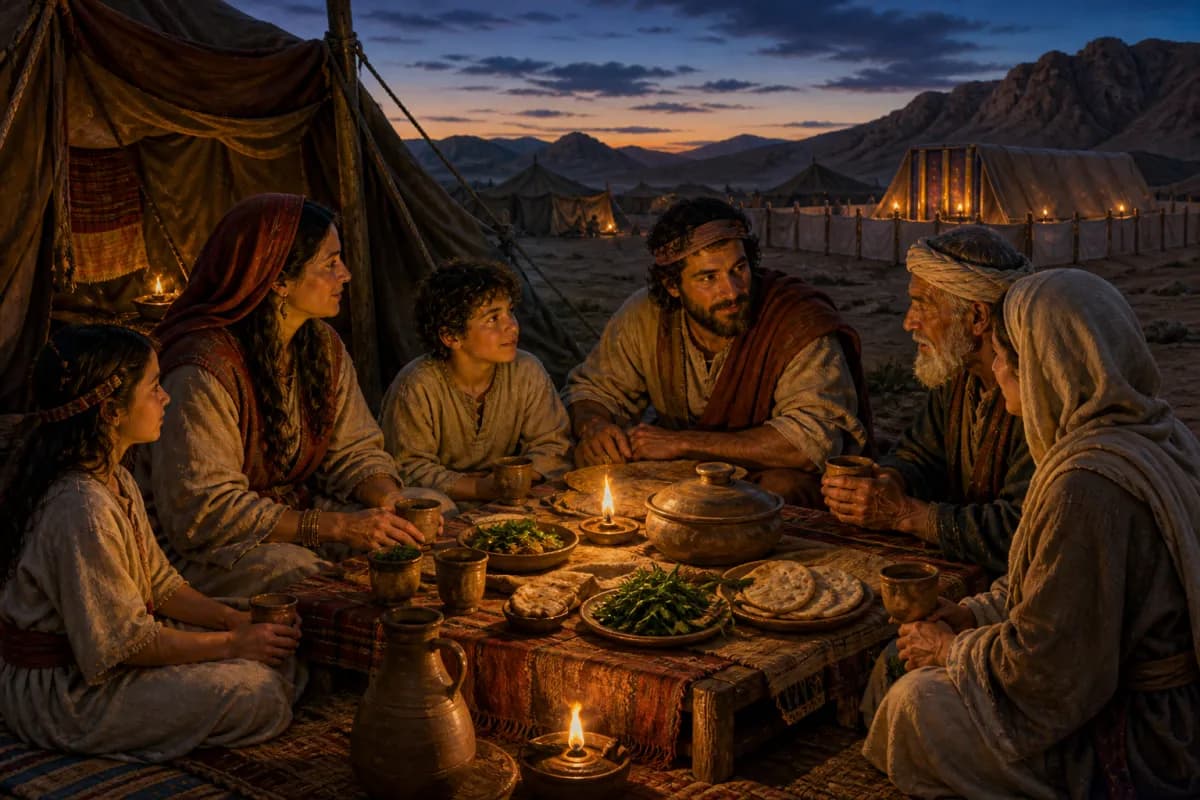
9:5They kept the Passover in the first month, on the fourteenth day of the month at evening, in the wilderness of Sinai. According to all that the LORD commanded Moses, so the children of Israel did.
9:6There were certain men who were unclean because of the dead body of a man, so that they could not keep the Passover on that day, and they came before Moses and Aaron on that day.
9:7Those men said to him, “We are unclean because of the dead body of a man. Why are we kept back, that we may not offer the offering of the LORD in its appointed season among the children of Israel?”
9:8Moses answered them, “Wait, that I may hear what the LORD will command concerning you.”
9:9The LORD spoke to Moses, saying,
9:10“Say to the children of Israel, ‘If any man of you or of your generations is unclean by reason of a dead body, or is on a journey far away, he shall still keep the Passover to the LORD.
9:11In the second month, on the fourteenth day at evening they shall keep it; they shall eat it with unleavened bread and bitter herbs.
9:12They shall leave none of it until the morning, nor break a bone of it. According to all the statute of the Passover they shall keep it.
9:13But the man who is clean, and is not on a journey, and fails to keep the Passover, that soul shall be cut off from his people. Because he didn’t offer the offering of the LORD in its appointed season, that man shall bear his sin.
9:14“‘If a foreigner lives among you and desires to keep the Passover to the LORD, then he shall do so according to the statute of the Passover, and according to its ordinance. You shall have one statute, both for the foreigner and for him who is born in the land.’”
CONTEXTUAL OVERVIEW
Numbers 9 reaches backward before it moves forward. Israel is about to leave Sinai, but the Lord first commands them to observe Passover on the fourteenth day of the first month. The meal remembers the night when God passed over Israel’s houses in Egypt and brought slaves out under His protection.
A real pastoral question interrupts the celebration. Some people are unclean because they have handled a corpse and cannot participate on the prescribed day. They do not dismiss the feast; they come to Moses and Aaron asking why they should be kept from bringing the Lord’s offering. Their question receives an answer that protects both holiness and their place among the redeemed people.
HISTORICAL AND LITERARY CONTEXT
This is the second Passover after the exodus, kept in the wilderness of Sinai. Exodus established the original meal and its regulations; Numbers treats it as the continuing memorial of Israel’s identity. The nation’s future journey must be shaped by the rescue that created it, not simply by its next military or geographic objective.
The second-month provision is limited. It addresses those made unclean by a corpse or away on a journey, not indifference. They keep the same Passover regulations a month later. The chapter also says that a resident alien who lives among Israel may keep Passover by the same statute, placing shared worship under the same holy requirements rather than creating a lesser category.
Did you know?
A 419 BCE papyrus in Berlin's collection records a letter from Hananiah to Jedoniah and the Jewish garrison at Elephantine about regulations for the Passover festival under Darius II.
Why it matters: This later primary record gives a tangible glimpse of Passover being coordinated by written instruction in a Jewish community far from the land; it does not reconstruct the wilderness observance or prove how Numbers 9 was first practiced.
Aramaic document: letter concerning the Passover festival — Staatliche Museen zu Berlin
SECTION-BY-SECTION ANALYSIS
- At its appointed time · Numbers 9:2Passover makes God’s historic rescue the recurring center of Israel’s communal memory.
- A second observance · Numbers 9:1The Lord provides for temporary exclusion without treating holiness as unimportant or the excluded as disposable.
- One statute · Numbers 9:14The resident alien is neither ignored nor given a separate path; shared worship rests on the same God-given terms.
CHRIST IN THIS PASSAGE
Passover bears an explicit Christ-centered fulfillment in the New Testament. Paul calls Christ “our Passover lamb,” and John’s passion narrative presents Jesus’ death during Passover with details that recall the lamb whose bones were not broken. Jesus does not merely renew Israel’s memory of an old rescue; by His death He accomplishes the decisive deliverance from sin and judgment.
The provision for people who want to join the feast should not be stretched into an allegory of every spiritual delay. Its clear pastoral force is that God makes a holy way for His redeemed people to participate. In Christ, people from every background are brought near by grace and invited into the one family formed by His saving sacrifice and mission.
REFLECTION
God knows that His people need regular remembrance. We easily treat salvation as a past fact rather than the foundation for today’s obedience, courage, and worship. Passover’s place in the wilderness teaches that the journey is sustained by remembering who rescued us and at what cost.
Jesus has given His church a meal of remembrance centered on His body and blood. Come to Him honestly when sin, grief, or isolation makes you feel distant. His grace does not make holiness irrelevant; it makes forgiveness and restored fellowship possible. Carry that welcome into your relationships so that people hear the gospel as God’s costly invitation to come near through Christ.
Original Hebrew Word Study
Numbers 9:2
פֶּסַח
pesach · H6453
Usually translated: Passover
Pesach is Passover. Israel keeps the feast in the wilderness, showing that deliverance from Egypt remains the foundation of their identity even while they travel.
Follow the Scripture trail
Passover in the Wilderness: Remembering the Rescue That Made a People in the larger story
The connection: Passover keeps Israel’s exodus rescue at the heart of its wilderness journey and opens a holy way for the community to remember together. Jesus fulfills that rescue as the true Passover Lamb, bringing people near to God and sending His redeemed family into the world with His gospel.
Respond to the passage
Take time to remember the concrete rescue Jesus accomplished at the cross. Ask Him to expose any indifference that treats His grace casually, and ask for a heart that warmly invites others to the same costly welcome.
- Why does God command Passover before Israel leaves Sinai?
- What do the people made unclean by death teach us about longing for worship and respecting holiness?
- How does Jesus as the Passover Lamb shape the church’s identity and mission?
Prayer
Lord Jesus, thank You for giving Yourself as the Passover Lamb who delivers me from sin and judgment. Keep Your cross at the center of my life. Give me reverence, grateful joy, and courage to invite others into the saving welcome You have made possible. Amen.