Passage Study
The Cloud Over the Tabernacle: Learning to Move at God’s Command
Numbers 9:15–9:23
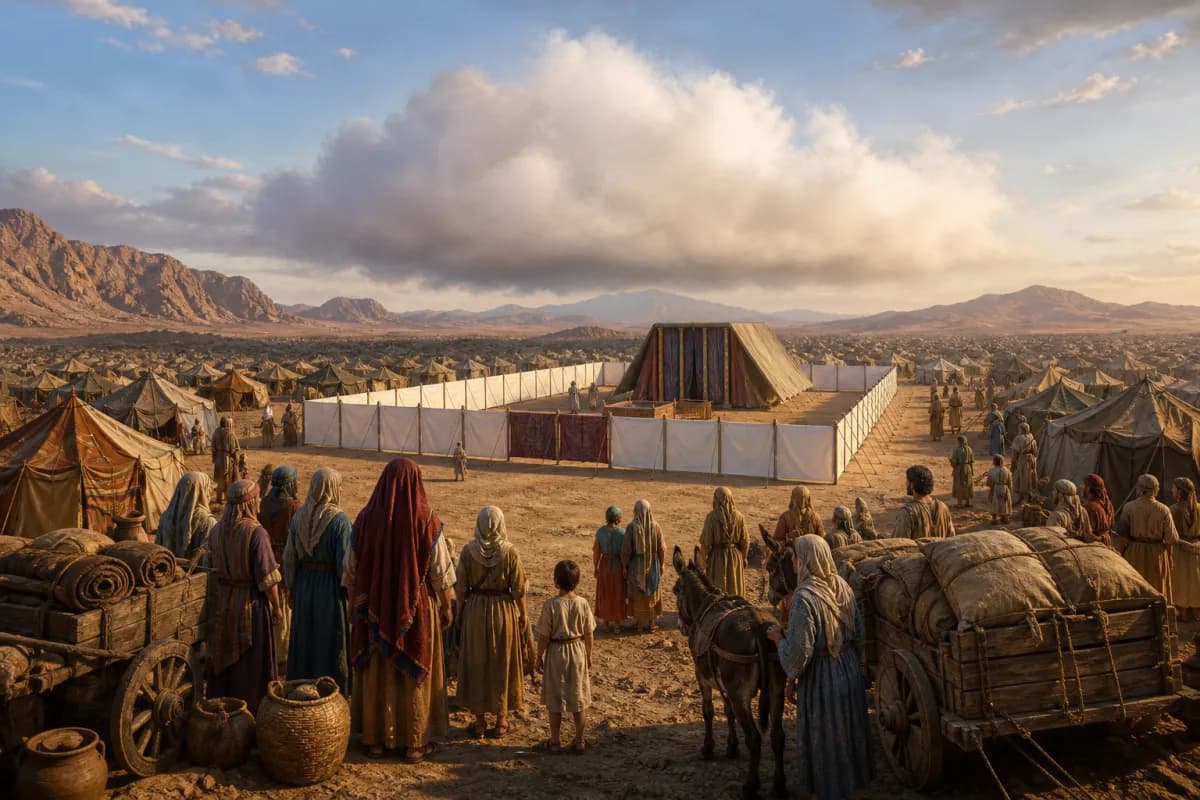
Numbers 9:15–23 shows Israel moving and resting only when the cloud of the Lord’s presence lifts or settles over the tabernacle. The people do not control the route or timetable; their life is ordered around the God who dwells among them. Jesus brings God near to His people and leads His church in faithful pilgrimage toward the promised rest of His kingdom.
- In this study
- 9 verses · 5 movements
Numbers 9
9:15On the day that the tabernacle was raised up, the cloud covered the tabernacle, even the Tent of the Testimony. At evening it was over the tabernacle, as it were the appearance of fire, until morning.
9:16So it was continually. The cloud covered it, and the appearance of fire by night.
9:17Whenever the cloud was taken up from over the Tent, then after that the children of Israel traveled; and in the place where the cloud remained, there the children of Israel encamped.
9:18At the commandment of the LORD, the children of Israel traveled, and at the commandment of the LORD they encamped. As long as the cloud remained on the tabernacle they remained encamped.
9:19When the cloud stayed on the tabernacle many days, then the children of Israel kept the LORD’s command, and didn’t travel.
9:20Sometimes the cloud was a few days on the tabernacle; then according to the commandment of the LORD they remained encamped, and according to the commandment of the LORD they traveled.
9:21Sometimes the cloud was from evening until morning; and when the cloud was taken up in the morning, they traveled; or by day and by night, when the cloud was taken up, they traveled.
9:22Whether it was two days, or a month, or a year that the cloud stayed on the tabernacle, remaining on it, the children of Israel remained encamped, and didn’t travel; but when it was taken up, they traveled.
9:23At the commandment of the LORD they encamped, and at the commandment of the LORD they traveled. They kept the LORD’s command, at the commandment of the LORD by Moses.
CONTEXTUAL OVERVIEW
Passover has just recalled the rescue that made Israel a people. Now Numbers turns to the presence that will direct that people through the wilderness. On the day the tabernacle is set up, the cloud covers it, while fire-like radiance appears over it at night. Israel’s God is neither a distant idea nor a tribal possession; He has chosen to dwell in the camp and lead its journey.
The passage repeatedly says that Israel sets out and camps “at the command of the Lord.” The repetition is the point. A people freed from Pharaoh must learn that freedom is not self-direction. They are safe and fruitful as they attend to the presence and word of the God who redeemed them.
HISTORICAL AND LITERARY CONTEXT
The cloud and fire continue the signs of the exodus, when the Lord went before Israel in a pillar of cloud by day and fire by night. Here the sign is explicitly linked to the tabernacle, the tent of the testimony. God’s presence at the center of the camp determines Israel’s movement through a terrain no tribe could master by its own knowledge.
Numbers is careful not to turn the cloud into a technique for private decision-making. The cloud directs the covenant community in its wilderness calling, and Moses receives the Lord’s commands. Its immediate lesson is corporate obedience: the whole camp waits, moves, worships, and bears its responsibilities under God’s initiative.
SECTION-BY-SECTION ANALYSIS
- The tabernacle · Numbers 9:15The cloud rests over God’s dwelling, making His presence rather than military strength the center of Israel’s life.
- Waiting and moving · Numbers 9:19Both are forms of obedience when the Lord, not anxiety or ambition, establishes the time.
- The whole camp · Numbers 9:16The sign governs a people together, not merely isolated individual spiritual impressions.
CHRIST IN THIS PASSAGE
The cloud is not a direct portrait of Jesus, yet it belongs to the biblical pattern of God making His dwelling presence known. John says that the Word became flesh and “dwelt” among us, using tabernacle-shaped language to announce that God has come near in His Son. Jesus is Emmanuel, God with us, and through His death He brings sinners into the Father’s presence rather than leaving them to navigate life apart from God.
Christ’s mission also gives the church a destination. Hebrews describes believers as pilgrims seeking the city God prepares and calls them to follow Jesus in perseverance. We should not claim a cloud-sign for every choice; we can trust the risen Lord to lead His people by His word and Spirit as they obey His gospel and wait for the rest He will complete.
REFLECTION
The hardest command in this story may be to remain when we would rather move. Numbers dignifies faithful waiting. Israel did not call a long stop wasted time if the cloud remained; their place under God’s presence was the right place, even when the next stage of the journey was unknown.
Jesus frees us from frantic self-management. Bring a delayed decision, a closed door, or a demanding transition to Him. Obey what He has already made clear, remain close to His people, and let His saving mission—not the pressure to control every outcome—set the direction of your life.
Original Hebrew Word Study
Numbers 9:15
עָנָן
anan · H6051
Usually translated: cloud
Anan is the cloud that covers the tabernacle. Israel moves and rests by the Lord’s visible leading, learning that the journey is governed by His presence rather than their timetable.
Follow the Scripture trail
The Cloud Over the Tabernacle: Learning to Move at God’s Command in the larger story
The connection: The cloud over the tabernacle teaches redeemed Israel to live by God’s presence and command. In Jesus, God comes near to bring sinners home, and the risen Lord leads His pilgrim people toward the lasting rest and city of God.
Respond to the passage
Name one area in which impatience is tempting you to force a timetable. Ask Jesus for obedient clarity in what He has already commanded and for patient trust while He leads the next step.
- Why does the passage repeat that Israel moved and camped at the Lord’s command?
- What is the difference between faithful waiting and passive avoidance in this passage?
- How does Jesus’ presence with His people reshape the way you face an uncertain season?
Prayer
Lord Jesus, You came near to bring me to the Father. Forgive my demand to control every next step. Teach me to wait and move in obedience to Your word, to remain close to Your people, and to follow Your saving mission with steady faith. Amen.