Passage Study
Psalm 148: Heaven and Earth Answer Their Creator
Psalms 148:1–148:14
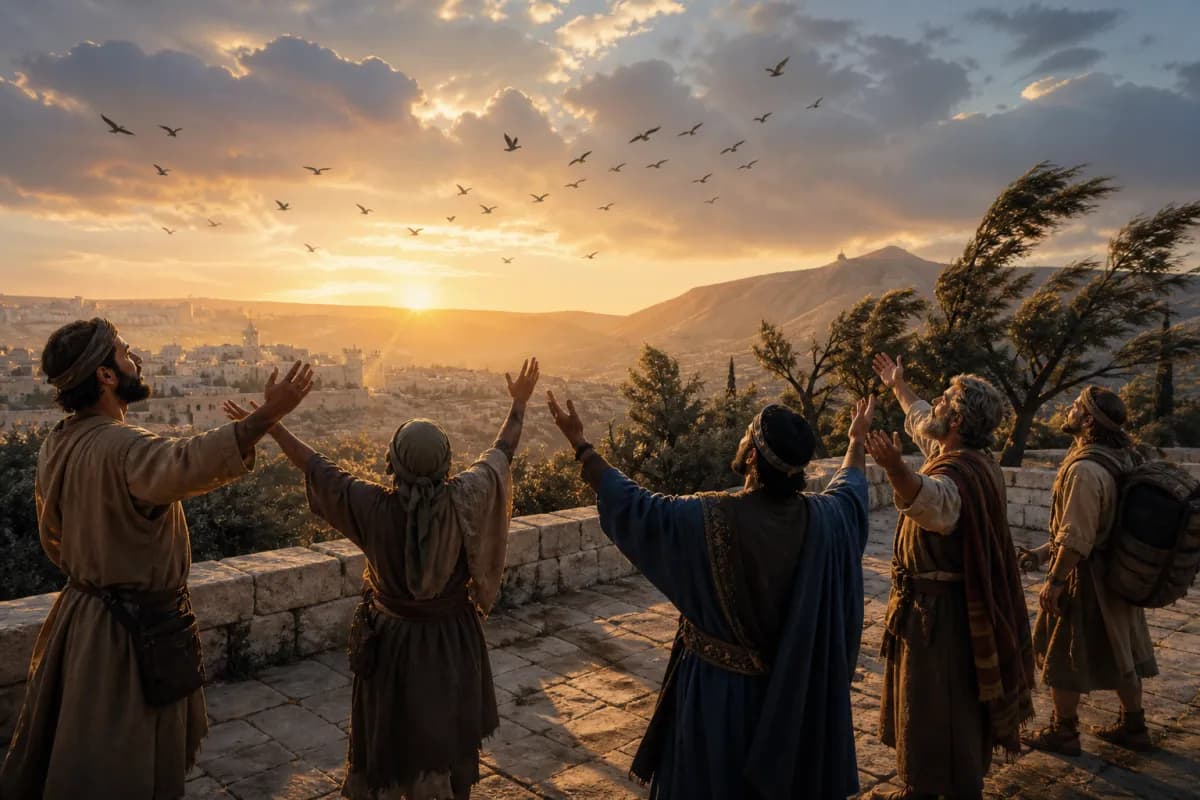
Psalm 148 summons the whole ordered creation to praise the Lord: angels, heavenly lights, waters above the heavens, stormy wind, mountains, animals, rulers, young and old alike. All exist by His command and bear His name alone. The psalm ends with the horn raised for His people; Jesus, through whom all things were made and who gathers a redeemed people, leads creation’s praise toward its final renewal.
- In this study
- 14 verses · 5 movements
Psalms 148
148:1Praise the LORD! Praise the LORD from the heavens! Praise him in the heights!
148:2Praise him, all his angels! Praise him, all his army!
148:3Praise him, sun and moon! Praise him, all you shining stars!
148:4Praise him, you heavens of heavens, you waters that are above the heavens.
148:5Let them praise the LORD’s name, for he commanded, and they were created.
148:6He has also established them forever and ever. He has made a decree which will not pass away.
148:7Praise the LORD from the earth, you great sea creatures, and all depths,
148:8lightning and hail, snow and clouds, stormy wind, fulfilling his word,
148:9mountains and all hills, fruit trees and all cedars,
148:10wild animals and all livestock, small creatures and flying birds,
148:11kings of the earth and all peoples, princes and all judges of the earth,
148:12both young men and maidens, old men and children.
148:13Let them praise the LORD’s name, for his name alone is exalted. His glory is above the earth and the heavens.
148:14He has lifted up the horn of his people, the praise of all his saints, even of the children of Israel, a people near to him. Praise the LORD!
CONTEXTUAL OVERVIEW
Psalm 148 sounds like a great choir being assembled. It begins “from the heavens,” names angels, sun, moon, stars, highest heavens, and waters above the heavens, then turns “from the earth” to sea creatures, weather, mountains, trees, animals, rulers, peoples, young men and women, old and young. No layer of creation is left outside the summons.
The supplied note on halal, “to praise,” is repeated in the psalm’s opening and throughout its calls. Praise is not presented as an escape from the material world. The physical world—the fire, hail, snow, frost, mountains, cedars, birds, cattle, and human bodies—is called to acknowledge the Lord who made it.
HISTORICAL AND LITERARY CONTEXT
Psalm 148 belongs to the closing sequence of praise psalms and has no superscription. Its list of heavenly and earthly creatures uses the ordinary world as Israel knew it, not a modern scientific inventory. “Waters above the heavens” reflects the psalm’s biblical cosmic imagery, while the theological claim remains clear: every realm is under the Creator’s command.
The poem does not say that rocks, storms, or animals sing with human words. It poetically summons them to fulfill the purpose for which God made them, while human worshipers give articulate voice to that purpose. The final focus on a “horn” raised for God’s people prevents the psalm from becoming vague nature spirituality; creation’s praise is joined to the covenant God’s saving favor toward Israel.
SECTION-BY-SECTION ANALYSIS
- Verses 1–6 · Psalms 148:5Heavenly beings and lights praise because the Lord created and established them by command.
- Verses 7–12 · Psalms 148:7Earth’s weather, landscapes, creatures, rulers, and generations are all summoned into one praise.
- Verses 13–14 · Psalms 148:14The Lord’s name is uniquely exalted, and He raises strength and praise for the people near to Him.
CHRIST IN THIS PASSAGE
Psalm 148’s universal praise has a direct New Testament horizon in Christ. The apostles proclaim that all things were created through Him and for Him, and that He is before all things. Jesus is therefore not one creature among the singers; He is the eternal Son through whom the choir exists, who enters His creation to redeem it from sin and decay.
The raised horn for the people of God fits the Bible’s royal hope and finds its fulfillment in the risen Messiah. Through His cross, Jesus brings guilty people near to God; through His resurrection He begins the renewal for which creation waits. Christian praise is not optimism about nature. It is worship of the crucified and risen Lord whose reign will make all things new.
REFLECTION
Psalm 148 breaks the illusion that worship belongs only in a private, religious corner of life. The created order is God’s, and every status—ruler, worker, child, elder, strong, frail—is accountable to His name. Let the next ordinary encounter with weather, a meal, an animal, or another person become a cue to thank the Creator rather than a possession to use thoughtlessly.
Because Jesus brings sinners near to God, praise also becomes a missionary witness. Speak of His goodness in a way that names the real Creator and Redeemer, not an undefined spiritual feeling. Join the gathered church’s praise with the hope that Christ will renew the world He made.
Original Hebrew Word Study
Psalm 148:1
הָלַל
halal · H1984
Usually translated: to praise
Halal means to praise. Heaven and earth are summoned together because every creature exists by God’s command and for His glory.
Follow the Scripture trail
Psalm 148: Heaven and Earth Answer Their Creator in the larger story
The connection: Psalm 148 summons heaven and earth to praise the Creator whose name alone is exalted and who draws a people near. Jesus is the eternal Son through whom all things were made; by His cross and resurrection He brings sinners near and will renew the whole creation for the praise of God.
Respond to the passage
Choose one ordinary part of creation you are likely to overlook and receive it today as a reminder of its Maker. Then join your gratitude to explicit praise of Jesus, whose saving reign gives creation its promised future.
- Why does the psalm summon both the highest heavens and the smallest human generations?
- How does verse 14 keep Psalm 148’s praise connected to God’s covenant grace?
- What changes when Jesus is recognized as the One through whom all things were made?
Prayer
Lord Jesus, through You all things were made and through You sinners are brought near to God. Tune my attention to Your glory in the world You made, and make my life a clear witness to Your coming renewal. Amen.