Passage Study
Psalm 84: Longing for the Living God’s Dwelling Place
Psalms 84:1–84:12
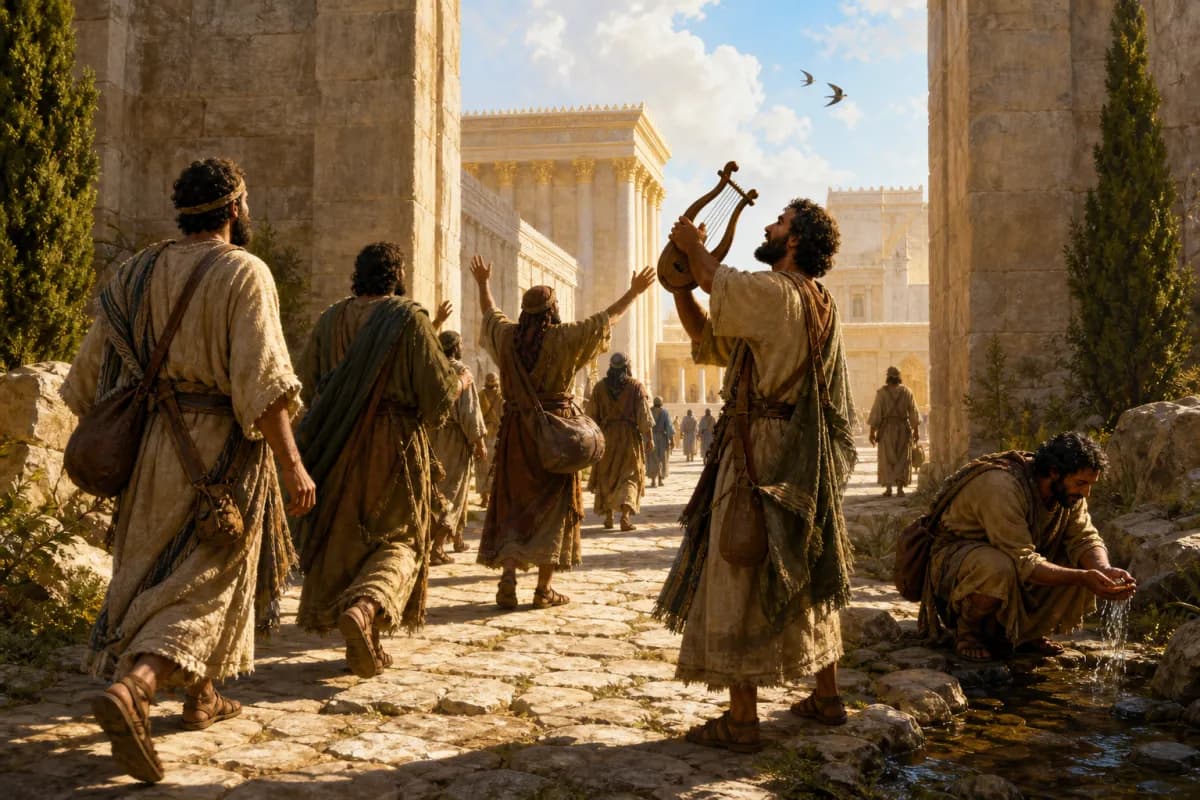
Psalm 84 celebrates the joy of drawing near to the Lord in His dwelling place. The singers envy even birds near the altar, call pilgrims blessed as they find strength in God on the road to Zion, and prefer one day in His courts to every alternative. Jesus fulfills the temple’s purpose by bringing people to the Father and making His people God’s dwelling through the Spirit.
- In this study
- 12 verses · 5 movements
Psalms 84
84:1How lovely are your dwellings, LORD of Armies!
84:2My soul longs, and even faints for the courts of the LORD. My heart and my flesh cry out for the living God.
84:3Yes, the sparrow has found a home, and the swallow a nest for herself, where she may have her young, near your altars, LORD of Armies, my King, and my God.
84:4Blessed are those who dwell in your house. They are always praising you. Selah.
84:5Blessed are those whose strength is in you, who have set their hearts on a pilgrimage.
84:6Passing through the valley of Weeping, they make it a place of springs. Yes, the autumn rain covers it with blessings.
84:7They go from strength to strength. Every one of them appears before God in Zion.
84:8LORD, God of Armies, hear my prayer. Listen, God of Jacob. Selah.
84:9Behold, God our shield, look at the face of your anointed.
84:10For a day in your courts is better than a thousand. I would rather be a doorkeeper in the house of my God, than to dwell in the tents of wickedness.
84:11For the LORD God is a sun and a shield. The LORD will give grace and glory. He withholds no good thing from those who walk blamelessly.
84:12LORD of Armies, blessed is the man who trusts in you.
CONTEXTUAL OVERVIEW
Psalm 84 is a song of longing. The singer’s soul faints for the courts of the Lord and his heart and flesh sing to the living God. He does not long for an attractive building as an end in itself; the temple matters because the God of hosts has made His name known there and received the worship of His people.
The psalm speaks both of people already near the altar and of pilgrims travelling toward Zion. That movement keeps the song from becoming sentimental nostalgia. Blessedness includes the road: those whose strength is in God keep going through dry places because their hearts are set on the pilgrimage to His presence.
HISTORICAL AND LITERARY CONTEXT
This is a Korahite temple psalm, likely sung in relation to Israel’s worship at Jerusalem. The reference to the Lord’s courts, altar, and anointed king places it within the life of the sanctuary and Davidic kingdom. The exact meaning of the Valley of Baca is uncertain; the poetic point is clear that pilgrims whose strength is in God find refreshment while travelling toward Zion.
The word “blessed” frames the poem. Those who dwell in God’s house, whose strength is in Him, and who trust Him are called blessed. The psalm does not say that access to God is casual; it delights in the provision God has made for His people to draw near in worship.
SECTION-BY-SECTION ANALYSIS
- Verses 1–4 · Psalms 84:2The singer longs for the living God and treats nearness to His altar as the heart of blessedness.
- Verses 5–8 · Psalms 84:7Pilgrims find strength in God as dry terrain becomes a place of provision on the way to Zion.
- Verses 9–12 · Psalms 84:3Prayer for the anointed king and the preference for God’s courts unite covenant hope with trusting worship.
CHRIST IN THIS PASSAGE
Psalm 84 centers on access to the living God through the temple and its worship. Jesus makes a strong canonical connection when He speaks of His own body as the true temple and then gives His life to bring sinners to the Father. The temple’s holiness is not bypassed; Christ bears sin and opens the way to God by His sacrificial death and resurrection.
The psalm’s prayer for God’s anointed also belongs within the Davidic hope fulfilled in Jesus. He is the true King and the meeting place between God and humanity. By His Spirit, those united to Him become God’s dwelling people, so the longing of Psalm 84 now directs believers toward gathered worship and final life in God’s presence.
REFLECTION
Psalm 84 asks what you really desire when your schedule finally opens. The singer does not treat worship as a duty to finish but as life with the living God. If that desire feels weak, bring the weakness honestly to Jesus rather than pretending spiritual appetite you do not have.
Set one deliberate practice that turns your heart toward God’s presence: prepare for gathered worship, pray through a psalm on the way to church, or invite another pilgrim to walk with you through a dry season. Christ has opened access to the Father; receive that access with gratitude and perseverance.
Original Hebrew Word Study
Psalm 84:4
אַשְׁרֵי
ashrei · H835
Usually translated: blessed, happy, or flourishing
Ashrei names the deep blessedness of those who dwell near God and keep finding their strength in Him.
Follow the Scripture trail
Psalm 84: Longing for the Living God’s Dwelling Place in the larger story
The connection: Psalm 84 celebrates the temple as the appointed place of access to the living God and prays for God’s anointed king. Jesus fulfills both hopes: through His death and resurrection He brings sinners to the Father, and by His Spirit He forms them into God’s dwelling people.
Respond to the passage
Ask Jesus to reorder one desire that competes with delight in God’s presence, then take a concrete step toward gathered worship or prayer as a pilgrim whose strength is in Him.
- Why does the psalmist long for the living God rather than merely for the beauty of the temple?
- How does the pilgrimage image speak to a season that feels like a dry valley?
- How does Jesus’ death and resurrection fulfill the access to God celebrated in Psalm 84?
Prayer
Lord Jesus, You have opened the way to the Father. Give my heart a true desire for Your presence, strengthen me in dry places, and make my life part of the dwelling You are building by Your Spirit. Amen.