Passage Study
Psalm 92: Sabbath Praise and the Flourishing of the Righteous
Psalms 92:1–92:15
Psalm 92 calls God’s people to give thanks from morning to night because the Lord’s works are great and His thoughts are deep. It contrasts evildoers who briefly sprout and perish with the righteous, who flourish like palm and cedar trees in God’s house. Jesus brings this Sabbath-shaped hope to its goal, giving His people rest in God and life that endures beyond the apparent success of evil.
- In this study
- 15 verses · 5 movements
Psalms 92
92:1It is a good thing to give thanks to the LORD, to sing praises to your name, Most High,
92:2to proclaim your loving kindness in the morning, and your faithfulness every night,
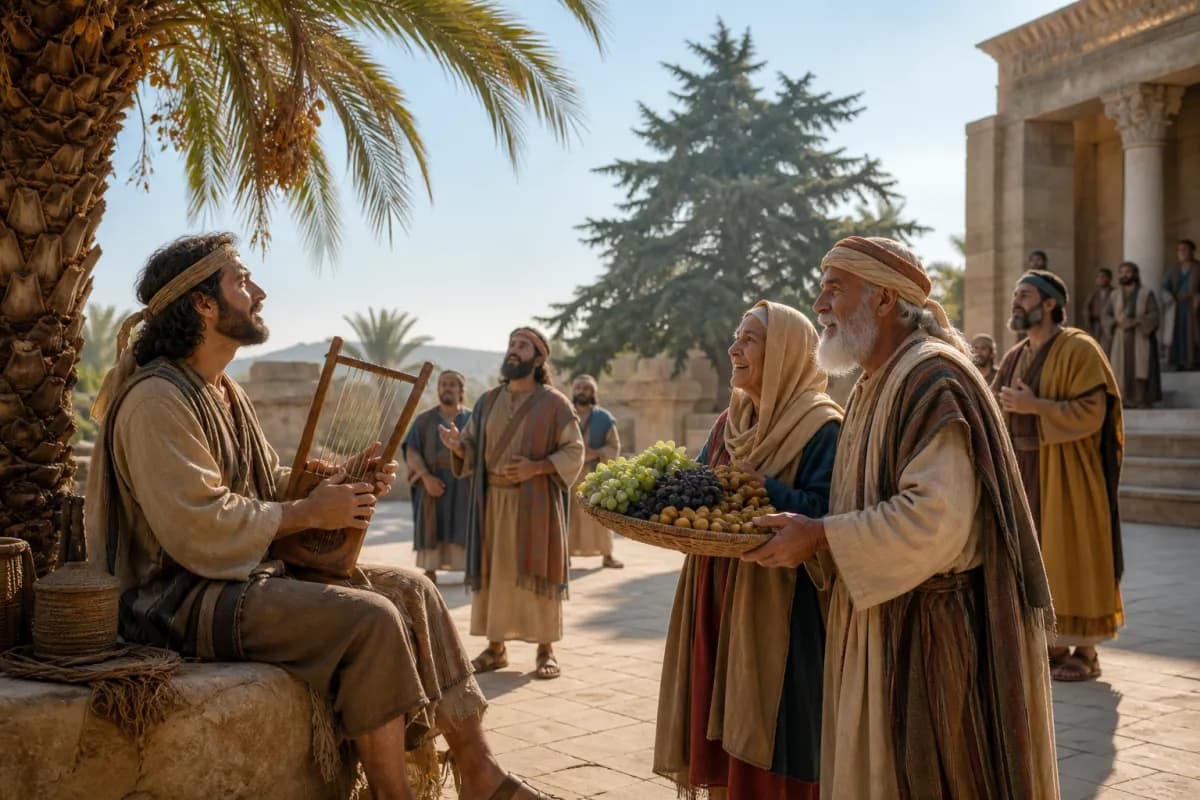
92:3with the ten-stringed lute, with the harp, and with the melody of the lyre.
92:4For you, LORD, have made me glad through your work. I will triumph in the works of your hands.
92:5How great are your works, LORD! Your thoughts are very deep.
92:6A senseless man doesn’t know, neither does a fool understand this:
92:7though the wicked spring up as the grass, and all the evildoers flourish, they will be destroyed forever.
92:8But you, LORD, are on high forever more.
92:9For behold, your enemies, LORD, for behold, your enemies shall perish. All the evildoers will be scattered.
92:10But you have exalted my horn like that of the wild ox. I am anointed with fresh oil.
92:11My eye has also seen my enemies. My ears have heard of the wicked enemies who rise up against me.
92:12The righteous shall flourish like the palm tree. He will grow like a cedar in Lebanon.
92:13They are planted in the LORD’s house. They will flourish in our God’s courts.
92:14They will still produce fruit in old age. They will be full of sap and green,
92:15to show that the LORD is upright. He is my rock, and there is no unrighteousness in him.
CONTEXTUAL OVERVIEW
Psalm 92 is marked as a Sabbath song, so its praise belongs to a day set apart for remembering the Creator and Redeemer rather than simply measuring life by labor, danger, or visible success. The opening says it is good to give thanks to the Lord, to sing to His name, and to declare His steadfast love in the morning and His faithfulness by night. Worship reorders a people whose days might otherwise be interpreted by anxiety or achievement.
The supplied note on tov, “good,” makes the first confession more substantial than a pleasant mood. Giving thanks is fitting because the Lord Himself is good, His works are great, and His thoughts are deep. The song does not deny that evil can look vigorous for a time; it teaches worshipers to judge that appearance by the Lord’s final, righteous purpose.
HISTORICAL AND LITERARY CONTEXT
This psalm is the only one explicitly titled “A Psalm. A Song for the Sabbath Day.” Its musical opening, with lute, harp, and lyre, places it in Israel’s gathered praise. Sabbath was a covenant sign that recalled both God’s creation and His rescue of Israel from slavery, making this poem a fitting confession that life is received from God rather than secured by endless human effort.
The poem’s central comparison is agricultural. Evildoers may spring up like grass, a quick and common growth, while the righteous are compared to a palm tree and the cedars of Lebanon, images of durable beauty and strength. The contrast is not a promise that every faithful person will have an easy life; it declares that the Lord’s verdict, not a season of visible prosperity, determines what truly lasts.
SECTION-BY-SECTION ANALYSIS
- Verses 1–5 · Psalms 92:2Sabbath worship declares God’s steadfast love and faithfulness because His works and purposes exceed human understanding.
- Verses 6–11 · Psalms 92:9The short-lived rise of evildoers cannot overturn the Lord’s everlasting exaltation or His vindication of His servants.
- Verses 12–15 · Psalms 92:13Righteous people planted in God’s presence bear lasting fruit and publicly declare His uprightness.
CHRIST IN THIS PASSAGE
Psalm 92 does not identify the righteous tree with Jesus, but it gives a strong canonical pattern for His saving work. Jesus invites the weary to receive rest from Him, and He rises on the first day of the week as the beginning of God’s new creation. The Sabbath song’s confidence that God’s purposes outlast the visible flourishing of evil is therefore anchored in the crucified and risen Christ.
Jesus also gives the righteous their enduring life. He is not a guarantee that believers will avoid age, weakness, or opposition; the psalm itself teaches patience under the temporary success of evil. Through union with Christ, however, believers are brought near to God, bear fruit by His Spirit, and await a final vindication in which evil’s brief season is decisively ended.
REFLECTION
Psalm 92 asks what has been allowed to define your week: your unfinished work, the success of people who disregard God, or the Lord’s steadfast love and faithfulness. Make room to thank Him in a concrete way at the beginning and end of a day. That practice does not erase hard circumstances; it teaches the heart to see them under God’s deeper purposes.
If you are discouraged by slow growth or by the apparent advantage of wrongdoing, remain planted in the ordinary means of grace: Scripture, prayer, gathered worship, repentance, and love for God’s people. Ask Jesus to make your later years, hidden faithfulness, and present work bear fruit that tells the truth about the upright Rock.
Original Hebrew Word Study
Psalm 92:1
טוֹב
tov · H2896
Usually translated: good
Tov means good. Sabbath praise begins with the simple confession that giving thanks to the Lord is fitting and life-giving.
Follow the Scripture trail
Psalm 92: Sabbath Praise and the Flourishing of the Righteous in the larger story
The connection: Psalm 92 rests in the Lord’s final judgment, not the brief bloom of evil, and celebrates durable life in His presence. Jesus, risen to begin God’s new creation, gives weary sinners rest and joins them to Himself so they may bear fruit that endures into His kingdom.
Respond to the passage
Set aside time this week to name two works of God for which you can give thanks, one from the morning and one from the night. Then bring to Jesus the discouragement caused by visible evil or slow growth, and choose one faithful practice that keeps you planted among His people.
- Why does the Sabbath setting matter for the psalm’s contrast between lasting fruit and temporary success?
- What does the grass-and-cedar comparison reveal about the way God measures flourishing?
- How does Jesus’ resurrection strengthen hope when evil appears to be thriving?
Prayer
Lord Jesus, risen giver of true rest, teach me to thank the Father for His steadfast love and faithfulness. Keep me planted in Your grace when evil seems strong, and make my life bear fruit that declares You are upright. Amen.